
- Simple Present Tense Stories with Exercises (PDF)
- A Quick Guide to the Simple Present Tense
- Simple Present Tense Stories
- Story 1: Tom’s Daily Routine
- Story 1 Vocabulary
- Exercise 1: Complete the Sentences
- Exercise 2: Answer the Questions
- Story 2: Michael’s Life in Atlanta
- Story 2 Vocabulary
- Exercise 3: Choose the Correct Verb
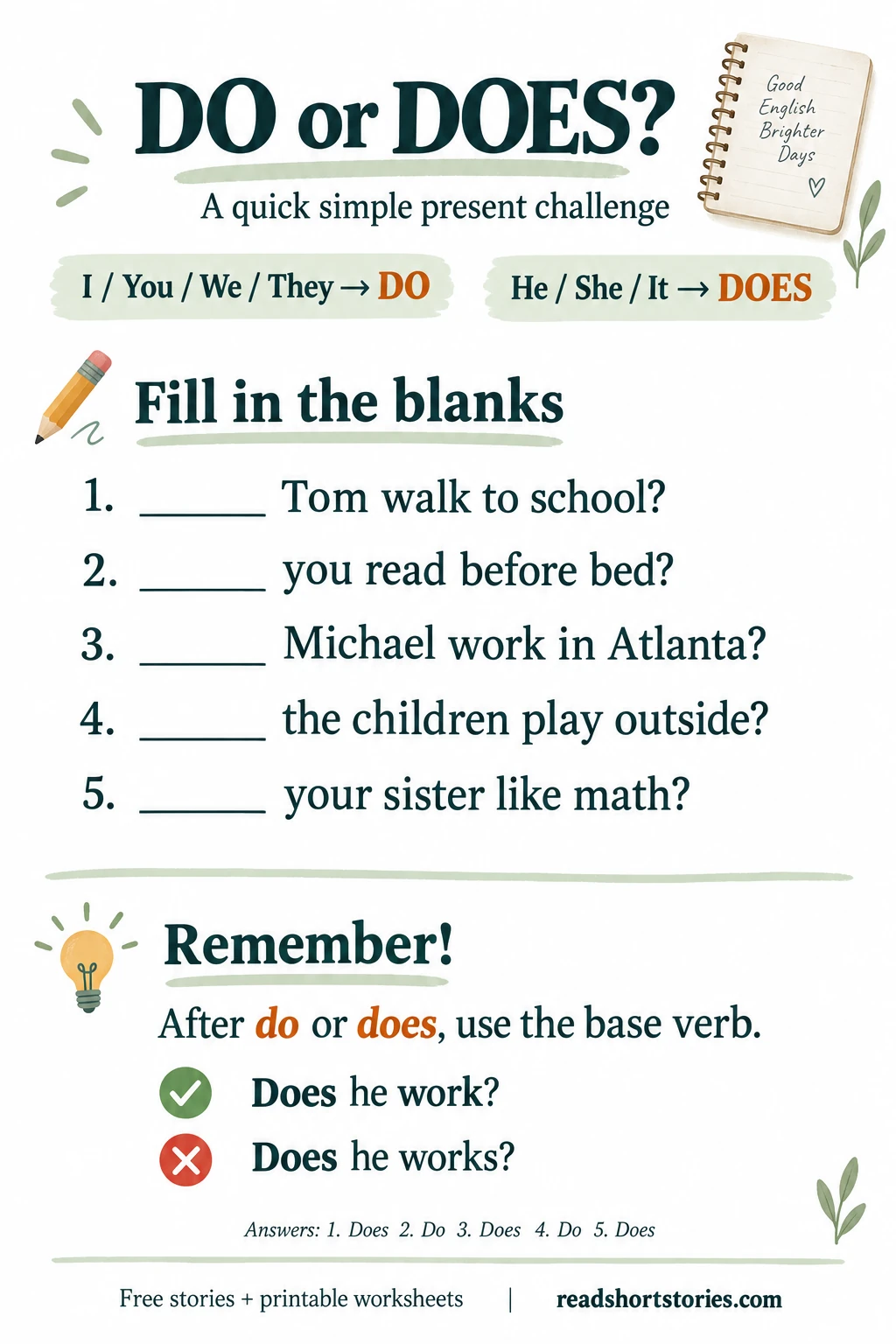
- Exercise 4: Make Questions with Do or Does
- Common Simple Present Mistakes
- Write Your Own Simple Present Story
- Download the Simple Present Tense Stories PDF
- Download the Simple Present Tense Stories PDF
- Download A4 Worksheet + Answers (PDF)
- Download US Letter Worksheet + Answers (PDF)
- What to Read Next
What does Tom do before school? Where does Michael work? These simple present tense stories show how we talk about everyday routines, habits, and regular activities.
Read two short stories, practice the verbs, and check your answers. The activities cover positive sentences, negatives with don’t and doesn’t, and questions with do and does. You can also find the existing story PDF at the end of the page.

A Quick Guide to the Simple Present Tense
We use the simple present, also called the present simple, for habits, regular activities, general facts, and situations that are true now.
| Sentence Type | I / You / We / They | He / She / It |
|---|---|---|
| Positive | They work in Atlanta. | He works in Atlanta. |
| Negative | They don’t work at a school. | He doesn’t work at a school. |
| Question | Do they work in Atlanta? | Does he work in Atlanta? |
| Short answer | Yes, they do. / No, they don’t. | Yes, he does. / No, he doesn’t. |
Remember: Add -s or -es to most verbs with he, she, and it: walks, watches, goes. After does or doesn’t, use the base form: Does he walk? and He doesn’t walk.
The verb be works differently: I am, you are, he is. We say Is he a student?, not Does he be a student?
For more examples and spelling rules, read this guide to the present simple tense.
Simple Present Tense Stories
How to practice: Read each story once for meaning. Then read it again and find the present simple verbs. Notice expressions such as every weekday, usually, and sometimes.
Story 1: Tom’s Daily Routine
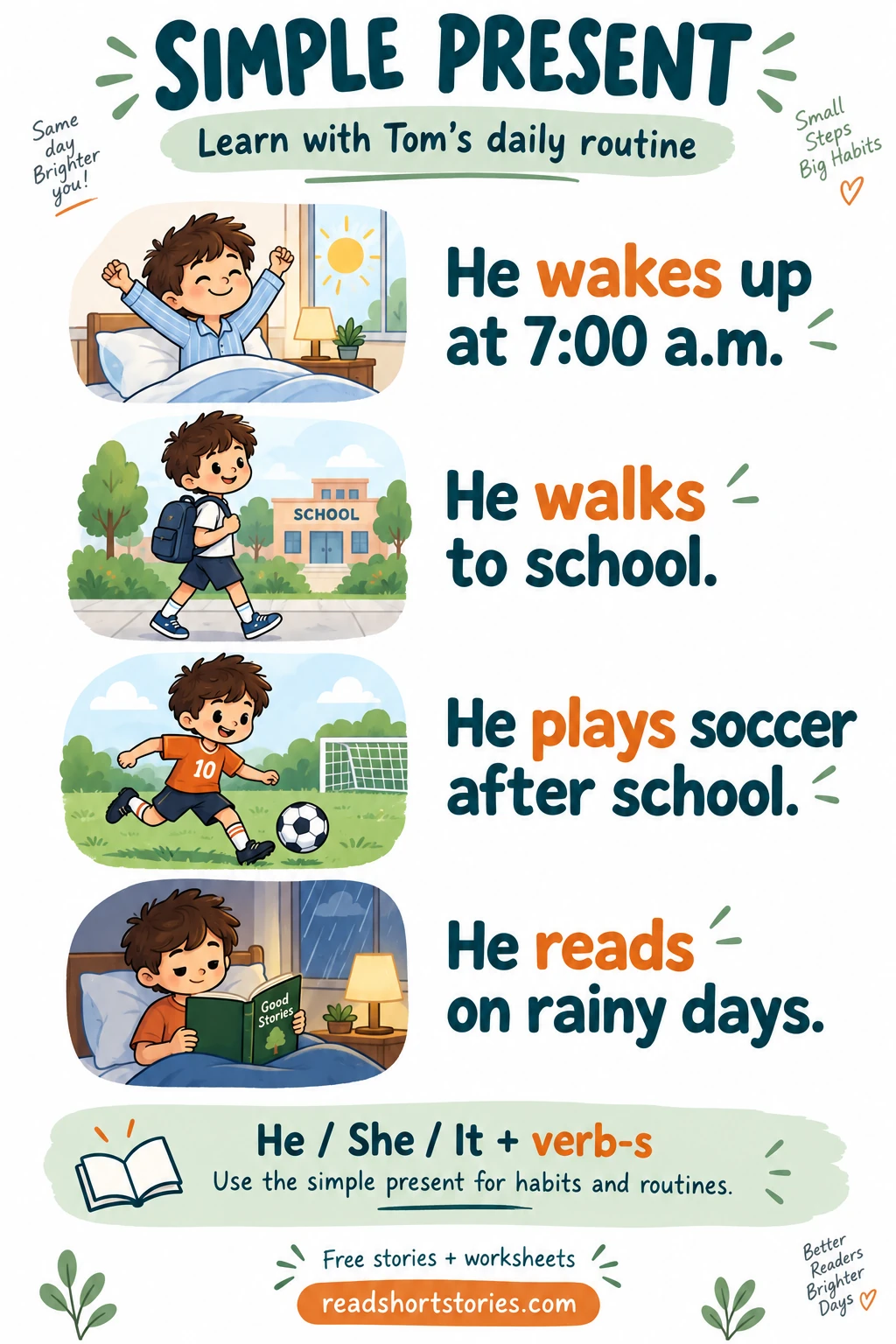
Tom lives in a small town with his family. Every weekday, he wakes up at 7:00 a.m. He checks the time on his phone, but he doesn’t stay in bed. He likes a quiet morning before school.
First, Tom brushes his teeth and washes his face. Then he goes to the kitchen and helps set the table. He usually eats toast and eggs for breakfast. Sometimes, he has cereal instead. His family eats breakfast together before everyone leaves the house.
At 8:00 a.m., Tom leaves home and walks to school. The walk takes fifteen minutes, so he doesn’t take the bus. On the way, he sometimes meets his friend Ben. They talk about music and soccer.
Tom enjoys his classes, especially math. He asks questions when he needs help. At lunchtime, he sits with his friends in the school cafeteria. They eat, chat, and compare their lunches. Ben always wants to know what everyone has!
School finishes at 3:00 p.m. After school, Tom usually plays soccer with his friends at the park. On rainy days, he goes straight home and reads or plays a board game with his sister.
Tom gets home by 5:00 p.m. and does his homework before dinner. In the evening, he helps clear the table. Then he watches TV or plays video games for a while.
Before bed, Tom packs his school bag and checks his homework. He goes to bed at 10:00 p.m. His weekdays are busy, but he always makes time for something he enjoys.
Story 1 Vocabulary
- Weekday: any day from Monday to Friday.
- Set the table: put plates, cups, and other things on the table before a meal.
- Instead: in place of something else.
- Cafeteria: a place in a school or workplace where people get and eat meals.
- Clear the table: remove plates and other things after a meal.
Exercise 1: Complete the Sentences
Write the correct simple present form of each verb. Use a negative form where you see not.
- Tom ______ (wake) up at 7:00 a.m. every weekday.
- He ______ (brush) his teeth before breakfast.
- His family ______ (eat) breakfast together.
- Tom ______ (not / take) the bus to school.
- The walk to school ______ (take) fifteen minutes.
- Tom and Ben ______ (talk) about music and soccer.
- Tom ______ (do) his homework before dinner.
- He ______ (watch) TV in the evening.
Exercise 2: Answer the Questions
Use information from the story. Try to answer in complete sentences.
- Does Tom stay in bed after he checks the time?
- How does Tom get to school?
- What is his favorite subject?
- Where does he usually play soccer?
- What does he do before bed?
Check the answers to Exercises 1 and 2
Exercise 1
- wakes
- brushes
- eat
- doesn’t take / does not take
- takes
- talk
- does
- watches
Exercise 2 — Suggested answers
- No, he doesn’t. He gets up.
- He walks to school.
- His favorite subject is math.
- He usually plays soccer at the park.
- He packs his school bag and checks his homework.
Story 2: Michael’s Life in Atlanta
Michael Johnson lives in Atlanta, Georgia, with his wife, Laura, and their two children, Alex and Lily. He works as a police officer. His work schedule changes, so he doesn’t start work at the same time every day.
Before work, Michael checks his schedule and gets ready. On mornings when he is at home, he makes breakfast with Laura. Alex likes eggs, but Lily prefers toast. Michael usually drinks coffee with his breakfast.
At work, Michael talks with his team and checks which tasks need attention. He answers calls for help, speaks to people in the community, and writes reports. He listens carefully when someone explains a problem. He also helps drivers and pedestrians when roads are busy.
Sometimes, Michael visits local schools to talk about road safety. He explains why people need to look carefully before crossing the street. The students ask questions, and he answers them in clear, simple language.
“Do you work every weekend?” one student asks.
“No, I don’t work every weekend,” Michael says. “But I sometimes work on Saturdays or Sundays.”
When Michael has a free afternoon, he spends time with his family. They often visit a nearby park. Alex brings a ball, and Lily looks for birds in the trees. Michael enjoys these quiet moments outside.
At home, Michael and Laura share the housework. He washes the dishes, and the children put their toys away. Before the children go to bed, he reads with them whenever he is home.
Michael’s days are not always the same, but work, family, and helping others are important parts of his life.
Story 2 Vocabulary
- Schedule: a plan that shows when activities happen.
- Task: a piece of work that someone needs to do.
- Community: the people who live in a particular area.
- Pedestrian: a person who walks, especially near a road.
- Housework: work such as cleaning and washing dishes at home.
Exercise 3: Choose the Correct Verb
- Michael live / lives in Atlanta.
- He don’t / doesn’t start work at the same time every day.
- Michael and Laura make / makes breakfast together when he is home in the morning.
- Lily prefer / prefers toast.
- Michael listen / listens carefully when people explain a problem.
- The students ask / asks questions.
- His children put / puts their toys away.
- Michael read / reads with the children whenever he is home before their bedtime.
Exercise 4: Make Questions with Do or Does
Put the words in order. Add do or does at the beginning.
- Michael / work / in Atlanta?
- Alex and Lily / live / with their parents?
- Michael / drink / coffee with breakfast?
- the students / ask / questions?
- Michael / work / every weekend?
Check the answers to Exercises 3 and 4
Exercise 3
- lives
- doesn’t
- make
- prefers
- listens
- ask
- put
- reads
Exercise 4
- Does Michael work in Atlanta?
- Do Alex and Lily live with their parents?
- Does Michael drink coffee with breakfast?
- Do the students ask questions?
- Does Michael work every weekend?
Extra practice: Answer each question. The short answers are: 1. Yes, he does. 2. Yes, they do. 3. Yes, he does. 4. Yes, they do. 5. No, he doesn’t.
Common Simple Present Mistakes
| Incorrect | Correct | Why? |
|---|---|---|
| Tom walk to school. | Tom walks to school. | Add -s with he, she, or it in positive sentences. |
| Michael doesn’t works every weekend. | Michael doesn’t work every weekend. | Use the base verb after doesn’t. |
| Does Tom likes math? | Does Tom like math? | Use the base verb after does. |
| The children plays outside. | The children play outside. | Use the base verb with the plural subject the children. |
Write Your Own Simple Present Story
Write six to eight sentences about your routine or someone you know. Include:
- Where the person lives, works, or studies.
- Two things the person does regularly.
- One thing the person doesn’t do.
- Two time expressions, such as every morning or on weekends.
Example: My sister works at a library. She starts work at nine. She helps people find books and answers their questions. She doesn’t work on Sundays. On weekends, she usually walks in the park.
Speaking practice: Ask a partner three questions about their routine. Start with Do you…? Then tell someone else about your partner using he, she, or your partner’s name.
Download the Simple Present Tense Stories PDF
Prefer to read offline? Download the original story PDF below.
Download the Simple Present Tense Stories PDF
Download A4 Worksheet + Answers (PDF)
Download US Letter Worksheet + Answers (PDF)
What to Read Next
To practice describing actions happening now, read our present continuous tense stories. Compare a routine such as Tom walks to school every day with an action happening now: Tom is walking to school now.
When you are ready to talk about completed events, try our past simple tense stories with exercises.
For practice across different tenses, explore our 12 English tenses through stories.




Thank you very much for sharing all of these short stories! Great readings for my students who are mixed up with these verb tenses.