- Context Clues Reading Passages and Worksheets — Free PDF
- Context Clue Strategies
- Contrast Clues
- Explanation Clues
- Example Clues
- Cause-and-Effect Clues
- Using the Whole Paragraph
- Science Sources
- 4th Grade Reading Passages: Context Clues
- The Tide Goes Out at Pelican Flat
- Questions
- Answers
- The Capsule from Itokawa
- Questions
- Answers
- Bryn Fixes the Bellows
- Questions
- Answers
- Download the Free Context Clues PDF Workbook
- Frequently Asked Questions
- How long are the passages?
- Does the PDF include answers?
- How can we use these passages?
- More Short Stories and Reading Activities
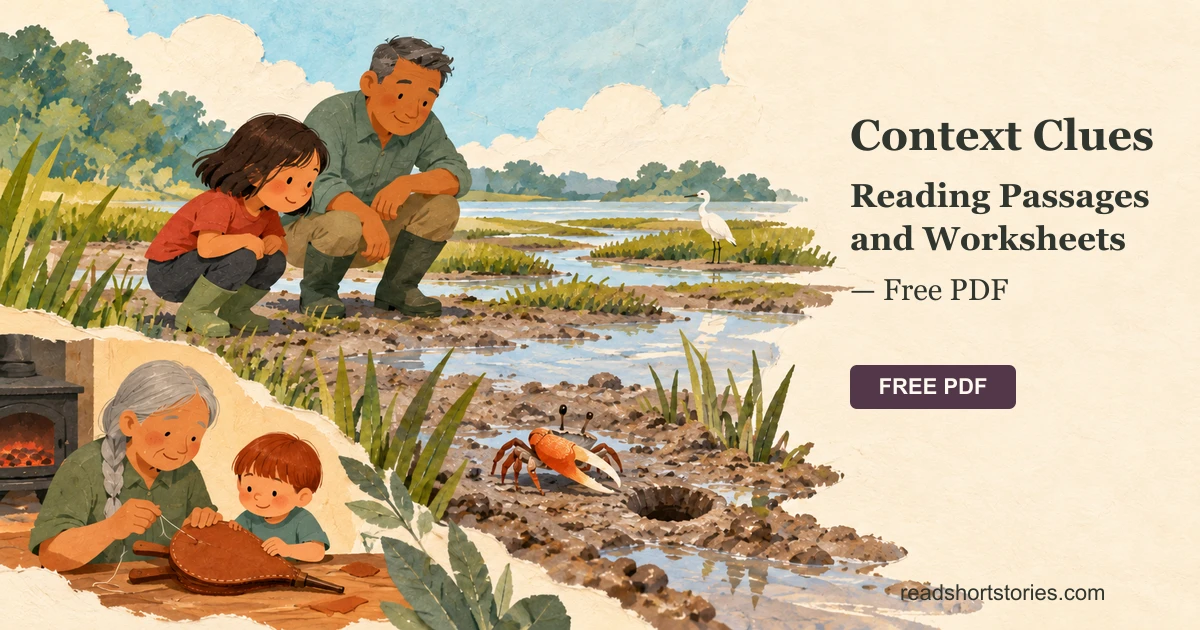
These context clues worksheets help students use nearby sentences to work out an unfamiliar word. Each passage gives practice with clues such as explanations, contrasts, examples, and cause and effect. Ask students to choose a meaning and point to the words that support it.
Read three passages below, or print all five with questions and a separate answer key. The activities are designed for Grade 4 reading practice and can also support other readers who need this skill.
Listen and read along: Audio versions are available for 3 stories on this page. Use the players below.
You can download the free 4th grade context clues reading workbook PDF below.
Context Clue Strategies
Contrast Clues
A contrast clue signals that a word means roughly the opposite of something nearby. Look for words like but, however, unlike, instead, or while. For example: The trail was usually tranquil, but today every bird in the woods seemed to be calling at once. The contrast with noisy bird calls helps a reader infer that tranquil means calm and quiet.
Explanation Clues
An author may explain an unfamiliar word just after using it. Example: The room was vacant — no one was inside. The words after the dash show that vacant means empty. Look for a nearby explanation that fits the whole sentence.
Example Clues
When an author follows a word with examples, those examples reveal its general meaning. Signal phrases include such as, for example, like, and including. For example: The market offered an array of provisions, such as dried beans, smoked fish, hard cheese, and wrapped cornbread. The listed foods show that provisions means supplies of food.
Cause-and-Effect Clues
A cause-and-effect clue places an unfamiliar word near its reason or its result. Words like because, so, as a result, and therefore often appear. For example: The bridge had deteriorated badly because no repairs had been made in twenty years, and sections of the railing had begun to crumble away. The cause (no repairs) and the result (crumbling) together reveal that deteriorated means broke down over time.
Using the Whole Paragraph
Sometimes a single sentence is not enough. Read the full paragraph around an unfamiliar word. A word’s meaning may build across two or three sentences through repeated descriptions, character reactions, or comparisons. Practice reading one sentence before and one sentence after the target word before deciding on a meaning.
Science Sources
The Capsule from Itokawa: JAXA, November 16, 2010; ISAS: Sand of Itokawa; JAXA: capsule recovery. Geological background for the fictional ridge passage in the PDF’s bonus passages: American Museum of Natural History: limestone; USGS: continents.
4th Grade Reading Passages: Context Clues
The Tide Goes Out at Pelican Flat
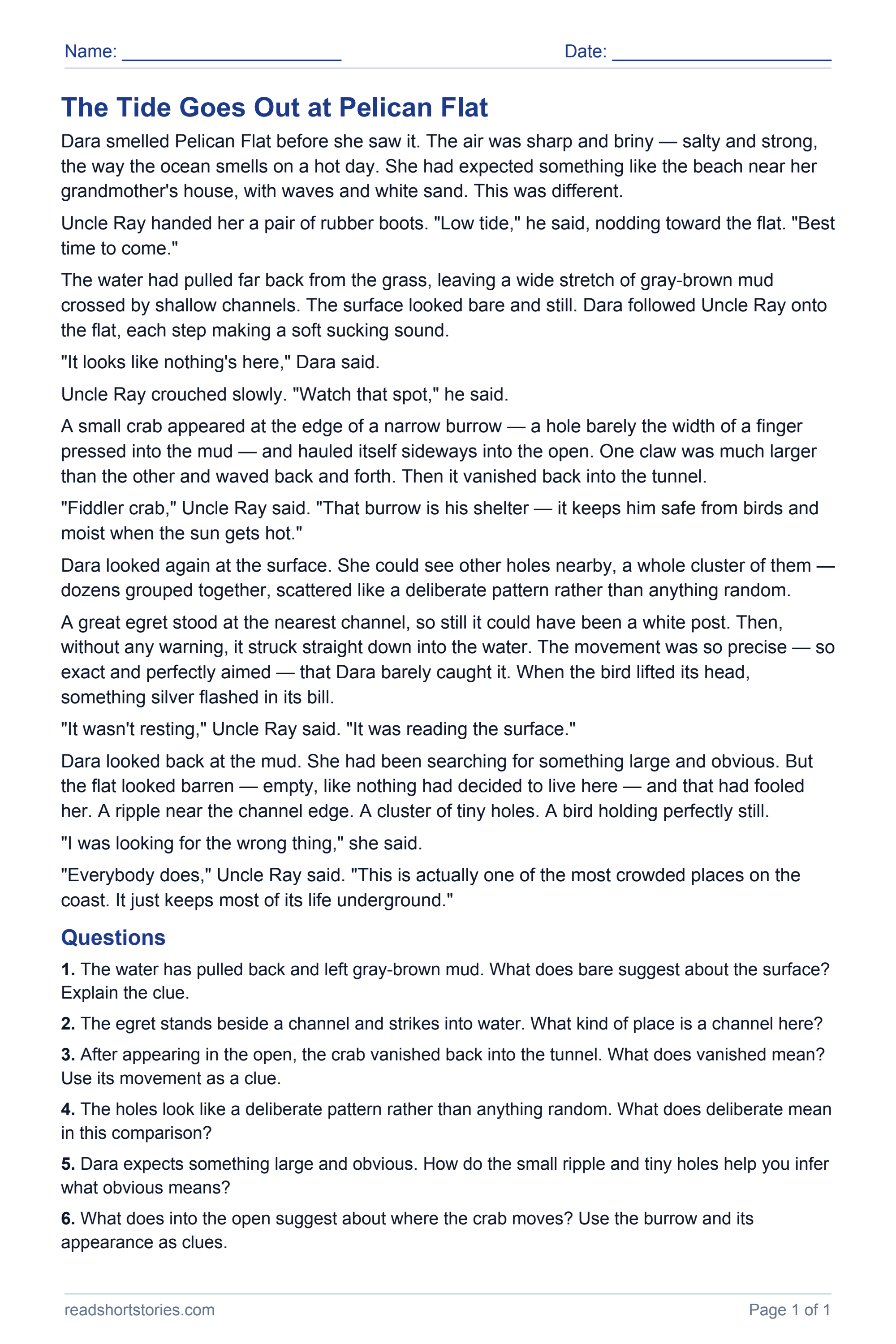
Dara smelled Pelican Flat before she saw it. The air was sharp and briny — salty and strong, the way the ocean smells on a hot day. She had expected something like the beach near her grandmother’s house, with waves and white sand. This was different.
Uncle Ray handed her a pair of rubber boots. “Low tide,” he said, nodding toward the flat. “Best time to come.”
The water had pulled far back from the grass, leaving a wide stretch of gray-brown mud crossed by shallow channels. The surface looked bare and still. Dara followed Uncle Ray onto the flat, each step making a soft sucking sound.
“It looks like nothing’s here,” Dara said.
Uncle Ray crouched slowly. “Watch that spot,” he said.
A small crab appeared at the edge of a narrow burrow — a hole barely the width of a finger pressed into the mud — and hauled itself sideways into the open. One claw was much larger than the other and waved back and forth. Then it vanished back into the tunnel.
“Fiddler crab,” Uncle Ray said. “That burrow is his shelter — it keeps him safe from birds and moist when the sun gets hot.”
Dara looked again at the surface. She could see other holes nearby, a whole cluster of them — dozens grouped together, arranged like a deliberate pattern rather than anything random.
A great egret stood at the nearest channel, so still it could have been a white post. Then, without any warning, it struck straight down into the water. The movement was so precise — so exact and perfectly aimed — that Dara barely caught it. When the bird lifted its head, something silver flashed in its bill.
“It wasn’t resting,” Uncle Ray said. “It was reading the surface.”
Dara looked back at the mud. She had been searching for something large and obvious. But the flat looked barren — empty, like nothing had decided to live here — and that had fooled her. A ripple near the channel edge. A cluster of tiny holes. A bird holding perfectly still.
“I was looking for the wrong thing,” she said.
“Everybody does,” Uncle Ray said. “This is actually one of the most crowded places on the coast. It just keeps most of its life underground.”
Questions
- The water has pulled back and left gray-brown mud. What does bare suggest about the surface? Explain the clue.
- The egret stands beside a channel and strikes into water. What kind of place is a channel here?
- After appearing in the open, the crab vanished back into the tunnel. What does vanished mean? Use its movement as a clue.
- The holes look like a deliberate pattern rather than anything random. What does deliberate mean in this comparison?
- Dara expects something large and obvious. How do the small ripple and tiny holes help you infer what obvious means?
- What does into the open suggest about where the crab moves? Use the burrow and its appearance as clues.
Click to see the answers
Answers
- Bare means uncovered or exposed. The retreating water has left the mud in view. Evidence: The water had pulled far back from the grass, leaving a wide stretch of gray-brown mud crossed by shallow channels. The surface looked bare and still.
- A channel is a passage holding water. The egret’s strike into the water provides the clue. Evidence: A great egret stood at the nearest channel, so still it could have been a white post. Then, without any warning, it struck straight down into the water.
- Vanished means disappeared from view. The crab goes back inside its tunnel. Evidence: Then it vanished back into the tunnel.
- Deliberate means planned or intentional. The contrast with randomness gives the clue. Evidence: She could see other holes nearby, a whole cluster of them — dozens grouped together, arranged like a deliberate pattern rather than anything random.
- Obvious means easy to notice. Small ripples and tiny holes need closer attention than Dara first expects. Evidence: She had been searching for something large and obvious. But the flat looked barren — empty, like nothing had decided to live here — and that had fooled her. A ripple near the channel edge. A cluster of tiny holes.
- Into the open means out of a hidden place and into view. The crab comes out of its burrow. Evidence: A small crab appeared at the edge of a narrow burrow — a hole barely the width of a finger pressed into the mud — and hauled itself sideways into the open.
Listen to this story (audio)
The Capsule from Itokawa
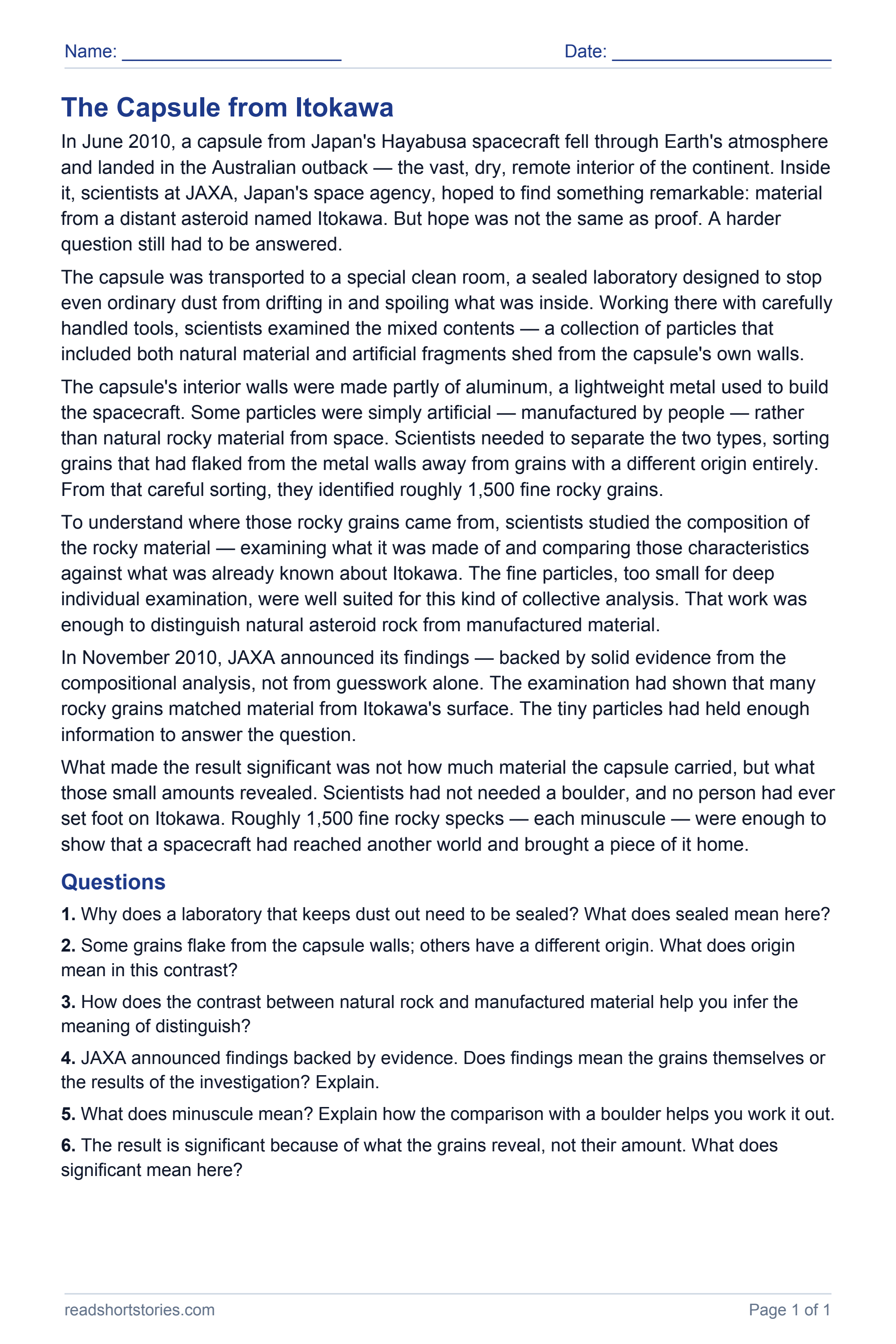
In June 2010, a capsule from Japan’s Hayabusa spacecraft fell through Earth’s atmosphere and landed in the Australian outback — the vast, dry, remote interior of the continent. Inside it, scientists at JAXA, Japan’s space agency, hoped to find something remarkable: material from a distant asteroid named Itokawa. But hope was not the same as proof. A harder question still had to be answered.
The capsule was transported to a special clean room, a sealed laboratory designed to stop even ordinary dust from drifting in and spoiling what was inside. Working there with carefully handled tools, scientists examined the mixed contents — a collection of particles that included both natural material and artificial fragments shed from the capsule’s own walls.
The capsule’s interior walls were made partly of aluminum, a lightweight metal used to build the spacecraft. Some particles were simply artificial — manufactured by people — rather than natural rocky material from space. Scientists needed to separate the two types, sorting grains that had flaked from the metal walls away from grains with a different origin entirely. From that careful sorting, they identified roughly 1,500 fine rocky grains.
To understand where those rocky grains came from, scientists studied the composition of the rocky material — examining what it was made of and comparing those characteristics against what was already known about Itokawa. The grains were tiny, but even tiny grains could be examined for the minerals inside them. That work was enough to distinguish natural asteroid rock from manufactured material.
In November 2010, JAXA announced its findings — backed by solid evidence from the compositional analysis, not from guesswork alone. The examination had shown that many rocky grains matched material from Itokawa’s surface. The tiny particles had held enough information to answer the question.
What made the result significant was not how much material the capsule carried, but what those small amounts revealed. Scientists had not needed a boulder, and no person had ever set foot on Itokawa. Roughly 1,500 fine rocky specks — each minuscule — were enough to show that a spacecraft had reached another world and brought a piece of it home.
Questions
- Why does a laboratory that keeps dust out need to be sealed? What does sealed mean here?
- Some grains flake from the capsule walls; others have a different origin. What does origin mean in this contrast?
- How does the contrast between natural rock and manufactured material help you infer the meaning of distinguish?
- JAXA announced findings backed by evidence. Does findings mean the grains themselves or the results of the investigation? Explain.
- What does minuscule mean? Explain how the comparison with a boulder helps you work it out.
- The result is significant because of what the grains reveal, not their amount. What does significant mean here?
Click to see the answers
Answers
- Sealed means closed tightly to keep unwanted material out. The laboratory prevents dust from entering. Evidence: The capsule was transported to a special clean room, a sealed laboratory designed to stop even ordinary dust from drifting in and spoiling what was inside.
- Origin means where something comes from. The sentence contrasts grains from the metal walls with grains from another source. Evidence: Scientists needed to separate the two types, sorting grains that had flaked from the metal walls away from grains with a different origin entirely.
- Distinguish means tell apart. The analysis separates natural asteroid rock from manufactured material. Evidence: That work was enough to distinguish natural asteroid rock from manufactured material.
- Findings means the investigation results. The next sentence reports what the examination showed. Evidence: In November 2010, JAXA announced its findings — backed by solid evidence from the compositional analysis, not from guesswork alone. The examination had shown that many rocky grains matched material from Itokawa’s surface.
- Minuscule means extremely small. Fine specks are contrasted with a boulder. Evidence: Scientists had not needed a boulder, and no person had ever set foot on Itokawa. Roughly 1,500 fine rocky specks — each minuscule — were enough to show that a spacecraft had reached another world and brought a piece of it home.
- Significant means important or meaningful. The information revealed matters more than the amount of material. Evidence: What made the result significant was not how much material the capsule carried, but what those small amounts revealed.
Listen to this story (audio)
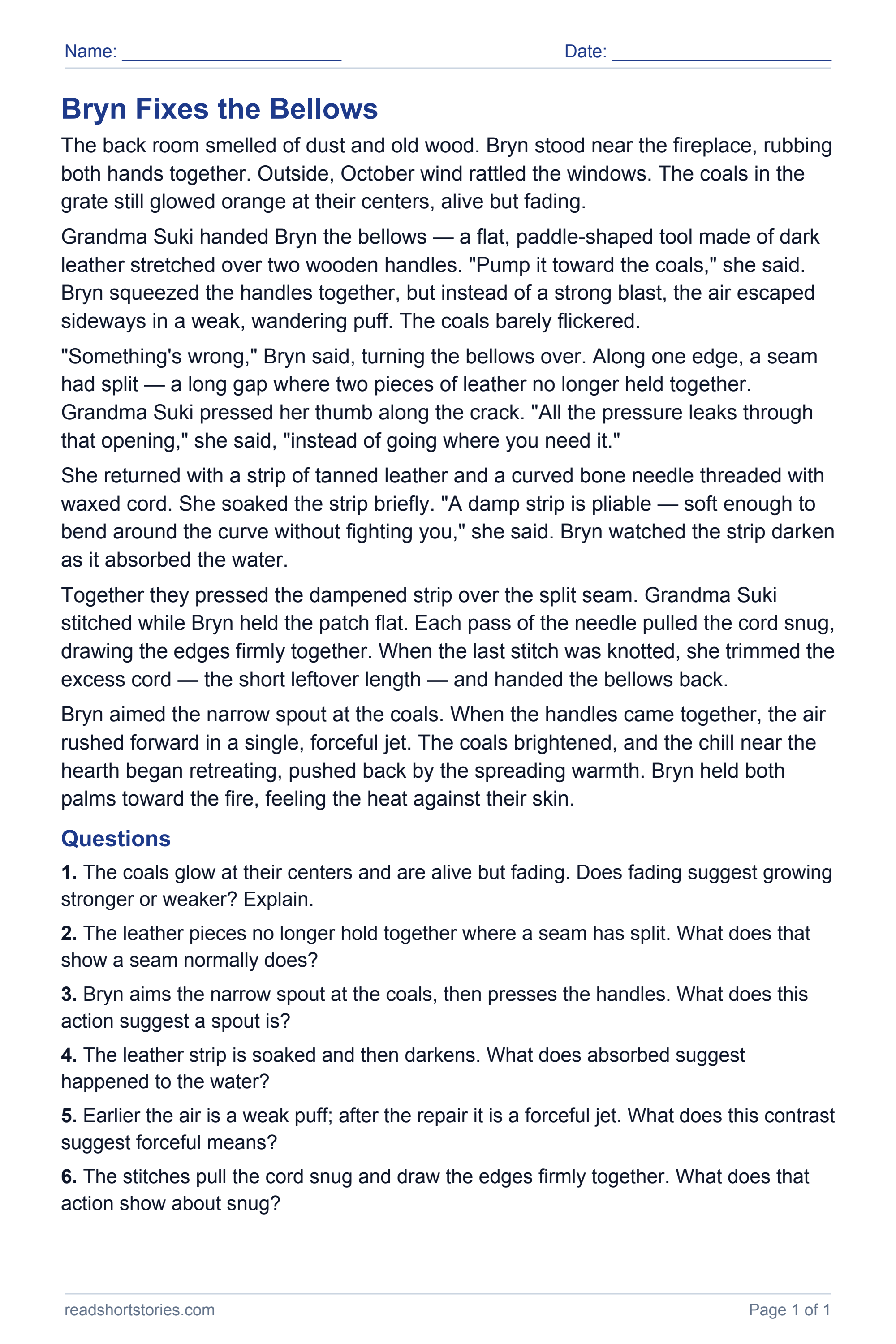
Bryn Fixes the Bellows
The back room smelled of dust and old wood. Bryn stood near the fireplace, rubbing both hands together. Outside, October wind rattled the windows. The coals in the grate still glowed orange at their centers, alive but fading.
Grandma Suki handed Bryn the bellows — a flat, paddle-shaped tool made of dark leather stretched over two wooden handles. “Pump it toward the coals,” she said. Bryn squeezed the handles together, but instead of a strong blast, the air escaped sideways in a weak, wandering puff. The coals barely flickered.
“Something’s wrong,” Bryn said, turning the bellows over. Along one edge, a seam had split — a long gap where two pieces of leather no longer held together. Grandma Suki pressed her thumb along the crack. “All the pressure leaks through that opening,” she said, “instead of going where you need it.”
She returned with a strip of tanned leather and a curved bone needle threaded with waxed cord. She soaked the strip briefly. “A damp strip is pliable — soft enough to bend around the curve without fighting you,” she said. Bryn watched the strip darken as it absorbed the water.
Together they pressed the dampened strip over the split seam. Grandma Suki stitched while Bryn held the patch flat. Each pass of the needle pulled the cord snug, drawing the edges firmly together. When the last stitch was knotted, she trimmed the excess cord — the short leftover length — and handed the bellows back.
Bryn aimed the narrow spout at the coals. When the handles came together, the air rushed forward in a single, forceful jet. The coals brightened, and the chill near the hearth began retreating, pushed back by the spreading warmth. Bryn held both palms toward the fire, feeling the heat against their skin.
Questions
- The coals glow at their centers and are alive but fading. Does fading suggest growing stronger or weaker? Explain.
- The leather pieces no longer hold together where a seam has split. What does that show a seam normally does?
- Bryn aims the narrow spout at the coals, then presses the handles. What does this action suggest a spout is?
- The leather strip is soaked and then darkens. What does absorbed suggest happened to the water?
- Earlier the air is a weak puff; after the repair it is a forceful jet. What does this contrast suggest forceful means?
- The stitches pull the cord snug and draw the edges firmly together. What does that action show about snug?
Click to see the answers
Answers
- Fading suggests growing weaker. The coals still have orange centers, but their glow is weakening. Evidence: The coals in the grate still glowed orange at their centers, alive but fading.
- A seam joins pieces of material. The split shows where the leather edges should hold together. Evidence: Along one edge, a seam had split — a long gap where two pieces of leather no longer held together.
- A spout is a narrow outlet that directs the air. Bryn points it toward the coals. Evidence: Bryn aimed the narrow spout at the coals. When the handles came together, the air rushed forward in a single, forceful jet.
- Absorbed means took in the water. The leather darkens as the water enters it. Evidence: Bryn watched the strip darken as it absorbed the water.
- Forceful means strong or powerful. The repaired bellows sends the air rushing forward. Evidence: When the handles came together, the air rushed forward in a single, forceful jet.
- Snug means tight or securely fitted. The stitches hold the edges firmly together. Evidence: Each pass of the needle pulled the cord snug, drawing the edges firmly together.
Listen to this story (audio)
Download the Free Context Clues PDF Workbook
The workbook includes 5 focused reading passages: the 3 passages above and 2 bonus passages, with context clues questions, instructional notes, and a separate answer key.
Frequently Asked Questions
How long are the passages?
The web passages have 294-374 words each, focused on context clues skills.
Does the PDF include answers?
Yes. All 5 passages have questions, and the answer key is on separate pages.
How can we use these passages?
Read the story carefully, spot unfamiliar target words, and examine the surrounding sentences for clues before checking answers.