- Figurative Language Short Stories and Worksheets — Free PDF
- Figurative Language Guide
- Similes
- Metaphors
- Personification
- Idioms
- Explain the Author's Choice
- Historical Sources
- 4th Grade Reading Passages: Figurative Language
- Sketching the Next Stop
- Questions
- Answers
- A Monument in Silver Folds
- Questions
- Answers
- Shadows Across the Meadow
- Questions
- Answers
- Download the Free Figurative Language PDF Workbook
- Frequently Asked Questions
- How long are the passages?
- Does the PDF include answers?
- How can we use these passages?
- More Short Stories and Reading Activities
Figurative language uses comparisons and expressions that mean more than their literal words. These Grade 4 short reading passages give students practice with similes, metaphors, personification, idioms, and hyperbole. Read three passages below, then ask students to explain what each expression means and why the author uses it. The printable workbook includes all five passages, six questions per passage, and a separate explanatory answer key.
Listen and read along: Audio versions are available for 3 stories on this page. Use the players below.
You can download the free 4th grade figurative language reading workbook PDF below.
Figurative Language Guide
Similes
A simile compares unlike things using like or as. Example: The line of cars moved like a slow turtle. The comparison helps readers picture the slow movement. Explain the shared quality, not just the word like.
Metaphors
A metaphor describes one thing as another without using like or as. Example: My backpack was a rock on my shoulders. The writer means that the backpack felt heavy, not that it became a real rock.
Personification
Personification gives something nonhuman a human action or quality. Example: The alarm clock shouted at seven. A clock does not have a human voice; shouted makes its noise seem loud and demanding.
Idioms
An idiom has a meaning that cannot be worked out simply by taking every word literally. Example: After her team won, she was on cloud nine. This means she was very happy. Use the surrounding action and feelings to check the meaning.
Explain the Author’s Choice
First identify the expression, then explain its meaning and effect. Does it help you picture movement, understand a feeling, or hear a sound? Some phrases can create more than one effect. Accept clear explanations supported by the passage rather than requiring identical wording to the sample key. Hyperbole is deliberate exaggeration, such as saying a wait lasted forever. Explain its effect instead of treating it as a fact.
Historical Sources
- Christo and Jeanne-Claude Foundation: Wrapped Reichstag anniversary documentation
- Science Museum Group collection record: Print of Wrapped Reichstag by Christo and Jeanne-Claude
4th Grade Reading Passages: Figurative Language
Sketching the Next Stop
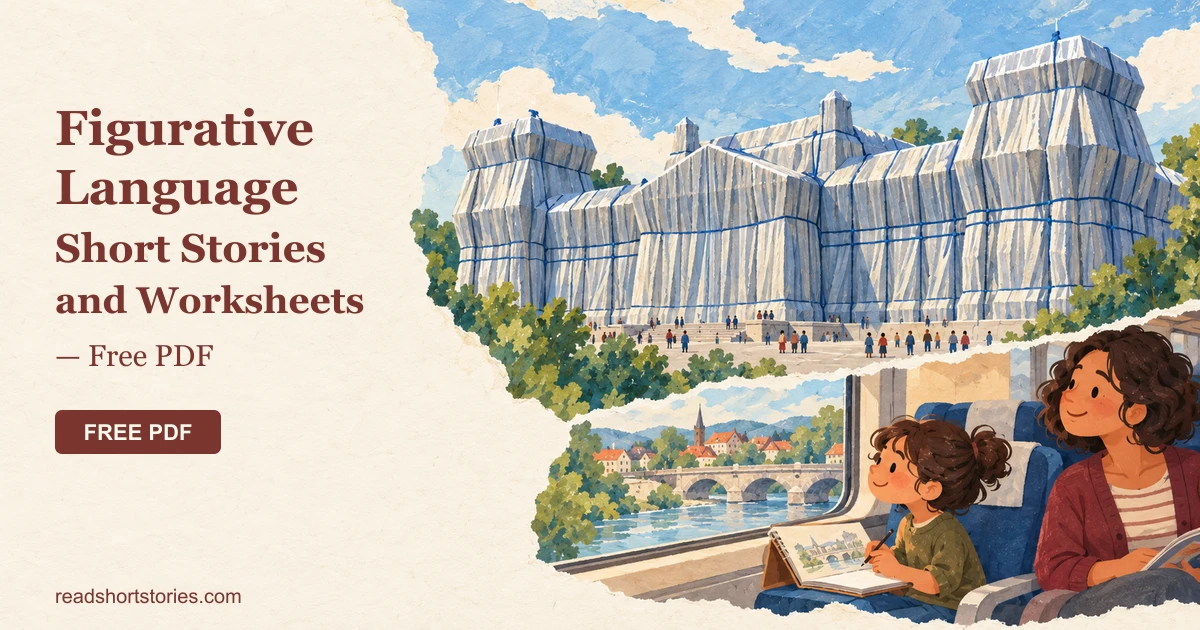
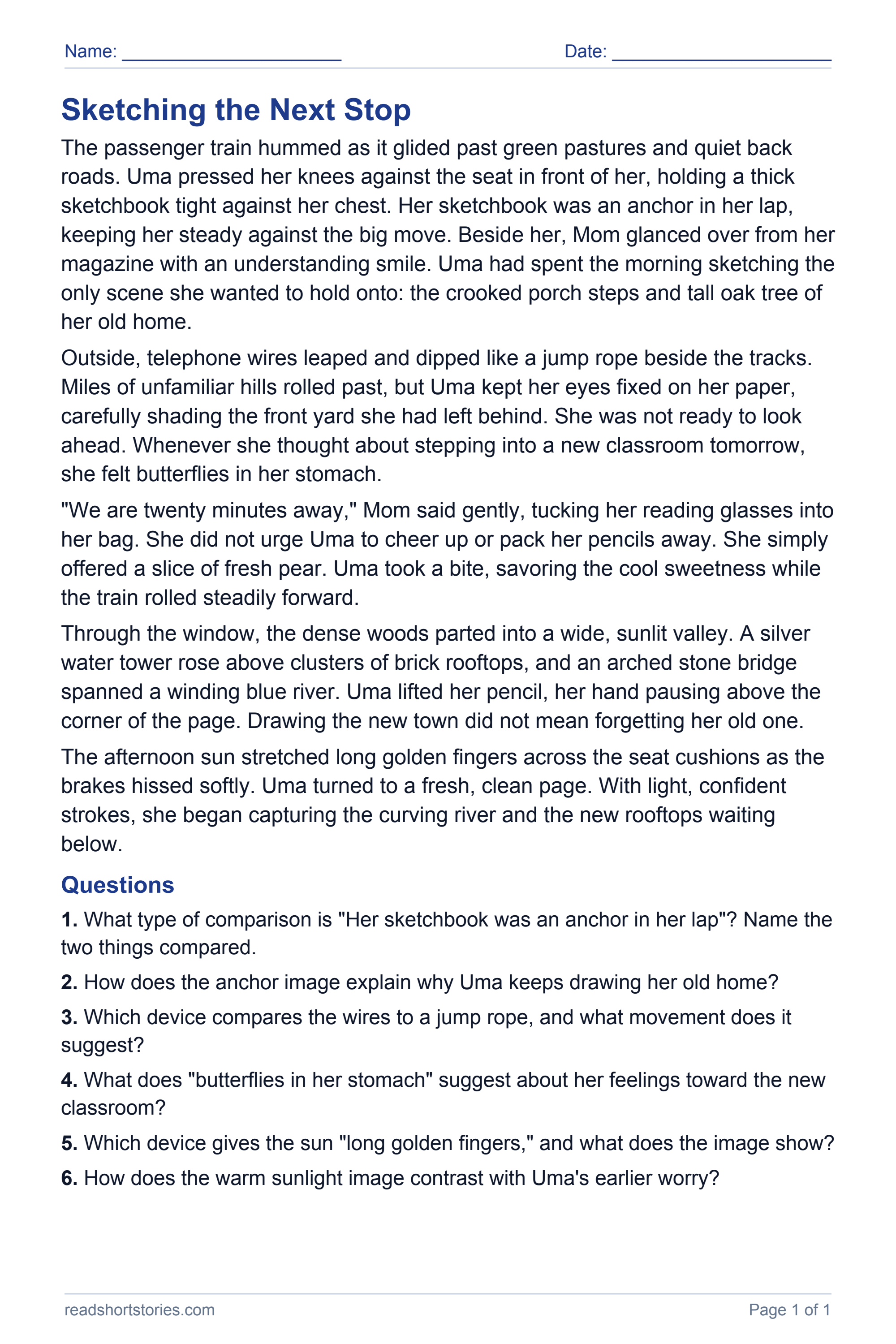
The passenger train hummed as it glided past green pastures and quiet back roads. Uma pressed her knees against the seat in front of her, holding a thick sketchbook tightly in her lap. Her sketchbook was an anchor in her lap, keeping her steady against the big move. Beside her, Mom glanced over from her magazine with an understanding smile. Uma had spent the morning sketching the only scene she wanted to hold onto: the crooked porch steps and tall oak tree of her old home.
Outside, telephone wires leaped and dipped like a jump rope beside the tracks. Miles of unfamiliar hills rolled past, but Uma kept her eyes fixed on her paper, carefully shading the front yard she had left behind. She was not ready to look ahead. Whenever she thought about stepping into a new classroom tomorrow, she felt butterflies in her stomach.
“We are twenty minutes away,” Mom said gently, tucking her reading glasses into her bag. She did not urge Uma to cheer up or pack her pencils away. She simply offered a slice of fresh pear. Uma took a bite, savoring the cool sweetness while the train rolled steadily forward.
Through the window, the dense woods parted into a wide, sunlit valley. A silver water tower rose above clusters of brick rooftops, and an arched stone bridge spanned a winding blue river. Uma lifted her pencil, her hand pausing above the corner of the page. Drawing the new town did not mean forgetting her old one.
The afternoon sun stretched long golden fingers across the seat cushions as the brakes hissed softly. Uma turned to a fresh, clean page. With light, confident strokes, she began capturing the curving river and the new rooftops waiting below.
Questions
- What type of comparison is “Her sketchbook was an anchor in her lap”? Name the two things compared.
- How does the anchor image explain why Uma keeps drawing her old home?
- Which device compares the wires to a jump rope, and what movement does it suggest?
- What does “butterflies in her stomach” suggest about her feelings toward the new classroom?
- Which device gives the sun “long golden fingers,” and what does the image show?
- How does the warm sunlight image contrast with Uma’s earlier worry?
Click to see the answers
Answers
- It is a metaphor comparing the sketchbook with an anchor. The familiar book gives Uma emotional steadiness during the move. Evidence: Her sketchbook was an anchor in her lap, keeping her steady against the big move.
- The familiar drawings comfort her while her surroundings change. The anchor image suggests steadiness, rather than a real ship’s weight. Evidence: Her sketchbook was an anchor in her lap, keeping her steady against the big move.
- The author uses a simile. Seen from the moving train, the wires appear to rise and dip like a jump rope. Evidence: Outside, telephone wires leaped and dipped like a jump rope beside the tracks.
- The idiom shows that she feels nervous or uneasy about the unfamiliar classroom. There are no real butterflies inside her. Evidence: Whenever she thought about stepping into a new classroom tomorrow, she felt butterflies in her stomach.
- The author uses personification. The sun’s reaching fingers suggest long shapes of golden light spreading across the cushions. Evidence: The afternoon sun stretched long golden fingers across the seat cushions as the brakes hissed softly.
- The warm light fits a more welcoming, hopeful mood as she begins drawing the new town. Earlier, she focused only on her old home. Evidence: The afternoon sun stretched long golden fingers across the seat cushions as the brakes hissed softly. Uma turned to a fresh, clean page.
A Monument in Silver Folds
In the summer of 1995, a famous stone building in Berlin began a surprising change. Artists Christo and Jeanne-Claude had spent years planning an ambitious public art project. They wanted to wrap the historic German Reichstag in woven fabric. Rather than hiding the grand landmark away, the artists hoped to reveal its underlying shape in a fresh light.
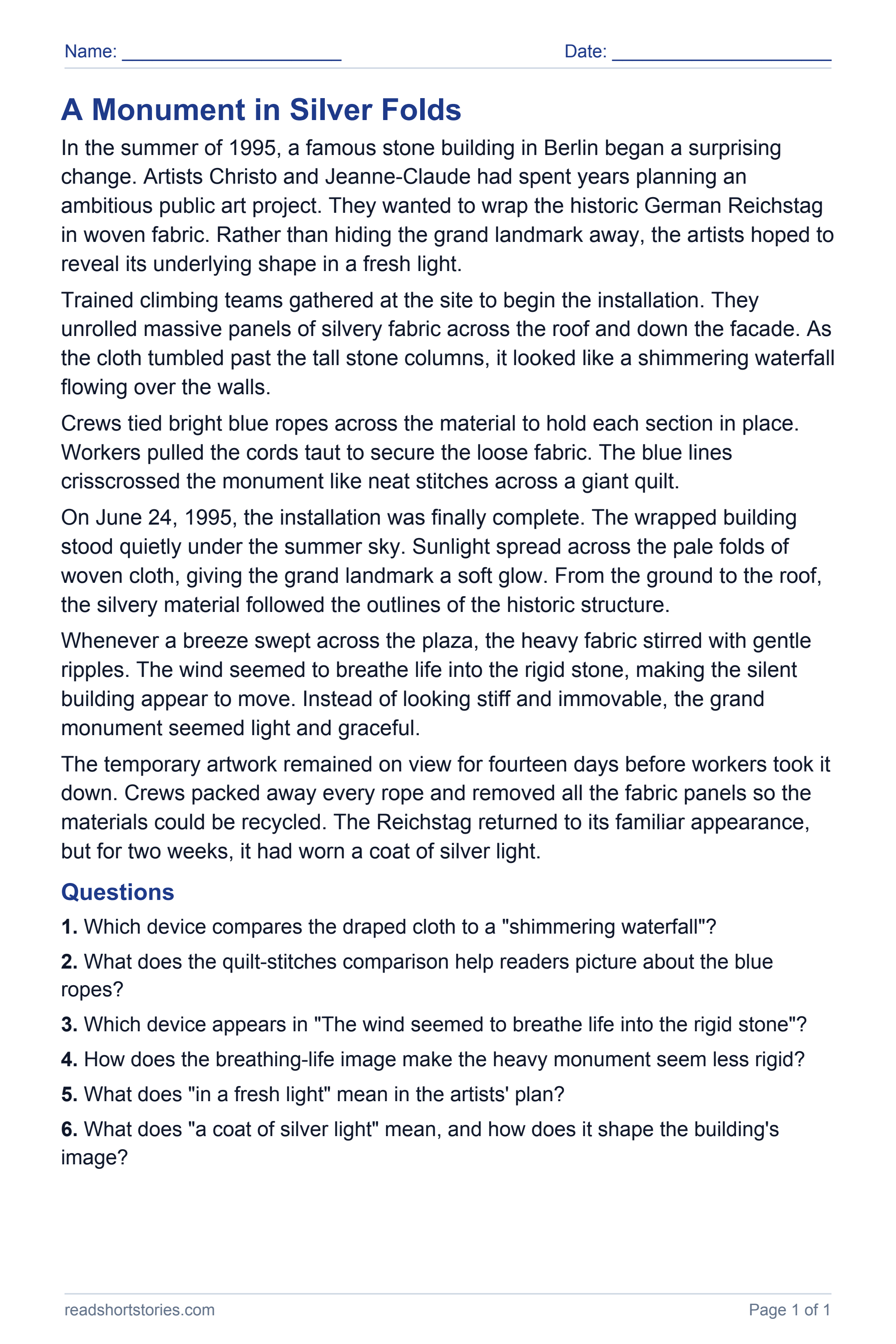
Trained climbing teams gathered at the site to begin the installation. They unrolled massive panels of silvery fabric across the roof and down the facade. As the cloth tumbled past the tall stone columns, it looked like a shimmering waterfall flowing over the walls.
Crews tied bright blue ropes across the material to hold each section in place. Workers pulled the cords taut to secure the loose fabric. The blue lines crisscrossed the monument like neat stitches across a giant quilt.
On June 24, 1995, the installation was finally complete. The wrapped building stood quietly under the summer sky. Sunlight spread across the pale folds of woven cloth, giving the grand landmark a soft glow. From the ground to the roof, the silvery material followed the outlines of the historic structure.
Whenever a breeze swept across the plaza, the heavy fabric stirred with gentle ripples. The wind seemed to breathe life into the rigid stone, making the silent building appear to move. Instead of looking stiff and immovable, the grand monument seemed light and graceful.
The temporary artwork remained on view for fourteen days before workers took it down. Crews packed away every rope and removed all the fabric panels so the materials could be recycled. The Reichstag returned to its familiar appearance, but for two weeks, it had worn a coat of silver light.
Questions
- Which device compares the draped cloth to a “shimmering waterfall”?
- What does the quilt-stitches comparison help readers picture about the blue ropes?
- Which device appears in “The wind seemed to breathe life into the rigid stone”?
- How does the breathing-life image make the heavy monument seem less rigid?
- What does “in a fresh light” mean in the artists’ plan?
- What does “a coat of silver light” mean, and how does it shape the building’s image?
Click to see the answers
Answers
- The author uses a simile. The falling fabric resembles gleaming water flowing down the walls. Evidence: As the cloth tumbled past the tall stone columns, it looked like a shimmering waterfall flowing over the walls.
- The crossing ropes resemble stitches across a large quilt. The image helps readers picture lines holding broad fabric in place. Evidence: The blue lines crisscrossed the monument like neat stitches across a giant quilt.
- The author uses personification, making the wind seem to give life to the building. The stone does not actually breathe. Evidence: The wind seemed to breathe life into the rigid stone, making the silent building appear to move.
- Rippling fabric makes the solid building appear softer and more lively. The image changes its appearance, not the stone itself. Evidence: Whenever a breeze swept across the plaza, the heavy fabric stirred with gentle ripples.
- It means seeing something in a new way. Wrapping the familiar building draws attention to its shape. Evidence: Rather than hiding the grand landmark away, the artists hoped to reveal its underlying shape in a fresh light.
- The silver fabric is compared with clothing. It makes the building seem dressed in a bright, temporary covering. Evidence: The Reichstag returned to its familiar appearance, but for two weeks, it had worn a coat of silver light.
Listen to this story (audio)
Shadows Across the Meadow
Nico crouched beside his older brother David inside the weathered timber blind, peering out through the narrow viewing slit. The setting sun had melted into copper streaks, and shadows stretched long fingers across the meadow. Nico shifted his weight impatiently, longing for his first glimpse of a hunting barn owl.
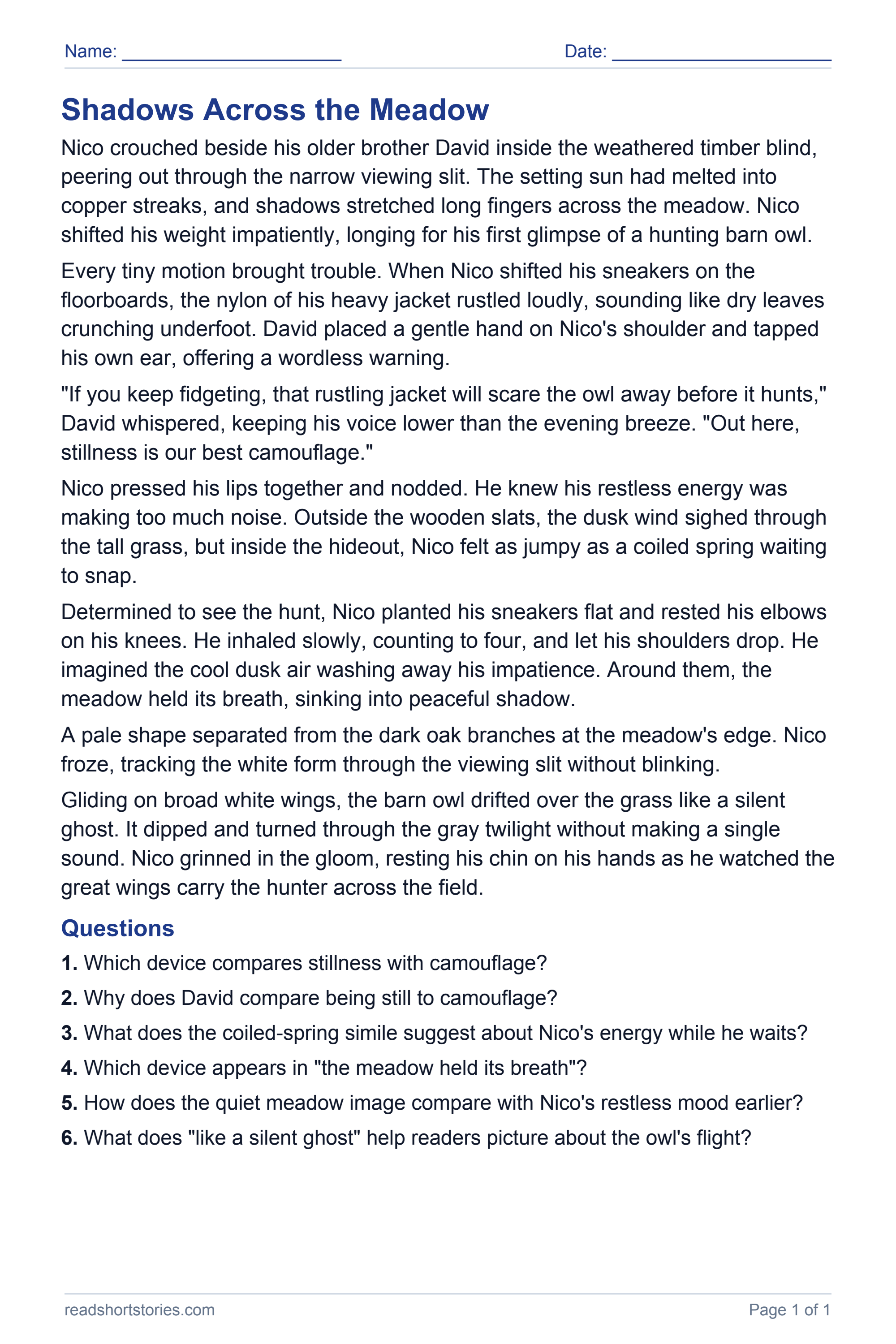
Every tiny motion brought trouble. When Nico shifted his sneakers on the floorboards, the nylon of his heavy jacket rustled loudly, sounding like dry leaves crunching underfoot. David placed a gentle hand on Nico’s shoulder and tapped his own ear, offering a wordless warning.
“If you keep fidgeting, that rustling jacket will scare the owl away before it hunts,” David whispered, keeping his voice lower than the evening breeze. “Out here, stillness is our best camouflage.”
Nico pressed his lips together and nodded. He knew his restless energy was making too much noise. Outside the wooden slats, the dusk wind sighed through the tall grass, but inside the hideout, Nico felt as jumpy as a coiled spring waiting to snap.
Determined to see the hunt, Nico planted his sneakers flat and rested his elbows on his knees. He inhaled slowly, counting to four, and let his shoulders drop. He imagined the cool dusk air washing away his impatience. Around them, the meadow held its breath, sinking into peaceful shadow.
A pale shape separated from the dark oak branches at the meadow’s edge. Nico froze, tracking the white form through the viewing slit without blinking.
Gliding on broad white wings, the barn owl drifted over the grass like a silent ghost. It dipped and turned through the gray twilight without making a single sound. Nico grinned in the gloom, resting his chin on his hands as he watched the great wings carry the hunter across the field.
Questions
- Which device compares stillness with camouflage?
- Why does David compare being still to camouflage?
- What does the coiled-spring simile suggest about Nico’s energy while he waits?
- Which device appears in “the meadow held its breath”?
- How does the quiet meadow image compare with Nico’s restless mood earlier?
- What does “like a silent ghost” help readers picture about the owl’s flight?
Click to see the answers
Answers
- David uses a metaphor. Being still is compared with camouflage because it helps the observers avoid notice. Evidence: “Out here, stillness is our best camouflage.”
- Quiet stillness helps them avoid drawing the owl’s attention. Their clothes do not literally change color or make them invisible. Evidence: “If you keep fidgeting, that rustling jacket will scare the owl away before it hunts,” David whispered, keeping his voice lower than the evening breeze.
- Nico has restless energy that feels ready to burst into movement. Like a tense spring, he finds it hard to remain still. Evidence: Outside the wooden slats, the dusk wind sighed through the tall grass, but inside the hideout, Nico felt as jumpy as a coiled spring waiting to snap.
- The author uses personification. Giving the meadow a living action creates a quiet, expectant mood. Evidence: Around them, the meadow held its breath, sinking into peaceful shadow.
- The peaceful image now fits his calmer stillness. It contrasts with his earlier springlike energy and impatience. Evidence: Around them, the meadow held its breath, sinking into peaceful shadow.
- The pale owl glides quietly and smoothly. The comparison gives its appearance a hushed, almost mysterious quality without making it a real ghost. Evidence: Gliding on broad white wings, the barn owl drifted over the grass like a silent ghost.
Listen to this story (audio)
Download the Free Figurative Language PDF Workbook
The workbook includes 5 focused reading passages: the 3 passages above and 2 bonus passages, with figurative language questions, instructional notes, and a separate answer key.
Frequently Asked Questions
How long are the passages?
The web passages have 284-296 words each, focused on figurative language skills.
Does the PDF include answers?
Yes. All 5 passages have questions, and the answer key is on separate pages.
How can we use these passages?
Identify figurative expressions as you read, visualize the imagery, and evaluate how each phrase affects the story meaning.