- Future Simple Stories with Exercises and Answers (Free PDF)
- Future Simple: A Quick Reminder
- Forming the Future Simple with Will and Won't
- Four Key Uses: Decisions, Offers, Promises, and Predictions
- Will vs. Be Going To
- About the True Story
- Future Simple Stories
- The Cake on the Bus
- Questions
- Future Simple Practice
- Reading Answers
- Practice Answers
- Fill in the Blanks
- True or False
- The Sound of Saturday
- Questions
- Future Simple Practice
- Reading Answers
- Practice Answers
- Fill in the Blanks
- True or False
- The Comet That Came Back: A True Story
- Questions
- Future Simple Practice
- Reading Answers
- Practice Answers
- Fill in the Blanks
- True or False
- Download the Free PDF
- Frequently Asked Questions
- What level are these stories for?
- What does the PDF include?
- When do we use will and won't?
- More Short Stories and Reading Activities
Read these Future Simple stories to see how will and won't express predictions, quick decisions, offers, and promises. This collection is for A2 English learners. Follow what the characters expect, decide, offer, and promise, then check what happens. Read three stories below and find three more in the PDF, with reading questions, grammar exercises, and answers. The stories are about 380–500 words each. Try the activities before opening the answers.
Listen and read along: Audio versions are available for 3 stories on this page. Use the players below.
You can download the free future simple stories PDF below.
Future Simple: A Quick Reminder
Forming the Future Simple with Will and Won't
Use will or won't (will not) followed by the base form of the verb for all subjects. Do not add -s, -ed, or -ing to the main verb. Example: 'I will call you tonight' or 'She won't forget the cake.'
Four Key Uses: Decisions, Offers, Promises, and Predictions
Use will for instant decisions made while speaking ('I'll answer the door'), helpful offers ('I will carry that box for you'), promises ('I won't tell anyone'), and general predictions ('I think tomorrow will be sunny').
Will vs. Be Going To
Use 'be going to' for plans decided before speaking or predictions based on immediate physical evidence (e.g., 'Look at those dark clouds; it is going to rain'). Use 'will' for spontaneous decisions made right now or general future beliefs (e.g., 'The bus is full; I will wait for the next one').
About the True Story
The Comet That Came Back retells Halley's verified prediction and return, then looks ahead to the expected 2061 visit. Sources: NASA history: NASA: Halley's Comet Halley's 1705 paper (University of Oklahoma): University of Oklahoma source NASA 1P/Halley: NASA comet facts ESA, Revisiting an old friend: NASA comet facts
Future Simple Stories
The Cake on the Bus
Nila stepped onto the number fourteen bus on Saturday morning. In her hands, she held a large white bakery box with two ribbons. Inside was a tall berry cake for her family's lunch. "I am going to visit my brother today," she thought happily. But the bus was crowded, and the road had three sharp turns. "The soft decoration will slide if I do not sit down," she thought. "It won't survive twenty minutes on a bumpy road."
She walked down the narrow aisle with careful steps. A man in a blue jacket looked up from the middle row. His name was Zeki, and he was returning home from the neighborhood market. He saw Nila carrying the box and noticed the bakery sticker.
"Excuse me!" Zeki said with a warm smile. "That box looks heavy. I'll make room on the seat beside me. You can place it here on this level bench."
"Thank you," Nila answered. "I'll take the seat, and the cake will stay safe between us."
She stepped closer to the bench, but a sharp smell suddenly reached her nose. On the floor by Zeki's feet sat an open bag with large raw onions. The strong smell filled the whole row.
Nila stopped. She did not want a strong onion smell near sweet cream. "If I put the cake beside that bag," she thought, "the sweet frosting will smell like soup! My niece won't eat onion-flavored cake."
Zeki noticed her look. "Don't worry," he offered warmly. "I'll push my shopping bag further away, or I'll hold the box on my lap for you."
"You are very kind," Nila replied with a friendly laugh. "But I won't trouble you with my cake. Your onions look wonderful, but I don't want the sweet frosting to smell like onions."
Zeki chuckled and looked into his bag. "You are right," he said. "My dinner will have onions, but your dessert will be sweet. They will not be good friends!"
Nila saw an open seat across the aisle. "I'll sit over there," she decided quickly. "I'll place my flat backpack on the floor between my shoes. That will support my feet, and I'll hold the cake firmly on my lap."
She sat down and arranged her bag on the floor. Her knees made a flat, steady table for the bakery box. When the bus turned the first sharp corner, the box did not tilt at all.
"It works!" Nila called softly with a smile. "The tall frosting will stay safe, and it will smell like fresh vanilla."
"Excellent," Zeki replied with a nod. "And I promise I won't let any onions roll toward you!"
Ten minutes later, the bus stopped near her brother's street. Nila stood up carefully with her sweet, safe dessert. She walked into the midday sunshine, confident that the family lunch would be a delicious success.
Questions
- Who was Nila going to visit on Saturday morning?
- Why did Nila stop as she moved closer to Zeki's seat?
- What showed that Nila's new way of holding the box worked?
- What can you tell about Zeki from his last promise to Nila?
Future Simple Practice
- Choose the correct words: Zeki smiled and said, 'That box looks heavy. I __________ room on the seat beside me.'
- will make
- 'll making
- make
- made
- Complete the sentence with 'will' or 'won't': Nila thought, 'The sweet frosting will smell like soup! My niece __________ eat onion-flavored cake.'
- Put the words in order to make a statement.
- cake
- stay
- The
- will
- safe
- Choose the correct words: Nila saw an open seat and decided, 'I __________ over there.'
- will sit
- sitting
- sat
- sit
- Read Zeki's words: 'I promise I won't let any onions roll toward you!' What is he doing?
- Making a prediction
- Making a promise
- Describing a past event
- Describing a habit
Click to see the answers
Reading Answers
- She was going to visit her brother. Evidence: "I am going to visit my brother today," she thought happily.
- She noticed a strong smell from his bag of onions. Evidence: She stepped closer to the bench, but a sharp smell suddenly reached her nose. On the floor by Zeki's feet sat an open bag with large raw onions.
- The box did not tilt when the bus turned a sharp corner. Evidence: When the bus turned the first sharp corner, the box did not tilt at all.
- He is friendly and understands her worry. Evidence: "Excellent," Zeki replied with a nod. "And I promise I won't let any onions roll toward you!"
Practice Answers
- will make
- won't
- The cake will stay safe
- will sit
- Making a promise He gives his word about what he will not do. Will not and won't can be used in promises.
Your turn: You are carrying a gift on a bus. Write three or four sentences about how you will keep it safe. Include an offer or a promise.
Click to see the worksheet text and answers
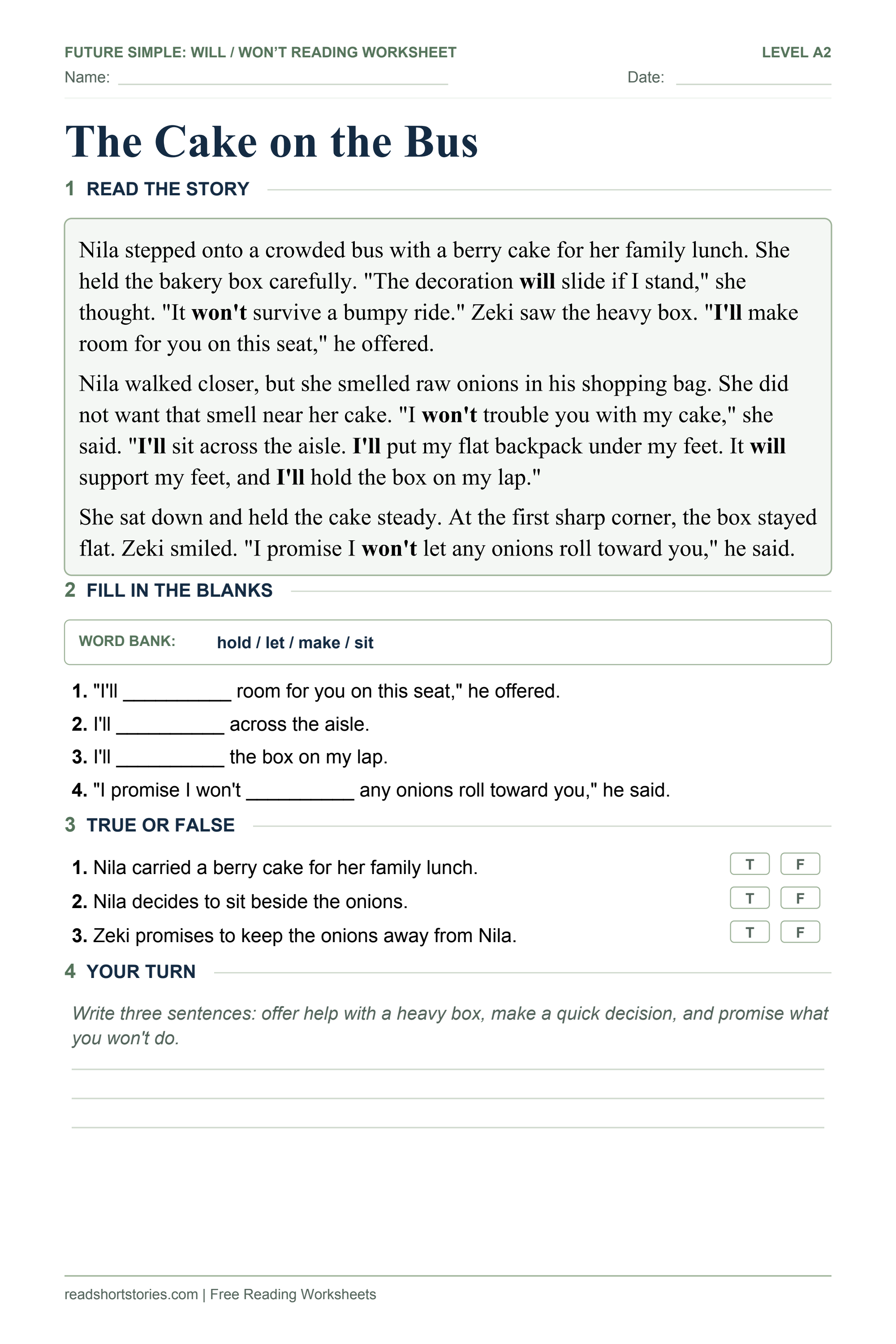
Nila stepped onto a crowded bus with a berry cake for her family lunch. She held the bakery box carefully. "The decoration will slide if I stand," she thought. "It won't survive a bumpy ride." Zeki saw the heavy box. "I'll make room for you on this seat," he offered.
Nila walked closer, but she smelled raw onions in his shopping bag. She did not want that smell near her cake. "I won't trouble you with my cake," she said. "I'll sit across the aisle. I'll put my flat backpack under my feet. It will support my feet, and I'll hold the box on my lap."
She sat down and held the cake steady. At the first sharp corner, the box stayed flat. Zeki smiled. "I promise I won't let any onions roll toward you," he said.
Fill in the Blanks
Words: make, sit, hold, let
- "I'll __________ room for you on this seat," he offered. Answer: make
- I'll __________ across the aisle. Answer: sit
- I'll __________ the box on my lap. Answer: hold
- "I promise I won't __________ any onions roll toward you," he said. Answer: let
True or False
- Nila carried a berry cake for her family lunch. True. Evidence: Nila stepped onto a crowded bus with a berry cake for her family lunch.
- Nila decides to sit beside the onions. False. Nila decided to sit across the aisle. Evidence: I'll sit across the aisle.
- Zeki promises to keep the onions away from Nila. True. Evidence: "I promise I won't let any onions roll toward you," he said.
Write three sentences: offer help with a heavy box, make a quick decision, and promise what you won't do.
Sample answer: I will carry that box for you. I'll put my bag on the floor to make room. I won't put anything on top of your cake.
The Sound of Saturday
Farah stood near the fountain in the town square on Saturday morning. The sun was bright, and the morning air was cool. Farah held her smartphone in both hands. Her sister, Vera, lived in Chicago now, and Farah missed their weekly walks. "I will send Vera a short audio postcard," Farah decided. "It will be a calm greeting. She will hear the water, and she will feel close to home."
Farah sat on a stone bench and opened her recording app. She held the phone near the splashing water. Then she smiled and tapped the red record button. "Good morning, Vera," Farah whispered into the microphone. "Listen to our peaceful square. Nobody is awake yet. The whole day will be quiet and slow."
Suddenly, heavy wooden wheels clattered over the rough stones. A fruit vendor pushed a tall cart past Farah's bench. "Sweet yellow peaches!" the vendor called in a booming voice. "Fresh fruit for Saturday morning!" A pigeon fluttered up, and a shop door banged open across the square.
Farah opened her eyes wide. The green audio meter on her screen jumped to the top. She quickly tapped the pause button. "Oh no," Farah thought. "This loud noise will ruin the peaceful greeting. The microphone won't catch the gentle fountain now." Her thumb moved toward the trash icon to delete the file.
Then Farah paused and listened to the square. The vendor hummed a cheerful song as he arranged his fruit. Water splashed, and church bells chimed softly down the street. A warm smile appeared on Farah's face. "No, I won't erase the recording," she decided. "I will keep every sound. Vera will love this lively morning much more than silence."
The vendor set his cart down and wiped his forehead. He noticed Farah holding her phone in the air. "Are you making a recording, young woman?" the vendor asked. "I am making an audio postcard for my sister abroad," Farah explained. The vendor smiled warmly. "Then I will help you!" he offered. "I will add a greeting from our market."
Farah smiled and tapped the record button again. The vendor leaned toward the microphone. "Hello, Vera!" he shouted cheerfully. "Come home soon, and we will save the sweetest peaches for you!" Farah laughed as a bicycle bell rang near the fountain. "That is wonderful," Farah said. "I will stop the recording now." She pressed the square button and saved the audio clip.
Farah tapped the send button, and the audio file traveled across the ocean. She leaned back on the bench and enjoyed the warm sunshine. Only three minutes later, her phone buzzed with an incoming voice note. Farah pressed play, and Vera's happy laughter filled the speaker. "That was amazing!" Vera said. "I will listen to those market sounds every morning. I promise I will visit home next summer, and we will walk through the square together."
Questions
- Where was Farah on Saturday morning?
- Why did Farah nearly delete the recording?
- How did the vendor make the postcard more personal?
- What does Vera's last promise suggest about her feelings?
Future Simple Practice
- Farah decided about the postcard: 'It __________ be a calm greeting.'
- will
- won't
- is
- was
- Complete with 'will' or 'won't': Farah changed her mind and said, 'I __________ keep every sound.'
- Put the words in order to make a statement.
- will
- I
- help
- you.
- Vera made a promise: 'I promise I __________ visit home next summer.'
- will
- won't
- did
- are
- Farah almost deletes the file, then says, 'No, I won't erase the recording.' Which use of won't is this?
- A past habit
- A decision made at that moment
- A fixed timetable
- An action happening now
Click to see the answers
Reading Answers
- She was near the fountain in the town square. Evidence: Farah stood near the fountain in the town square on Saturday morning.
- She thought the loud noise would spoil her quiet greeting. Evidence: This loud noise will ruin the peaceful greeting. The microphone won't catch the gentle fountain now.
- He gave a greeting directly to Vera. Evidence: "Hello, Vera!" he shouted cheerfully. "Come home soon, and we will save the sweetest peaches for you!"
- She wants to spend time with her sister at home again. Evidence: I promise I will visit home next summer, and we will walk through the square together.
Practice Answers
- will
- will
- I will help you.
- will
- A decision made at that moment Farah changes her mind while looking at the recording. Won't expresses her decision not to erase it.
Your turn: You are sending an audio message to a friend who lives far away. Write three or four sentences about the sounds around you. Include a promise or a prediction with will or won't.
Click to see the worksheet text and answers
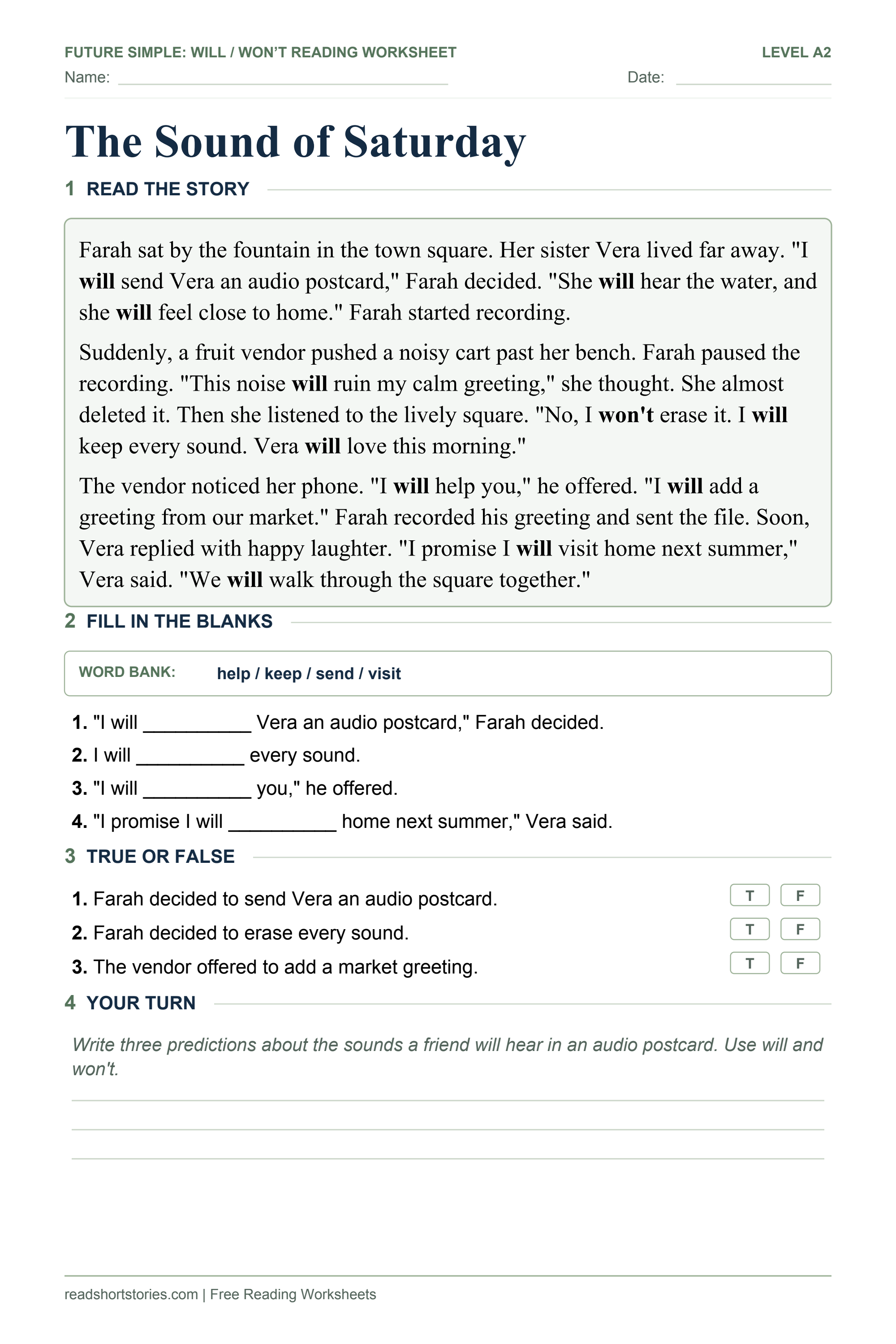
Farah sat by the fountain in the town square. Her sister Vera lived far away. "I will send Vera an audio postcard," Farah decided. "She will hear the water, and she will feel close to home." Farah started recording.
Suddenly, a fruit vendor pushed a noisy cart past her bench. Farah paused the recording. "This noise will ruin my calm greeting," she thought. She almost deleted it. Then she listened to the lively square. "No, I won't erase it. I will keep every sound. Vera will love this morning."
The vendor noticed her phone. "I will help you," he offered. "I will add a greeting from our market." Farah recorded his greeting and sent the file. Soon, Vera replied with happy laughter. "I promise I will visit home next summer," Vera said. "We will walk through the square together."
Fill in the Blanks
Words: send, keep, help, visit
- "I will __________ Vera an audio postcard," Farah decided. Answer: send
- I will __________ every sound. Answer: keep
- "I will __________ you," he offered. Answer: help
- "I promise I will __________ home next summer," Vera said. Answer: visit
True or False
- Farah decided to send Vera an audio postcard. True. Evidence: I will send Vera an audio postcard,
- Farah decided to erase every sound. False. Farah decided to keep every sound. Evidence: No, I won't erase it. I will keep every sound.
- The vendor offered to add a market greeting. True. Evidence: I will add a greeting from our market.
Write three predictions about the sounds a friend will hear in an audio postcard. Use will and won't.
Sample answer: You will hear water from the fountain. You will hear people talking near the market. You won't hear complete silence.
The Comet That Came Back: A True Story
Edmond Halley lives in England during the late seventeenth century. He is an astronomer. An astronomer is a scientist who studies space, stars, and planets. Halley studies bright objects in the sky called comets. A comet is an object made of ice, dust, and rock. It travels around the Sun in a huge oval path.
In 1682, a bright comet crosses the night sky. Halley studies its path and examines old science records. In these records, he finds reports of comets from the years 1531 and 1607. Halley compares the three paths and notices something surprising. The three comets followed almost the same path.
Halley realizes that they are one single object that returns again and again. About seventy-five or seventy-six years pass between each appearance. In 1705, Halley publishes his findings in a science paper. He makes a famous prediction about the comet. He states that the comet will return in the year 1758. He calculates that gravity from large planets will pull slightly on the comet. Halley predicts that people in the future will see the bright visitor again.
Years later, on December 25, 1758, a sky watcher spots the glowing comet. The comet returns, just as Halley predicted. Scientists name the object Halley's Comet to honor his work. People observe the comet again in 1835, 1910, and 1986. Because large planets pull on it, the travel time varies between seventy-four and seventy-nine years. Today, astronomers track the comet with modern computers.
Scientists predict that Halley's Comet will return to our sky in the year 2061. In the summer of 2061, the comet will pass close to the Sun. Heat from the Sun will warm the comet's icy surface. Frozen gas and dust will escape into space. This glowing material will form a bright cloud around the comet. Sunlight will push the dust into a long tail. The tail will point away from the Sun across space.
Astronomers on Earth will study the comet with powerful telescopes. The comet will not hit our planet, and it won't stay near the Sun. The Sun's gravity will pull the comet into another long orbit. The icy traveler will fly far beyond the planet Neptune. Then, it will begin its long journey back to Earth once more.
Questions
- What year do today's astronomers predict for Halley's Comet's next return?
- What does Halley realize after comparing the old comet records?
- What evidence confirms Halley's prediction about 1758?
- Why can a reader expect a long wait after the comet's 2061 visit?
Future Simple Practice
- Complete the prediction: 'Scientists predict that the comet __________ in 2061.'
- will returns
- will return
- returned
- returning
- Use will or won't according to the story: 'The comet __________ hit our planet.'
- Put the words in order to make a prediction.
- 2061.
- will
- The
- in
- return
- comet
- Complete with the base form of warm: 'Heat from the Sun will __________ the icy surface.'
- Scientists predict that Halley's Comet will return in 2061. What does will express here?
- A finished past event
- A daily habit
- A prediction about the future
- An offer to help
Click to see the answers
Reading Answers
- They predict that it will return in 2061. Evidence: Scientists predict that Halley's Comet will return to our sky in the year 2061.
- He realizes that the three visits were made by one comet that returns. Evidence: Halley realizes that they are one single object that returns again and again.
- A sky watcher spots the comet in 1758, the year Halley predicted. Evidence: Years later, on December 25, 1758, a sky watcher spots the glowing comet. The comet returns, just as Halley predicted.
- The comet will travel far away on another long trip around the Sun. Evidence: The Sun's gravity will pull the comet into another long orbit. The icy traveler will fly far beyond the planet Neptune.
Practice Answers
- will return
- won't
- The comet will return in 2061.
- warm
- A prediction about the future The sentence says what scientists expect to happen in the future, based on their calculations.
Your turn: Write three predictions about your town in 2050. Use will for two predictions and won't for one.
Click to see the worksheet text and answers
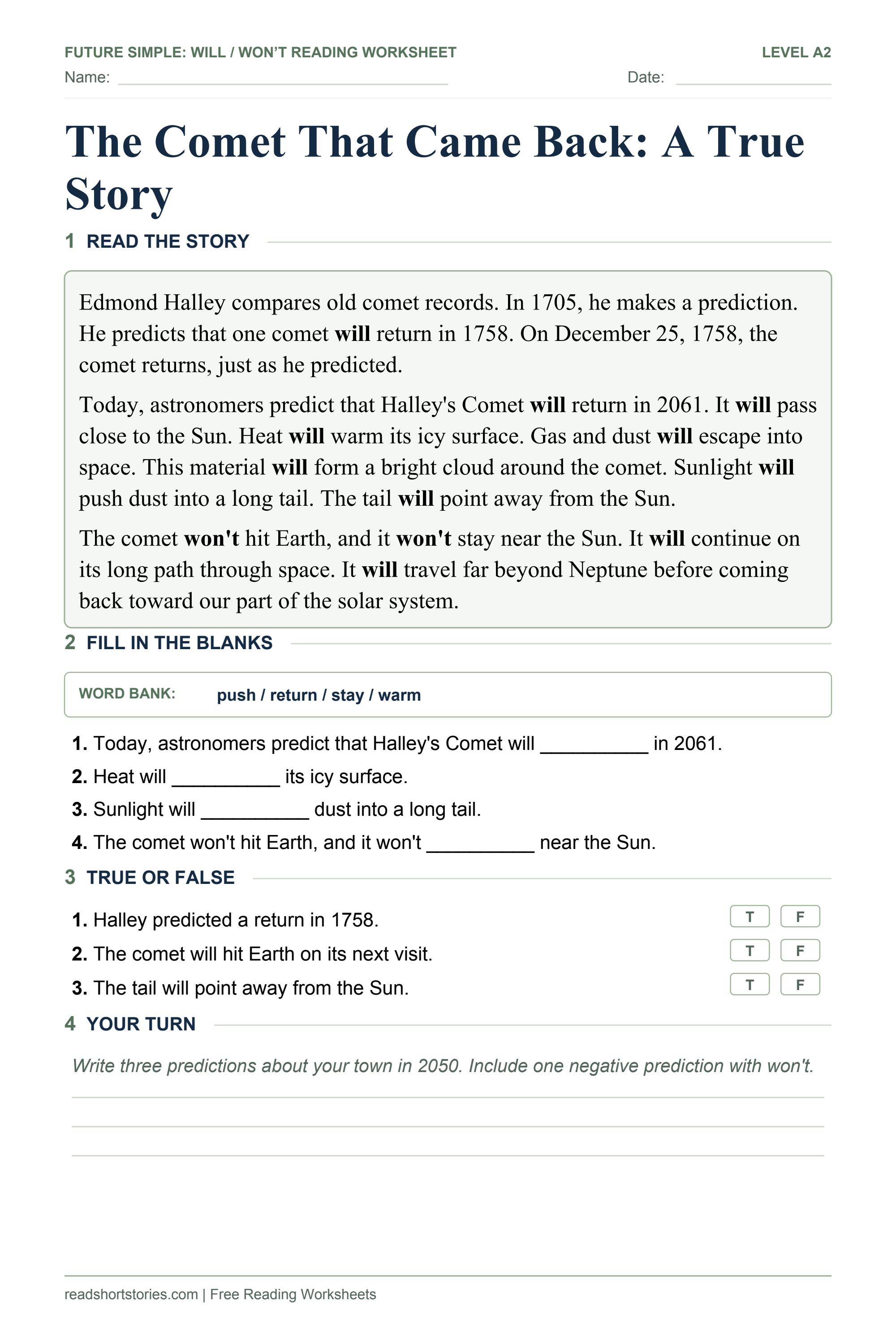
Edmond Halley compares old comet records. In 1705, he makes a prediction. He predicts that one comet will return in 1758. On December 25, 1758, the comet returns, just as he predicted.
Today, astronomers predict that Halley's Comet will return in 2061. It will pass close to the Sun. Heat will warm its icy surface. Gas and dust will escape into space. This material will form a bright cloud around the comet. Sunlight will push dust into a long tail. The tail will point away from the Sun.
The comet won't hit Earth, and it won't stay near the Sun. It will continue on its long path through space. It will travel far beyond Neptune before coming back toward our part of the solar system.
Fill in the Blanks
Words: return, warm, push, stay
- Today, astronomers predict that Halley's Comet will __________ in 2061. Answer: return
- Heat will __________ its icy surface. Answer: warm
- Sunlight will __________ dust into a long tail. Answer: push
- The comet won't hit Earth, and it won't __________ near the Sun. Answer: stay
True or False
- Halley predicted a return in 1758. True. Evidence: He predicts that one comet will return in 1758.
- The comet will hit Earth on its next visit. False. The comet won't hit Earth. Evidence: The comet won't hit Earth, and it won't stay near the Sun.
- The tail will point away from the Sun. True. Evidence: The tail will point away from the Sun.
Write three predictions about your town in 2050. Include one negative prediction with won't.
Sample answer: I think my town will have more parks in 2050. People will use more electric buses. The streets won't be as noisy.
Download the Free PDF
Print all 6 stories and their activities. The answer key follows the student pages.
Frequently Asked Questions
What level are these stories for?
These stories are written for A2 English learners. Read with support when needed.
What does the PDF include?
6 stories, reading questions, future simple exercises, writing tasks, and a separate answer key.
When do we use will and won't?
Use will plus a base verb for predictions, decisions made as you speak, offers, and promises. Use won't plus a base verb for the negative. Be going to often describes an earlier plan or a prediction based on clear present evidence.