- Reading Comprehension Strategies with Practice Passages — Free PDF
- Reading Strategy Notes
- Before Reading: Predict and Ask
- During Reading: Infer and Reread
- After Reading: Summarize
- Mini Passage: Before Opening
- Worked Example: Think Aloud
- Historical Sources
- 4th Grade Reading Passages: Reading Strategies
- Asha and the Swap Tables
- Questions
- Answers
- Katherine Johnson and the Orbital Path
- Questions
- Answers
- Willa Plans the Afternoon
- Questions
- Answers
- Download the Free Reading Strategies PDF Workbook
- Frequently Asked Questions
- How long are the passages?
- Does the PDF include answers?
- How can we use these passages?
- More Short Stories and Reading Activities
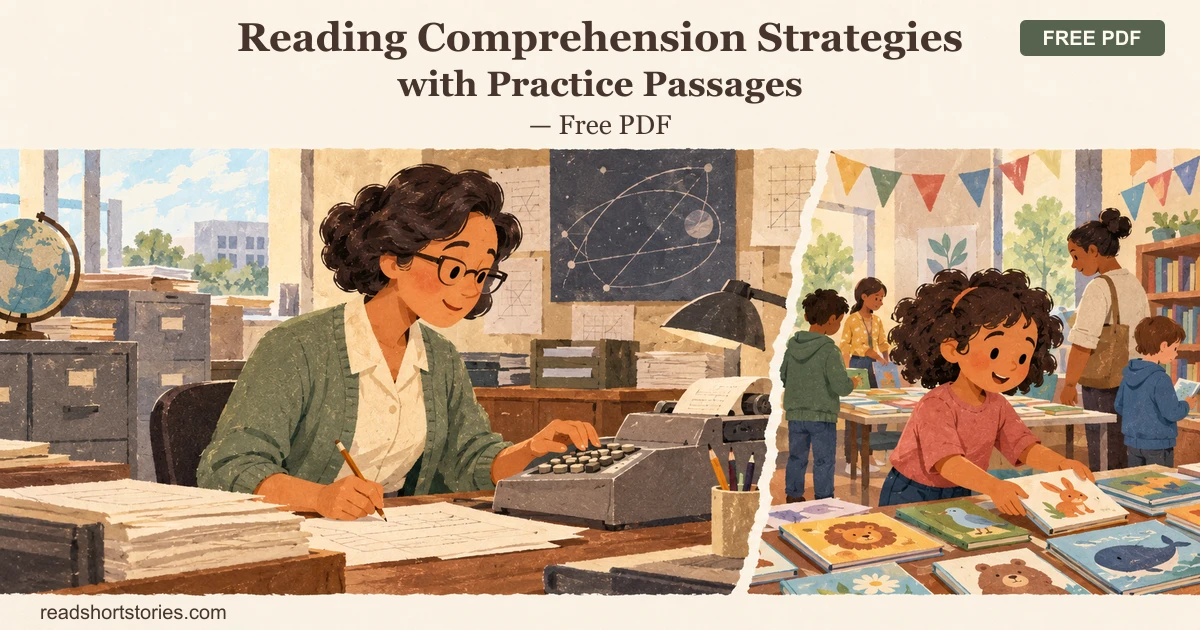
Reading comprehension strategies help students notice clues, check understanding, and explain ideas from a text. This Grade 4 practice pack focuses on predicting, asking questions, making inferences, rereading, and summarizing. Start with the short worked example, then read three practice passages below. The printable workbook includes all five passages, six questions per passage, space to write, and a separate explanatory answer key.
Listen and read along: Audio versions are available for 3 stories on this page. Use the players below.
You can download the free 4th grade reading strategies workbook PDF below.
Reading Strategy Notes
Before Reading: Predict and Ask
Read the title and think about what you want to find out. Make a prediction from a clue, then check it as you read. A prediction is a reasonable possibility, not a fact you already know. Ask a question that the text may help you answer.
During Reading: Infer and Reread
Connect details to an idea that the writer does not state directly. Name the clues behind your inference. If a pronoun, date, or action seems confusing, stop and reread the nearby sentences. Change your first idea when new details do not fit it.
After Reading: Summarize
State the main point or important change, then include only the details needed to explain it. Leave out small actions that do not affect that point. A good summary uses your own words and keeps the original meaning.
Mini Passage: Before Opening
At the bakery, the front door was locked. A sign read, ‘Open at nine.’ The street clock showed eight forty. Rae put away her shopping list and sat on a nearby bench.
Worked Example: Think Aloud
I ask why the door is locked. I reread the sign and clock: eight forty is earlier than nine. I infer that Rae has arrived before opening time. I predict that she will probably wait until nine, but the passage does not show what happens next. My summary is: Rae finds the bakery not yet open and waits nearby. The sign and time support this idea; the shopping list is a small detail.
Historical Sources
NASA: Katherine Johnson facility dedication. NASA: Langley’s human computers. NASA: Katherine Johnson biography by Margot Lee Shetterly.
4th Grade Reading Passages: Reading Strategies
Asha and the Swap Tables
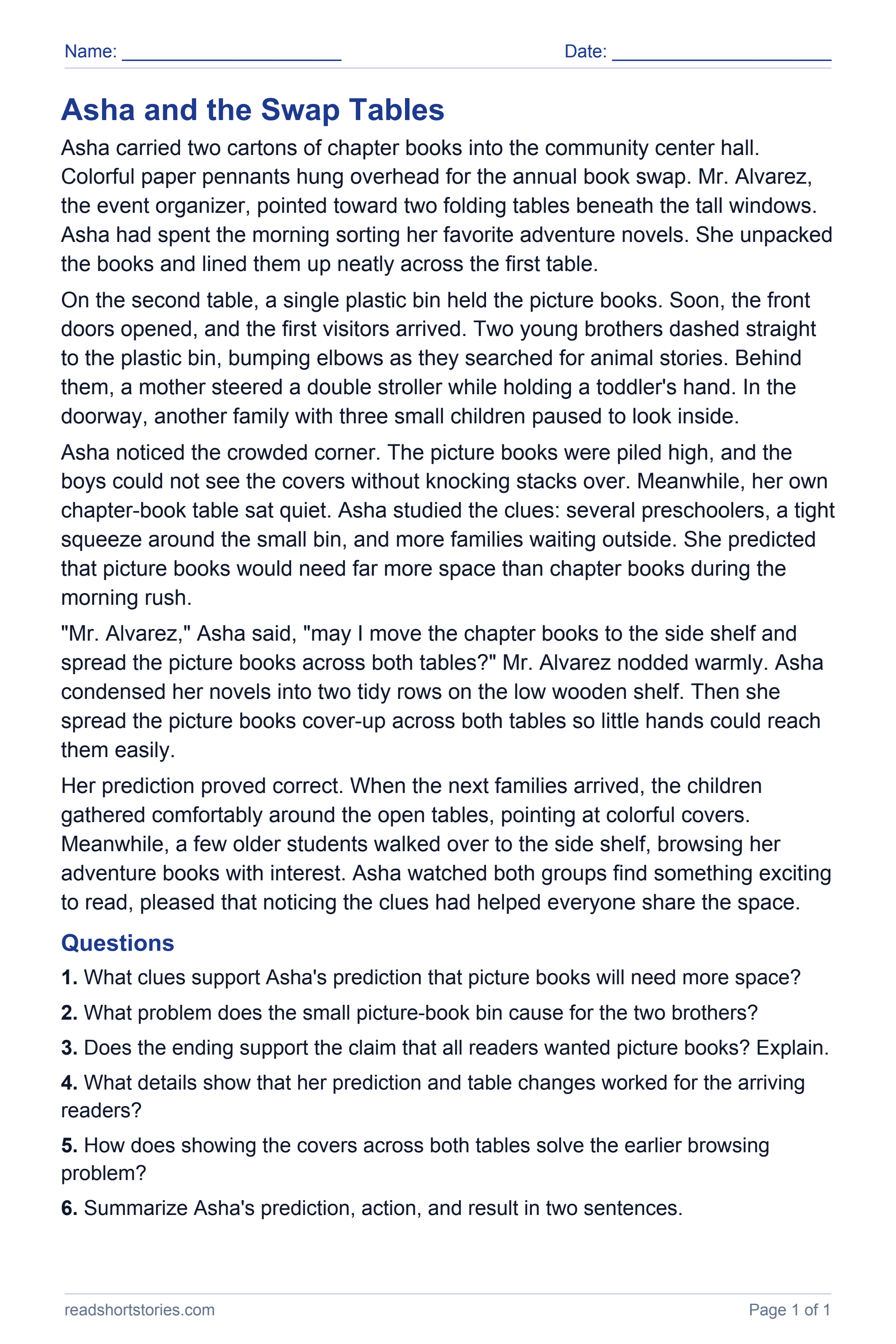
Asha carried two cartons of chapter books into the community center hall. Colorful paper pennants hung overhead for the annual book swap. Mr. Alvarez, the event organizer, pointed toward two folding tables beneath the tall windows. Asha had spent the morning sorting her favorite adventure novels. She unpacked the books and lined them up neatly across the first table.
On the second table, a single plastic bin held the picture books. Soon, the front doors opened, and the first visitors arrived. Two young brothers dashed straight to the plastic bin, bumping elbows as they searched for animal stories. Behind them, a mother steered a double stroller while holding a toddler’s hand. In the doorway, another family with three small children paused to look inside.
Asha noticed the crowded corner. The picture books were piled high, and the boys could not see the covers without knocking stacks over. Meanwhile, her own chapter-book table sat quiet. Asha studied the clues: several preschoolers, a tight squeeze around the small bin, and more families waiting outside. She predicted that picture books would need far more space than chapter books during the morning rush.
“Mr. Alvarez,” Asha said, “may I move the chapter books to the side shelf and spread the picture books across both tables?” Mr. Alvarez nodded warmly. Asha condensed her novels into two tidy rows on the low wooden shelf. Then she spread the picture books cover-up across both tables so little hands could reach them easily.
Her prediction proved correct. When the next families arrived, the children gathered comfortably around the open tables, pointing at colorful covers. Meanwhile, a few older students walked over to the side shelf, browsing her adventure books with interest. Asha watched both groups find something exciting to read, pleased that noticing the clues had helped everyone share the space.
Questions
- What clues support Asha’s prediction that picture books will need more space?
- What problem does the small picture-book bin cause for the two brothers?
- Does the ending support the claim that all readers wanted picture books? Explain.
- What details show that her prediction and table changes worked for the arriving readers?
- How does showing the covers across both tables solve the earlier browsing problem?
- Summarize Asha’s prediction, action, and result in two sentences.
Click to see the answers
Answers
- Young children crowd the small bin, and more families are arriving. Those clues suggest that picture books will need extra browsing room. Evidence: Asha studied the clues: several preschoolers, a tight squeeze around the small bin, and more families waiting outside.
- High piles hide the covers and make browsing crowded. The boys cannot see choices without knocking stacks over. Evidence: The picture books were piled high, and the boys could not see the covers without knocking stacks over.
- No. Younger children browse picture books, while older students still choose novels on the side shelf. The ending shows different interests. Evidence: Meanwhile, a few older students walked over to the side shelf, browsing her adventure books with interest.
- Younger children browse comfortably around the open tables. Older students can still find the novels, so both groups have useful space. Evidence: When the next families arrived, the children gathered comfortably around the open tables, pointing at colorful covers.
- Children can see and reach the books without digging through high piles. Using both tables also gives them more room. Evidence: Then she spread the picture books cover-up across both tables so little hands could reach them easily.
- Asha predicts that picture books need more room, so she moves novels to a shelf and uses both tables. Younger visitors browse comfortably while older readers still find novels. Evidence: Asha watched both groups find something exciting to read, pleased that noticing the clues had helped everyone share the space.
Listen to this story (audio)
Katherine Johnson and the Orbital Path
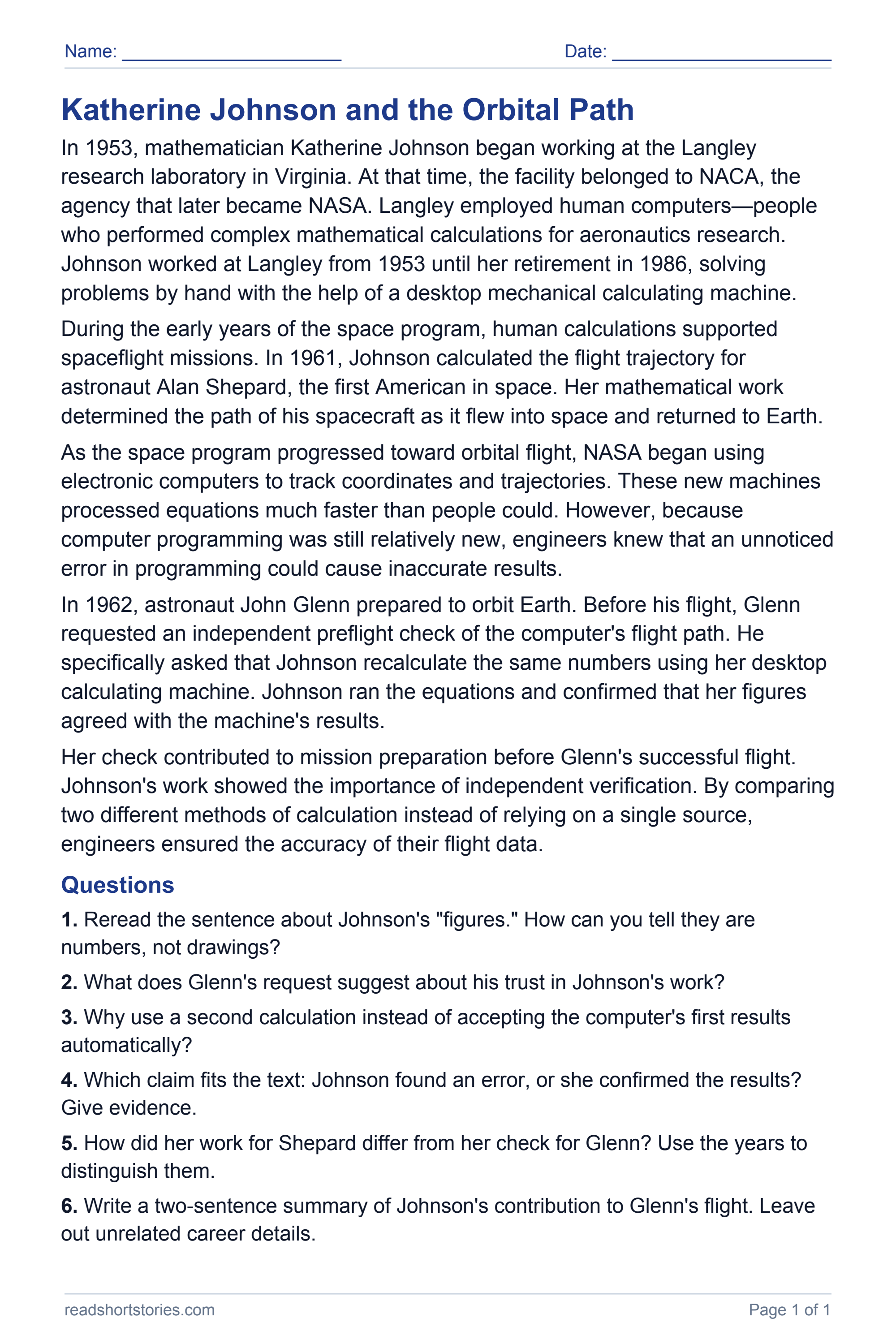
In 1953, mathematician Katherine Johnson began working at the Langley research laboratory in Virginia. At that time, the facility belonged to NACA, the agency that later became NASA. Langley employed human computers—people who performed complex mathematical calculations for aeronautics research. Johnson worked at Langley from 1953 until her retirement in 1986, solving problems by hand with the help of a desktop mechanical calculating machine.
During the early years of the space program, human calculations supported spaceflight missions. In 1961, Johnson calculated the flight trajectory for astronaut Alan Shepard, the first American in space. Her mathematical work determined the path of his spacecraft as it flew into space and returned to Earth.
As the space program progressed toward orbital flight, NASA began using electronic computers to track coordinates and trajectories. These new machines processed equations much faster than people could. However, because computer programming was still relatively new, engineers knew that an unnoticed error in programming could cause inaccurate results.
In 1962, astronaut John Glenn prepared to orbit Earth. Before his flight, Glenn requested an independent preflight check of the computer’s flight path. He specifically asked that Johnson recalculate the same numbers using her desktop calculating machine. Johnson ran the equations and confirmed that her figures agreed with the machine’s results.
Her check contributed to mission preparation before Glenn’s successful flight. Johnson’s work showed the importance of independent verification. By comparing two different methods of calculation instead of relying on a single source, engineers ensured the accuracy of their flight data.
Questions
- Reread the sentence about Johnson’s “figures.” How can you tell they are numbers, not drawings?
- What does Glenn’s request suggest about his trust in Johnson’s work?
- Why use a second calculation instead of accepting the computer’s first results automatically?
- Which claim fits the text: Johnson found an error, or she confirmed the results? Give evidence.
- How did her work for Shepard differ from her check for Glenn? Use the years to distinguish them.
- Write a two-sentence summary of Johnson’s contribution to Glenn’s flight. Leave out unrelated career details.
Click to see the answers
Answers
- The nearby words numbers and equations show that figures means numerical results. Johnson compares her calculated values with the electronic computer’s results. Evidence: He specifically asked that Johnson recalculate the same numbers using her desktop calculating machine. Johnson ran the equations and confirmed that her figures agreed with the machine’s results.
- Specifically asking for her check suggests that he values her mathematical skill. It does not mean he thinks every computer result is wrong. Evidence: He specifically asked that Johnson recalculate the same numbers using her desktop calculating machine.
- An unnoticed programming error could produce inaccurate results. A second calculation gives a way to compare results before accepting them. Evidence: However, because computer programming was still relatively new, engineers knew that an unnoticed error in programming could cause inaccurate results.
- She confirmed the results: her figures agreed with the computer’s results. The passage does not say that she found an error. Evidence: Johnson ran the equations and confirmed that her figures agreed with the machine’s results.
- In 1961, she calculated Shepard’s flight path. In 1962, she independently checked the computer’s numbers for Glenn’s flight. Evidence: In 1961, Johnson calculated the flight trajectory for astronaut Alan Shepard, the first American in space.
- For Glenn’s 1962 flight, Johnson recalculated the electronic computer’s numbers using her desktop calculating machine and confirmed they agreed. Her independent check contributed to mission preparation. Evidence: Her check contributed to mission preparation before Glenn’s successful flight. Johnson’s work showed the importance of independent verification.
Listen to this story (audio)
Willa Plans the Afternoon
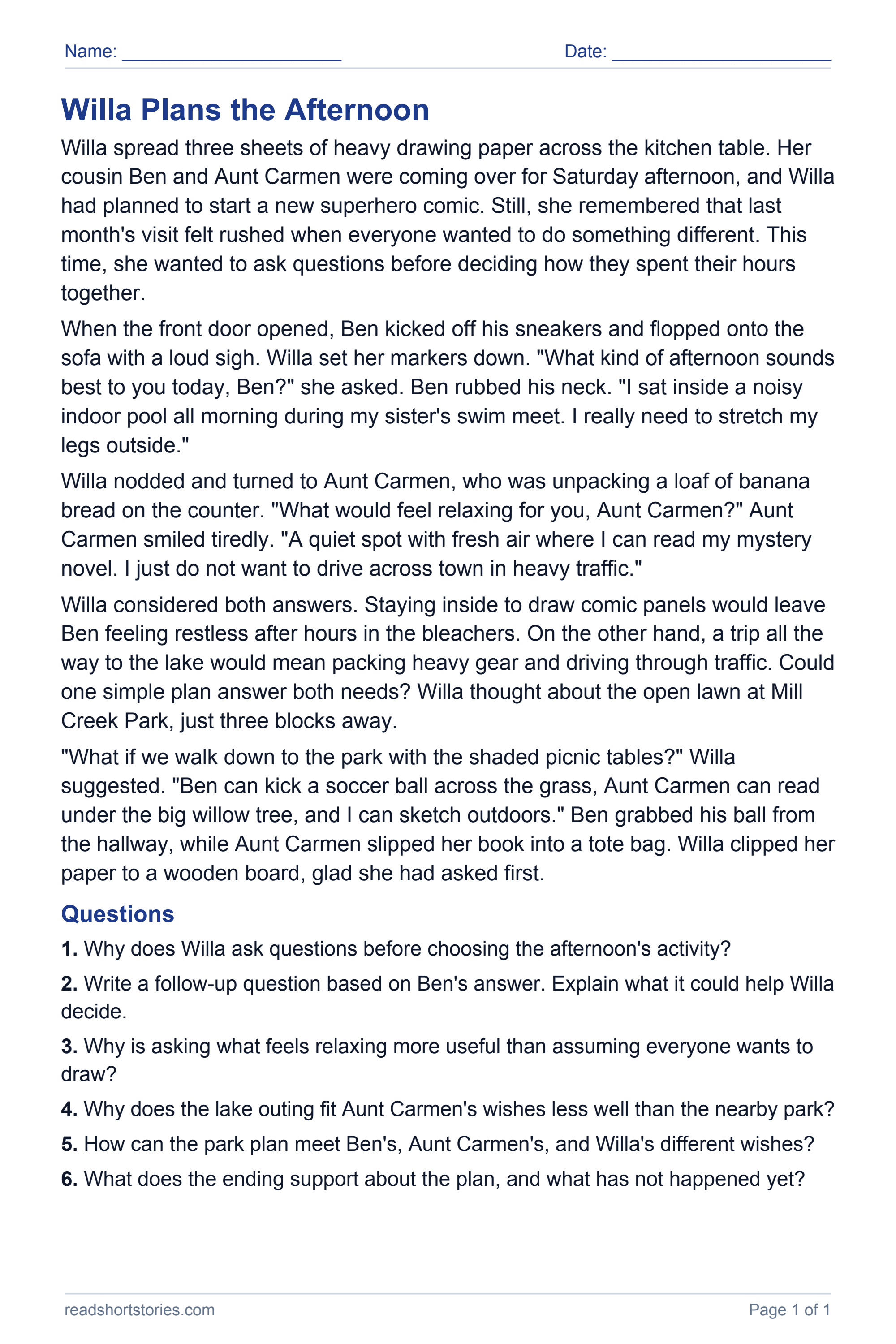
Willa spread three sheets of heavy drawing paper across the kitchen table. Her cousin Ben and Aunt Carmen were coming over for Saturday afternoon, and Willa had planned to start a new superhero comic. Still, she remembered that last month’s visit felt rushed when everyone wanted to do something different. This time, she wanted to ask questions before deciding how they spent their hours together.
When the front door opened, Ben kicked off his sneakers and flopped onto the sofa with a loud sigh. Willa set her markers down. “What kind of afternoon sounds best to you today, Ben?” she asked. Ben rubbed his neck. “I sat inside a noisy indoor pool all morning during my sister’s swim meet. I really need to stretch my legs outside.”
Willa nodded and turned to Aunt Carmen, who was unpacking a loaf of banana bread on the counter. “What would feel relaxing for you, Aunt Carmen?” Aunt Carmen smiled tiredly. “A quiet spot with fresh air where I can read my mystery novel. I just do not want to drive across town in heavy traffic.”
Willa considered both answers. Staying inside to draw comic panels would leave Ben feeling restless after hours in the bleachers. On the other hand, a trip all the way to the lake would mean packing heavy gear and driving through traffic. Could one simple plan answer both needs? Willa thought about the open lawn at Mill Creek Park, just three blocks away.
“What if we walk down to the park with the shaded picnic tables?” Willa suggested. “Ben can kick a soccer ball across the grass, Aunt Carmen can read under the big willow tree, and I can sketch outdoors.” Ben grabbed his ball from the hallway, while Aunt Carmen slipped her book into a tote bag. Willa clipped her paper to a wooden board, glad she had asked first.
Questions
- Why does Willa ask questions before choosing the afternoon’s activity?
- Write a follow-up question based on Ben’s answer. Explain what it could help Willa decide.
- Why is asking what feels relaxing more useful than assuming everyone wants to draw?
- Why does the lake outing fit Aunt Carmen’s wishes less well than the nearby park?
- How can the park plan meet Ben’s, Aunt Carmen’s, and Willa’s different wishes?
- What does the ending support about the plan, and what has not happened yet?
Click to see the answers
Answers
- The last visit felt rushed because people wanted different things. She wants to understand their preferences before deciding. Evidence: Still, she remembered that last month’s visit felt rushed when everyone wanted to do something different.
- She could ask, “What would you enjoy doing outside?” The answer could help her choose an activity that lets Ben move. Evidence: I really need to stretch my legs outside.
- The answer reveals Carmen’s wish for quiet, fresh air, and reading without another drive. Willa’s own drawing preference would not reveal those needs. Evidence: A quiet spot with fresh air where I can read my mystery novel. I just do not want to drive across town in heavy traffic.
- The lake trip would require packing and driving through traffic. The nearby park offers fresh air without that extra drive. Evidence: On the other hand, a trip all the way to the lake would mean packing heavy gear and driving through traffic.
- Ben can play soccer, Carmen can read in the shade, and Willa can draw. One nearby place gives each person a suitable activity. Evidence: Ben can kick a soccer ball across the grass, Aunt Carmen can read under the big willow tree, and I can sketch outdoors.
- Getting their materials suggests that they are ready to try the plan. The passage ends before their time at the park, so enjoyment remains a prediction. Evidence: Ben grabbed his ball from the hallway, while Aunt Carmen slipped her book into a tote bag. Willa clipped her paper to a wooden board, glad she had asked first.
Listen to this story (audio)
Download the Free Reading Strategies PDF Workbook
The workbook includes 5 focused reading passages: the 3 passages above and 2 bonus passages, with reading strategies questions, instructional notes, and a separate answer key.
Frequently Asked Questions
How long are the passages?
The web passages have 251-312 words each, focused on reading strategies skills.
Does the PDF include answers?
Yes. All 5 passages have questions, and the answer key is on separate pages.
How can we use these passages?
Review the modeled strategy example first, then apply the active reading strategy independently to answer the questions.