- Past Perfect Stories with Exercises and Answers (Free PDF)
- Past Perfect: A Quick Reminder
- Forming the Past Perfect
- Making the Order Clear
- Explaining a Past Result
- About the True Story
- Past Perfect Stories
- The Tool That Was Not Lost
- Questions
- Past Perfect Practice
- Reading Answers
- Practice Answers
- Fill in the Blanks
- True or False
- A Clear Circle: A True Discovery
- Questions
- Past Perfect Practice
- Reading Answers
- Practice Answers
- Fill in the Blanks
- True or False
- The Bones Beyond the Skull: A True Discovery
- Questions
- Past Perfect Practice
- Reading Answers
- Practice Answers
- Fill in the Blanks
- True or False
- Download the Free PDF
- Frequently Asked Questions
- What level are these stories for?
- What does the PDF include?
- When do we use the past perfect?
- More Short Stories and Reading Activities
Listen and read along: Audio versions are available for 3 stories on this page. Use the players below.
You can download the free past perfect stories PDF below.
Listen to the web stories and read along. The PDF also includes 3 bonus stories.
Past Perfect: A Quick Reminder
Forming the Past Perfect
Use had + past participle for every subject. Use had not (hadn’t) for negatives. For questions, put had before the subject: Had you finished before the bus arrived?
Making the Order Clear
The past perfect makes an earlier event clear against a later past event or reference point: When Soraya scanned the tool, the system had already marked it as lost. Before and after can also make the order clear, so the past simple is sometimes enough.
Explaining a Past Result
Use the past perfect to explain what had happened before a past situation: The actors were surprised because the youth group had left its scenery on the stage.
About the True Story
A Clear Circle is based on the American Chemical Society’s history of penicillin and Nobel Prize records: Source and Source . The Bones Beyond the Skull follows the Natural History Museum and Lyme Regis Museum: Source and Source . The Geological Society archive documents the early scientific comparison: Source .
Past Perfect Stories
The Tool That Was Not Lost
Kaelen and Soraya worked at the community tool library on Oak Street. Every Saturday, neighbors borrowed drills, saws, and gardening gear for weekend home projects. The library owned two identical laser levels, labeled Unit A and Unit B. Six months earlier, a neighborhood grant had funded both tools so people could hang shelves and build fences accurately.
At two o’clock, a member walked to the counter and returned a yellow laser level. When Soraya scanned the barcode, the screen flashed red. A bright alert stated that the tool was lost. Soraya frowned at the screen. The borrower had only checked it out the previous morning, and he held a valid paper receipt.
“Why did the system mark this tool lost?” Soraya asked. “Had someone made an error during the weekly audit?”
Kaelen walked over and inspected the yellow plastic case. The small metal label on the side read Unit B. “Wait,” Kaelen said. “Unit B is right here in our hands. But two weeks ago, Unit A vanished from the display rack. We hadn’t seen Unit A since the big woodworking workshop.”
Because nobody could locate Unit A back then, the director had marked the laser level as missing in the main system. However, the software had attached the penalty flag to Unit B by mistake. Even worse, the digital catalog had not received any maintenance updates for two weeks.
“Let’s check the paper logbook,” Soraya suggested. She pulled a thick binder from beneath the counter. Several volunteers preferred writing notes by hand before they entered changes online.
Soraya turned back to the entries from two Tuesdays earlier. A short pencil note caught her eye. A volunteer had handled the tools before closing time. The volunteer had noticed a loose power switch on Unit A, so that volunteer had placed it on the top repair shelf. Unfortunately, the volunteer had not updated the computer because the library’s internet connection had failed right before five o’clock.
Kaelen walked into the back workshop and inspected the metal shelving. Behind two heavy wood sanders, he spotted a second yellow case. He opened the latch and checked the barcode. It was Unit A, exactly where the volunteer had left it. The tool had not disappeared into the city after all.
Kaelen carried the case to the front desk with a smile. “Had anyone actually searched behind the sanders last week?”
“We had checked the floor and the front cabinets,” Soraya admitted, “but we hadn’t climbed up to inspect the upper workshop.” Relieved, she cleared the warning from the member’s account and typed the correct repair ticket into the database. Both levels were safe, and the inventory was accurate once more.
Questions
- Which specific tool did the member return to the counter?
- Why did the computer screen show that the returned tool was lost?
- Why hadn’t the volunteer updated the computer about moving Unit A?
- Why hadn’t staff members discovered Unit A during their earlier search?
Past Perfect Practice
- Complete the sentence with the affirmative two-word past perfect form of ‘fund’: Six months before the mix-up, a grant __________ both laser levels for the community library.
- Why was the penalty alert on the screen incorrect? The borrower __________ the tool only the previous morning.
- had checked out
- has checked out
- was checking out
- Put these words in order to form a past perfect sentence:
- connection
- failed
- had
- internet
- the
- Complete the sentence with the negative three-word past perfect form (had not + past participle) of ‘receive’: The digital catalog __________ any maintenance updates for two weeks.
- Soraya found a pencil note showing that a volunteer __________ Unit A on the top repair shelf.
- had placed
- has placed
- was placing
Click to see the answers
Reading Answers
- The member returned Unit B. Evidence: The small metal label on the side read Unit B.
- The computer showed an alert because the software had mistakenly linked the penalty flag to Unit B instead of Unit A. Evidence: However, the software had attached the penalty flag to Unit B by mistake.
- The volunteer could not update the database because the library lost its internet connection right before five o’clock. Evidence: Unfortunately, the volunteer had not updated the computer because the library’s internet connection had failed right before five o’clock.
- Staff members had only checked the floor and front cabinets and had not climbed up to inspect the upper workshop. Evidence: “We had checked the floor and the front cabinets,” Soraya admitted, “but we hadn’t climbed up to inspect the upper workshop.”
Practice Answers
- had funded
- had checked out
- The internet connection had failed.
- had not received
- had placed
Your turn: Write 2–3 sentences about a time you thought you lost an item, but discovered someone had moved it earlier. Use the past perfect (had / had not + past participle).
Listen to this story (audio)
Click to see the short worksheet text and answers
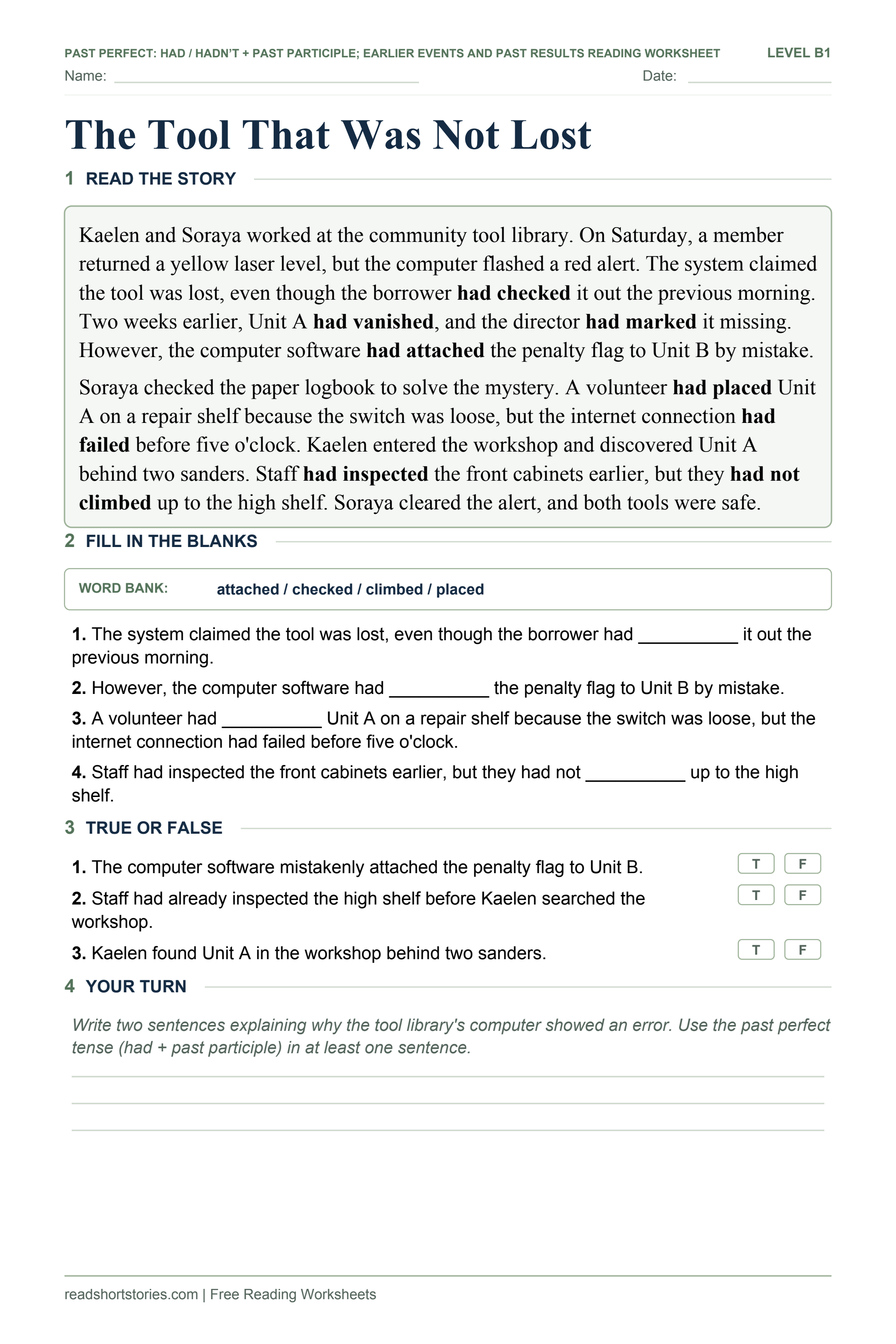
Kaelen and Soraya worked at the community tool library. On Saturday, a member returned a yellow laser level, but the computer flashed a red alert. The system claimed the tool was lost, even though the borrower had checked it out the previous morning. Two weeks earlier, Unit A had vanished, and the director had marked it missing. However, the computer software had attached the penalty flag to Unit B by mistake.
Soraya checked the paper logbook to solve the mystery. A volunteer had placed Unit A on a repair shelf because the switch was loose, but the internet connection had failed before five o’clock. Kaelen entered the workshop and discovered Unit A behind two sanders. Staff had inspected the front cabinets earlier, but they had not climbed up to the high shelf. Soraya cleared the alert, and both tools were safe.
Fill in the Blanks
Words: checked, attached, placed, climbed
- The system claimed the tool was lost, even though the borrower had __________ it out the previous morning. Answer: checked
- However, the computer software had __________ the penalty flag to Unit B by mistake. Answer: attached
- A volunteer had __________ Unit A on a repair shelf because the switch was loose, but the internet connection had failed before five o’clock. Answer: placed
- Staff had inspected the front cabinets earlier, but they had not __________ up to the high shelf. Answer: climbed
True or False
- The computer software mistakenly attached the penalty flag to Unit B. True. Evidence: However, the computer software had attached the penalty flag to Unit B by mistake.
- Staff had already inspected the high shelf before Kaelen searched the workshop. False. Staff had not climbed up to inspect the high shelf. Evidence: Staff had inspected the front cabinets earlier, but they had not climbed up to the high shelf.
- Kaelen found Unit A in the workshop behind two sanders. True. Evidence: Kaelen entered the workshop and discovered Unit A behind two sanders.
Write two sentences explaining why the tool library’s computer showed an error. Use the past perfect tense (had + past participle) in at least one sentence.
Sample answer: The computer showed an error because the software had attached a penalty flag to Unit B by mistake. The director had marked Unit A missing two weeks earlier, but the system confused the two laser levels.
A Clear Circle: A True Discovery
In September 1928, Dr. Alexander Fleming returned to his laboratory at St. Mary’s Hospital in London. Before his vacation, he had prepared several glass plates with staphylococcus bacteria. These bacteria were harmful germs that had caused severe wound infections in hospital patients. Fleming had studied these microbes for years, searching for treatments that would not harm human tissue. When he arrived at work, he inspected what had grown on the plates during his absence.
While examining the dishes, Fleming noticed something unexpected on one plate. A stray mold spore had landed on the surface by accident and had started to grow. In ordinary laboratory routines, researchers discarded plates whenever foreign mold had contaminated an experiment. Fleming, however, had not thrown this contaminated plate away. Instead, he examined the unusual pattern that had developed on the glass.
Across most of the dish, the bacteria had grown into thick, cloudy colonies. Around the patch of mold, however, a clear, empty circle had formed. In that ring, the bacteria had stopped growing and had dissolved. Fleming realized that a substance from the mold had destroyed the nearby bacteria.
Fleming cultivated the mold in liquid broth to test its properties. In further tests, he collected the fluid that the mold had produced. When he applied this fluid to different bacteria, it prevented many harmful types from multiplying. In 1929, Fleming published a scientific paper about his findings. He named the substance penicillin, after the mold that had produced it.
This observation did not lead to an immediate medical treatment. Fleming had not found a way to purify penicillin or produce it in large quantities. Producing a widely available medicine required further research. In the late 1930s, an Oxford University team led by Howard Florey and Ernst Chain resumed the research. They successfully purified penicillin and proved its value in clinical trials. In 1945, Fleming, Florey, and Chain shared the Nobel Prize in Medicine for the breakthrough that had changed healthcare forever.
Questions
- Why did Dr. Fleming decide to examine the contaminated plate rather than discard it?
- What caused the clear, empty circle to form around the patch of mold?
- Why was Fleming unable to turn penicillin into an immediate medical treatment right after his discovery?
- How does the story show that Fleming’s previous research helped him recognize the importance of the mold?
Past Perfect Practice
- Choose the past perfect form to mark the earlier action: Fleming noticed a clear ring on the plate because the mold __________ the surrounding bacteria before his inspection.
- had destroyed
- destroyed
- has destroyed
- destroys
- Complete with the affirmative two-word past perfect form of ‘prepare’ (had + past participle): Dr. Fleming examined the culture plates that he __________ earlier.
- Put these words in order to form a past perfect sentence:
- contaminated
- had
- mold
- plate
- stray
- the
- Choose the correct negative past perfect form: Fleming could not treat patients right away because he __________ a way to purify the substance.
- had not found
- did not find
- has not found
- was not finding
- Complete with the negative three-word past perfect form of ‘throw’ (had not + past participle): Fleming __________ the dish away before he investigated the unusual pattern.
Click to see the answers
Reading Answers
- He examined the dish because he noticed an unusual pattern on it. Evidence: Fleming, however, had not thrown this contaminated plate away. Instead, he examined the unusual pattern that had developed on the glass.
- A substance produced by the mold had destroyed the nearby bacteria. Evidence: Fleming realized that a substance from the mold had destroyed the nearby bacteria.
- He could not make an immediate medicine because he had not found an effective method to purify the penicillin or manufacture it in large quantities. Evidence: Fleming had not found a way to purify penicillin or produce it in large quantities.
- Fleming had studied harmful microbes for years and was searching for treatments that would not harm human tissue. This background helps explain why he investigated the mold’s effect on bacteria. Evidence: Fleming had studied these microbes for years, searching for treatments that would not harm human tissue.
Practice Answers
- had destroyed
- had prepared
- Stray mold had contaminated the plate.
- had not found
- had not thrown
Your turn: Write 3–4 sentences describing an accidental discovery or mistake in history or everyday life. Use the Past Perfect (had / hadn’t + past participle) at least twice to explain actions that occurred before the discovery.
Listen to this story (audio)
Click to see the short worksheet text and answers
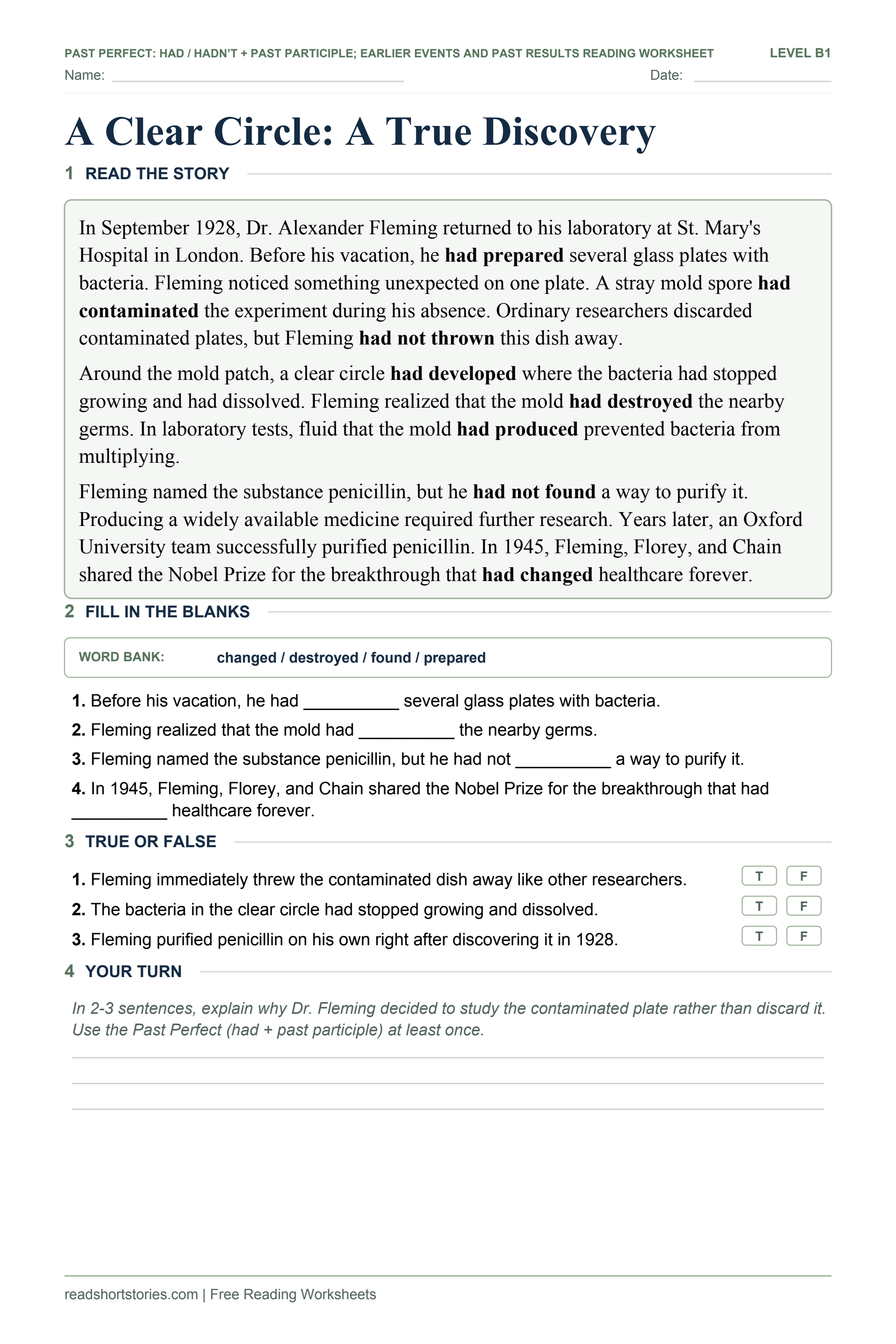
In September 1928, Dr. Alexander Fleming returned to his laboratory at St. Mary’s Hospital in London. Before his vacation, he had prepared several glass plates with bacteria. Fleming noticed something unexpected on one plate. A stray mold spore had contaminated the experiment during his absence. Ordinary researchers discarded contaminated plates, but Fleming had not thrown this dish away.
Around the mold patch, a clear circle had developed where the bacteria had stopped growing and had dissolved. Fleming realized that the mold had destroyed the nearby germs. In laboratory tests, fluid that the mold had produced prevented bacteria from multiplying.
Fleming named the substance penicillin, but he had not found a way to purify it. Producing a widely available medicine required further research. Years later, an Oxford University team successfully purified penicillin. In 1945, Fleming, Florey, and Chain shared the Nobel Prize for the breakthrough that had changed healthcare forever.
Fill in the Blanks
Words: prepared, destroyed, found, changed
- Before his vacation, he had __________ several glass plates with bacteria. Answer: prepared
- Fleming realized that the mold had __________ the nearby germs. Answer: destroyed
- Fleming named the substance penicillin, but he had not __________ a way to purify it. Answer: found
- In 1945, Fleming, Florey, and Chain shared the Nobel Prize for the breakthrough that had __________ healthcare forever. Answer: changed
True or False
- Fleming immediately threw the contaminated dish away like other researchers. False. Fleming had not thrown the contaminated dish away. Evidence: Ordinary researchers discarded contaminated plates, but Fleming had not thrown this dish away.
- The bacteria in the clear circle had stopped growing and dissolved. True. Evidence: Around the mold patch, a clear circle had developed where the bacteria had stopped growing and had dissolved.
- Fleming purified penicillin on his own right after discovering it in 1928. False. Fleming had not found a way to purify penicillin, which was later accomplished by an Oxford University team. Evidence: Fleming named the substance penicillin, but he had not found a way to purify it.
In 2–3 sentences, explain why Dr. Fleming decided to study the contaminated plate rather than discard it. Use the Past Perfect (had + past participle) at least once.
Sample answer: Fleming noticed an unusual circle that had developed around the mold. Nearby bacteria had stopped growing, so he investigated the dish instead of discarding it.
The Bones Beyond the Skull: A True Discovery
In the coastal town of Lyme Regis, England, Mary Anning spent her youth collecting curiosities along the cliffs. Years earlier, her father had taught Mary and her brother Joseph how to search for fossils and clean them carefully. A fossil is the preserved remains or trace of an ancient plant or animal in rock. The family had sold fossil shells in their workshop for years.
In the early 1810s, Joseph made an unexpected discovery. He had noticed an unusual fossil skull in the rock face. When he collected the head, he realized that the body was missing. Joseph had found the skull, but nobody had located the other bones.
Mary searched the coastal cliffs where her brother had spotted the skull. By roughly 1812, she had uncovered the rest of the five-meter skeleton. The skull that Joseph had discovered earlier had become part of a much larger find. The large fossil offered scholars an extraordinary opportunity for scientific study.
The discovery presented an exciting mystery for scientists. At first, scholars thought the animal was a strange crocodile. They compared the skeleton to modern reptiles and fish, trying to understand how it had lived. Scientists soon realized that the creature had belonged to an extinct group. They eventually named the marine reptile an ichthyosaur.
In later years, scholars published scientific descriptions of the fossil. Museums in London later displayed the skeleton for the public. The creature was not a dinosaur, but it provided clear physical evidence of ancient life. By uncovering the bones that had remained hidden in the rock, Mary helped scientists understand that prehistoric animals had vanished from the earth.
Questions
- Why did Mary decide to search the coastal cliffs after Joseph’s discovery?
- What resulted from Mary uncovering the rest of the five-meter skeleton?
- Why did scientists compare the fossil skeleton to modern fish and reptiles?
- What broader idea about ancient life did Mary’s discovery help scientists understand?
Past Perfect Practice
- Complete with the two-word past perfect form of ‘teach’: Years earlier, her father __________ (teach) Mary and Joseph how to search for fossils.
- Which sentence correctly uses the past perfect to explain the situation before Mary searched the cliffs?
- Joseph had found the skull, but nobody had located the other bones.
- Joseph has found the skull, but nobody locates the other bones.
- Joseph had find the skull, but nobody had located the other bones.
- Joseph was finding the skull while nobody has located the other bones.
- Put these words in order to form a past perfect sentence:
- located
- bones
- had
- nobody
- other
- the
- Complete with the negative three-word past perfect form of ‘uncover’ (no contractions): When Joseph found the skull, Mary __________ the rest of the skeleton yet.
- Select the correct past perfect question asking about an action that happened before Mary explored the cliffs:
- Had Joseph noticed the unusual skull before Mary explored the cliffs?
- Did Joseph had noticed the unusual skull before Mary explored the cliffs?
- Had Joseph notice the unusual skull before Mary explored the cliffs?
- Was Joseph noticed the unusual skull before Mary explored the cliffs?
Click to see the answers
Reading Answers
- Mary searched for the missing body after Joseph had found only the skull. Evidence: When he collected the head, he realized that the body was missing.
- The skull became part of a much larger find, giving scholars a large fossil to study. Evidence: The skull that Joseph had discovered earlier had become part of a much larger find. The large fossil offered scholars an extraordinary opportunity for scientific study.
- Scholars made the comparison to help them understand how the unfamiliar creature had lived before they realized it was extinct. Evidence: They compared the skeleton to modern reptiles and fish, trying to understand how it had lived.
- The bones helped scientists understand that prehistoric animals had vanished from the earth. Evidence: By uncovering the bones that had remained hidden in the rock, Mary helped scientists understand that prehistoric animals had vanished from the earth.
Practice Answers
- had taught
- Joseph had found the skull, but nobody had located the other bones.
- Nobody had located the other bones.
- had not uncovered
- Had Joseph noticed the unusual skull before Mary explored the cliffs?
Your turn: Write 3–4 sentences describing an important scientific or historical discovery. Use at least two past perfect verbs (had + past participle) to show what had occurred before the discovery happened.
Listen to this story (audio)
Click to see the short worksheet text and answers
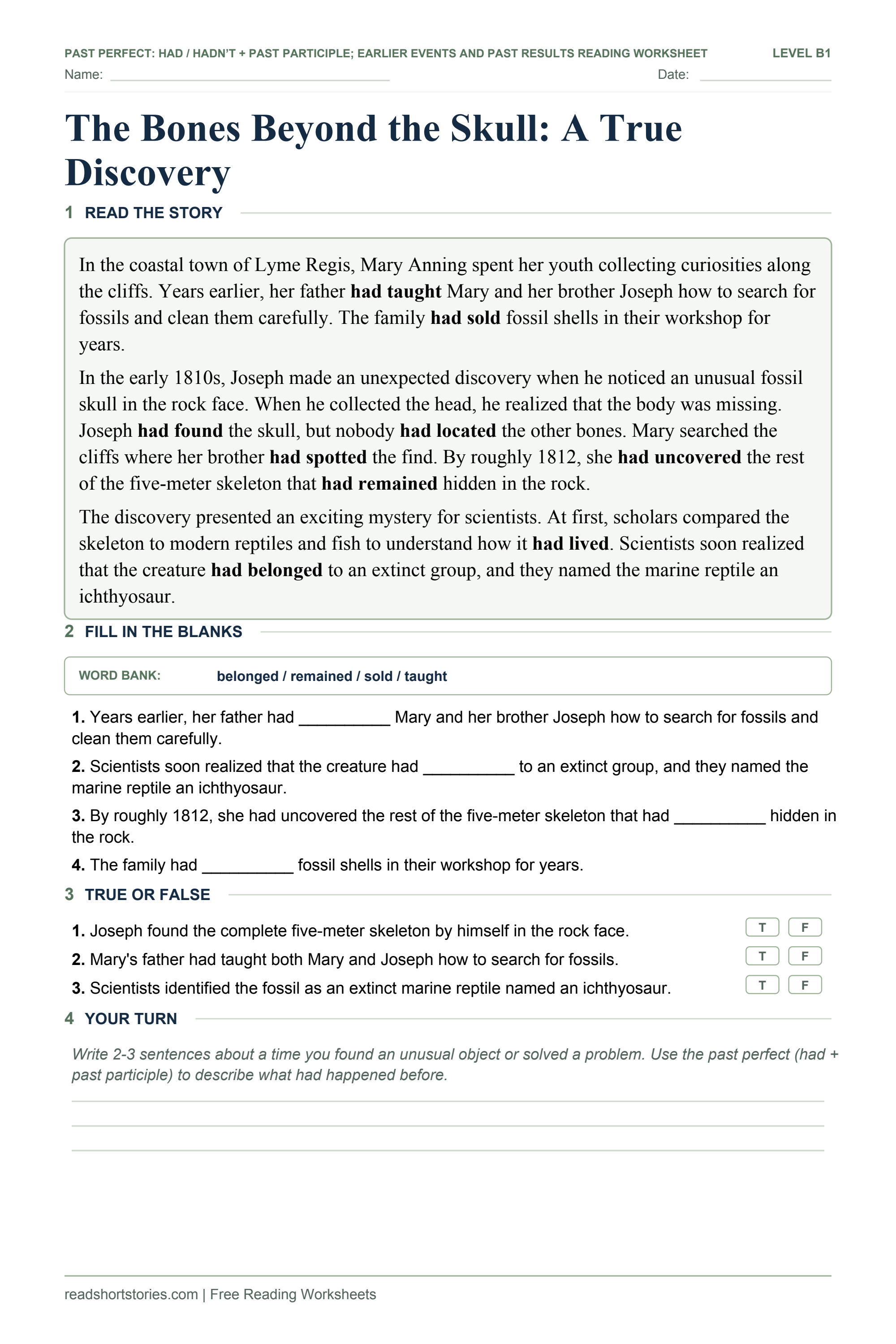
In the coastal town of Lyme Regis, Mary Anning spent her youth collecting curiosities along the cliffs. Years earlier, her father had taught Mary and her brother Joseph how to search for fossils and clean them carefully. The family had sold fossil shells in their workshop for years.
In the early 1810s, Joseph made an unexpected discovery when he noticed an unusual fossil skull in the rock face. When he collected the head, he realized that the body was missing. Joseph had found the skull, but nobody had located the other bones. Mary searched the cliffs where her brother had spotted the find. By roughly 1812, she had uncovered the rest of the five-meter skeleton that had remained hidden in the rock.
The discovery presented an exciting mystery for scientists. At first, scholars compared the skeleton to modern reptiles and fish to understand how it had lived. Scientists soon realized that the creature had belonged to an extinct group, and they named the marine reptile an ichthyosaur.
Fill in the Blanks
Words: taught, belonged, remained, sold
- Years earlier, her father had __________ Mary and her brother Joseph how to search for fossils and clean them carefully. Answer: taught
- Scientists soon realized that the creature had __________ to an extinct group, and they named the marine reptile an ichthyosaur. Answer: belonged
- By roughly 1812, she had uncovered the rest of the five-meter skeleton that had __________ hidden in the rock. Answer: remained
- The family had __________ fossil shells in their workshop for years. Answer: sold
True or False
- Joseph found the complete five-meter skeleton by himself in the rock face. False. Joseph found only the skull, while Mary later uncovered the rest of the skeleton. Evidence: Joseph had found the skull, but nobody had located the other bones.
- Mary’s father had taught both Mary and Joseph how to search for fossils. True. Evidence: Years earlier, her father had taught Mary and her brother Joseph how to search for fossils and clean them carefully.
- Scientists identified the fossil as an extinct marine reptile named an ichthyosaur. True. Evidence: Scientists soon realized that the creature had belonged to an extinct group, and they named the marine reptile an ichthyosaur.
Write 2–3 sentences about a time you found an unusual object or solved a problem. Use the past perfect (had + past participle) to describe what had happened before.
Sample answer: Yesterday, I found an old photograph inside a secondhand book. Someone had placed it between the pages before I bought the book. I had not noticed it when I first opened the cover.
Download the Free PDF
Print all 6 stories and their activities. The answer key follows the student pages.
Frequently Asked Questions
What level are these stories for?
These stories are written for B1 English learners. Read with support when needed.
What does the PDF include?
6 stories, reading questions, past perfect exercises, writing tasks, and a separate answer key.
When do we use the past perfect?
Use had plus a past participle for an event before another past event or reference point. Use had not (hadn’t) for the negative and Had + subject + past participle for questions. The past simple usually gives the later event or reference point.