- Future Continuous Stories with Exercises and Answers (Free PDF)
- Future Continuous: A Quick Reminder
- Form and Questions
- Actions in Progress and Simultaneous Activities
- Future Time Clauses
- About the True Story
- Future Continuous Stories
- The Sound after Sunset
- Questions
- Future Continuous Practice
- Reading Answers
- Practice Answers
- Fill in the Blanks
- True or False
- A Shadow across Tomorrow
- Questions
- Future Continuous Practice
- Reading Answers
- Practice Answers
- Fill in the Blanks
- True or False
- The Bakery Window
- Questions
- Future Continuous Practice
- Reading Answers
- Practice Answers
- Fill in the Blanks
- True or False
- Download the Free PDF
- Frequently Asked Questions
- What level are these stories for?
- What does the PDF include?
- When do we use the future continuous?
- More Short Stories and Reading Activities
Listen and read along: Audio versions are available for 3 stories on this page. Use the players below.
You can download the free future continuous stories PDF below.
Listen to the web stories and read along. The PDF also includes 3 bonus stories.

Future Continuous: A Quick Reminder
Form and Questions
Use will be + an -ing verb: At seven thirty tomorrow, Yara will be recording waterfront sounds. Use will not be (won’t be) + -ing for negatives. For questions, put will before the subject: Will Ari be taking photographs at six thirty?
Actions in Progress and Simultaneous Activities
Use the future continuous for an action in progress at a future time: At ten tomorrow, the students will be drawing. It also connects simultaneous future activities: Rina will be packing bread while Ari is taking photographs. The future simple often expresses decisions, promises, or predictions; context determines the choice.
Future Time Clauses
Use the present simple or present continuous in ordinary future time clauses with when or while, rather than will: When the customers arrive, Rina will be serving them. While the artists are packing, the helpers will be clearing the room.
About the True Story
A Shadow across Tomorrow is a factual account of a predicted natural event, written before August 2, 2027. Eclipse visibility depends on location and weather. Sources: National Solar Observatory National Solar Observatory ; NASA future eclipses NASA: eclipse information ; NASA eclipse viewing guidance NASA: eclipse information .
Future Continuous Stories
The Sound after Sunset
Yara adjusted her headphones and clicked play on her portable sound recorder. Across the wooden table in the community harbor office, Mr. Ramos examined a map of the waterfront trail. Next month, the town heritage society will be launching a self-guided evening walk for visitors. Walkers will be downloading the audio clips onto their phones and following the boardwalk path after dusk. Yara had agreed to collect the background sounds for every stop along the shoreline.
“Listen to Stop Three,” Yara said, handing him one of the earphones. “I recorded this by the docks.” Through the small speaker, a diesel engine rumbled, followed by a heavy metal door slamming and a delivery truck beeping in reverse.
Mr. Ramos took off the earphone and smiled gently. “That definitely sounds like ten o’clock on a Tuesday morning. But what will visitors be doing when they reach that sign?”
“At eight o’clock in the evening, they will be standing near the old lighthouse,” Yara admitted, tapping her notebook. “They will be listening for water against the wooden pilings. On this track, noisy delivery vans will be drowning out the river. The timing is completely wrong.”
“You noticed the key problem,” Mr. Ramos said. “When our guests arrive with their headphones, they will be taking a quiet evening walk. While they stroll along the boardwalk, will they be listening to gentle waves, or will they be trying to ignore traffic?”
“They will be trying to ignore the trucks,” Yara agreed with a small laugh. “To match the real walk, we must record at the exact hour people will visit. Tomorrow at seven thirty, the sun will be setting behind the bay. The delivery drivers will be parking their vans for the night.”
Mr. Ramos checked the municipal harbor schedule on his tablet. “The harbor master gave us permission to record after dusk, as long as two team members work together. Will you be finishing your school assignments before seven tomorrow, or will we be meeting on Wednesday instead?”
“Tomorrow works better,” Yara answered firmly. “At seven thirty tomorrow, I will be waiting by the pier entrance with the microphone and a wind screen. Will the gate attendant be locking the entrance before nine?”
“No, he will not be locking the gate until nine thirty,” Mr. Ramos replied. “A security guard will be patrolling the walkway all evening. We will have plenty of quiet time to finish.”
Yara placed the microphone neatly into her canvas backpack. She felt relieved that they had caught the mismatch before editing the final tracks. Tomorrow at twilight, the cool evening breeze will be blowing across the pier. The distant harbor bell will be ringing across the bay. Yara will be standing on the dock, recording the true calm of the waterfront.
Questions
- Why did Yara and Mr. Ramos decide that the Stop Three recording could not be used for the walking tour?
- What condition did the harbor master require before allowing the team to record after dusk?
- Why is the gate’s closing time relevant to Yara’s evening recording plan?
- What does Yara’s decision to return at twilight suggest about what she wants listeners to experience?
Future Continuous Practice
- Next month, at eight o’clock in the evening, visitors __________ along the harbor trail with their headphones.
- will be walking
- were walking
- walked
- are walk
- Complete the future continuous form: At seven thirty tomorrow, the cool wind __________ (blow) across the pier.
- Put the words in order to form a future continuous statement: listening / will / to / they / waves / be
- listening
- will
- to
- they
- waves
- be
- Select the polite question asking about plans in progress tomorrow: “__________ your homework before seven o’clock?”
- Will you be finishing
- Did you finish
- Do you finish
- Have you finished
- Complete the negative future continuous sentence: The gate attendant __________ (not / lock) the harbor entrance until nine thirty.
Click to see the answers
Reading Answers
- Its delivery noise did not match the quiet evening waterfront walk. Evidence: They will be listening for water against the wooden pilings. On this track, noisy delivery vans will be drowning out the river.
- The harbor master gave permission under the condition that two team members work together. Evidence: The harbor master gave us permission to record after dusk, as long as two team members work together.
- They need enough time to record before the gate is locked. Evidence: No, he will not be locking the gate until nine thirty,
- She wants the sounds to match the visitors’ actual evening walk. Evidence: To match the real walk, we must record at the exact hour people will visit.
Practice Answers
- will be walking
- will be blowing
- They will be listening to waves.
- Will you be finishing
- will not be locking
Your turn: Describe what you will be doing tomorrow at eight o’clock in the evening. Write three sentences using the future continuous tense.
Listen to this story (audio)
Click to see the short worksheet text and answers
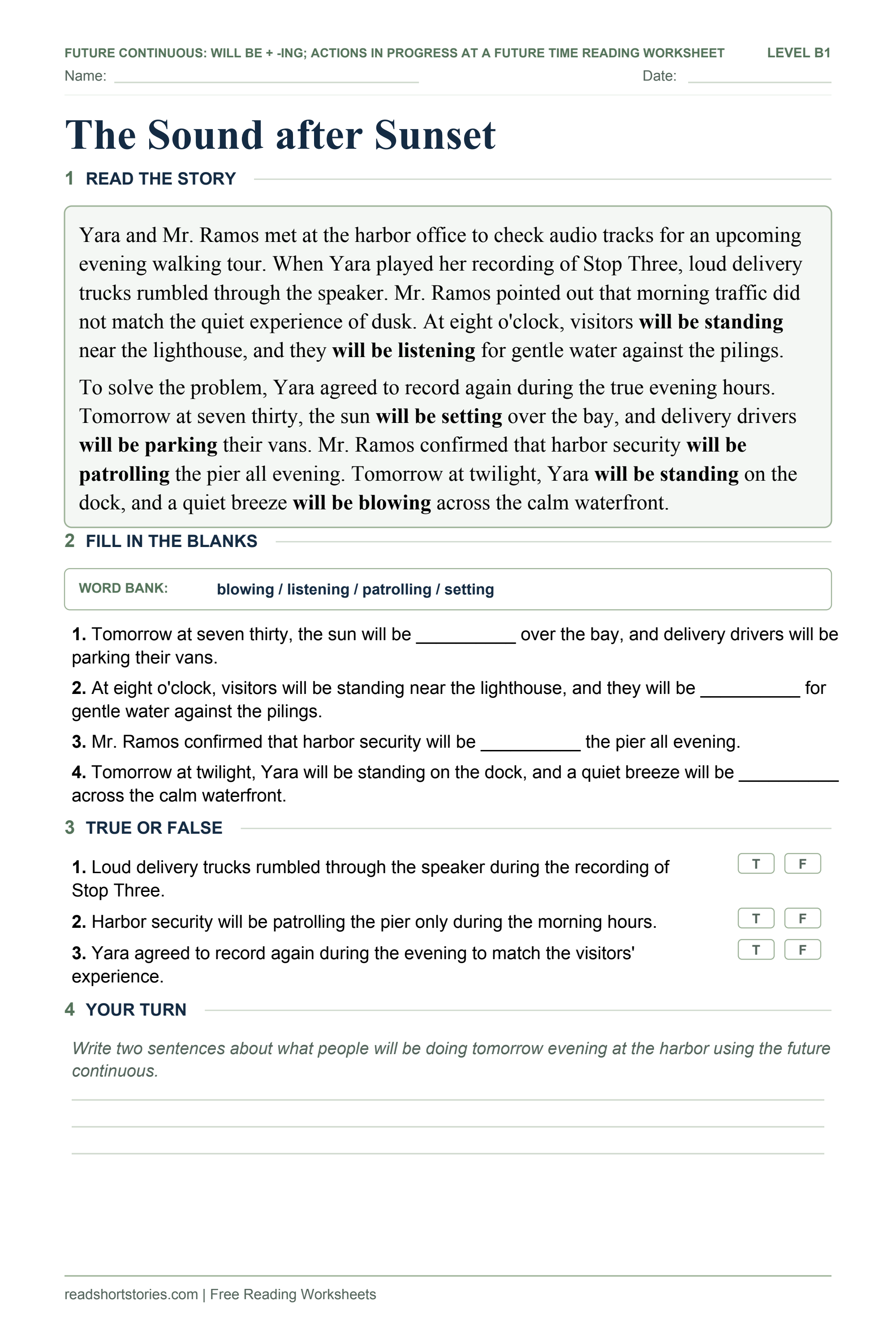
Yara and Mr. Ramos met at the harbor office to check audio tracks for an upcoming evening walking tour. When Yara played her recording of Stop Three, loud delivery trucks rumbled through the speaker. Mr. Ramos pointed out that morning traffic did not match the quiet experience of dusk. At eight o’clock, visitors will be standing near the lighthouse, and they will be listening for gentle water against the pilings.
To solve the problem, Yara agreed to record again during the true evening hours. Tomorrow at seven thirty, the sun will be setting over the bay, and delivery drivers will be parking their vans. Mr. Ramos confirmed that harbor security will be patrolling the pier all evening. Tomorrow at twilight, Yara will be standing on the dock, and a quiet breeze will be blowing across the calm waterfront.
Fill in the Blanks
Words: setting, listening, patrolling, blowing
- Tomorrow at seven thirty, the sun will be __________ over the bay, and delivery drivers will be parking their vans. Answer: setting
- At eight o’clock, visitors will be standing near the lighthouse, and they will be __________ for gentle water against the pilings. Answer: listening
- Mr. Ramos confirmed that harbor security will be __________ the pier all evening. Answer: patrolling
- Tomorrow at twilight, Yara will be standing on the dock, and a quiet breeze will be __________ across the calm waterfront. Answer: blowing
True or False
- Loud delivery trucks rumbled through the speaker during the recording of Stop Three. True. Evidence: When Yara played her recording of Stop Three, loud delivery trucks rumbled through the speaker.
- Harbor security will be patrolling the pier only during the morning hours. False. Harbor security will be patrolling the pier all evening, not only during the morning. Evidence: Mr. Ramos confirmed that harbor security will be patrolling the pier all evening.
- Yara agreed to record again during the evening to match the visitors’ experience. True. Evidence: To solve the problem, Yara agreed to record again during the true evening hours.
Write two sentences about what people will be doing tomorrow evening at the harbor using the future continuous.
Sample answer: Tomorrow evening, Yara will be standing on the dock with her recorder. The security guard will be patrolling the walkway.
A Shadow across Tomorrow
On the morning of August 2, 2027, a remarkable astronomical event will take place across parts of our planet. At that time, the Moon will be passing directly between Earth and the Sun, casting a large moving shadow. The path of totality will trace a narrow corridor across southern Spain, northern Africa, and the Middle East. Across this designated track, the Moon’s shadow will be traveling eastward at high speed over land and sea.
As the event begins, the Moon will slowly move across the Sun’s bright face. During these partial stages, the Moon will be covering more and more of the solar surface. Official safety guidelines state that observers must protect their eyes throughout every partial phase. Anyone looking at the partial eclipse will need approved solar viewing glasses, because ordinary sunglasses are never safe. In addition, viewers must not use cameras, binoculars, or telescopes without specialized solar filters. While partial stages continue, responsible observers will be following official safety guidance at all times.
By midday, the Moon’s dark central shadow will be sweeping rapidly across the landscape. Along the center of the path, daylight will be fading into deep twilight as totality arrives. Near the center line of the corridor, totality can last several minutes, though its duration decreases toward the outer edges. Near Luxor, Egypt, where the eclipse lasts longest, the Moon will be hiding the Sun for approximately six minutes and twenty-two seconds. Official sources note that exact times can vary slightly depending on precise local calculations.
While totality lasts, skywatchers under clear skies will be observing the Sun’s outer atmosphere, called the corona. This glowing halo of soft white light normally remains invisible because the Sun’s direct surface shines too brightly. Outside the narrow central corridor, observers will not be experiencing total darkness. Instead, people across wider areas of Africa, Europe, and western Asia will be seeing only a partial eclipse as the Moon covers part of the Sun.
Throughout the afternoon, the shadow will continue its eastward journey across the Middle East. As the Moon moves steadily along its orbit, sunlight will be returning to the landscape behind the path of totality. By late afternoon, the Moon will no longer be blocking the Sun, and normal daylight will be returning across the entire route. This predictable event will offer an inspiring demonstration of orbital motion and how celestial bodies interact in our solar system.
Questions
- Where will the total eclipse last the longest on August 2, 2027?
- Why must viewers wear approved solar glasses rather than regular sunglasses during partial phases?
- What causes the solar corona to become visible to observers during totality?
- Why can two people watching from different places have different eclipse experiences?
Future Continuous Practice
- At midday on August 2, 2027, the Moon’s shadow __________ (travel) eastward at high speed.
- Choose the correct future continuous form: ‘While the partial phases continue, responsible observers __________ official safety guidance.’
- will be following
- will have followed
- are followed
- will be follow
- It refers to the Moon. Put all six words in order: Sun / hiding / It / be / the / will
- Sun
- hiding
- It
- be
- the
- will
- Choose the negative future continuous form: ‘Outside the narrow path, people __________ total darkness.’
- will not be experiencing
- will be not experiencing
- are not experienced
- will not experiencing
- Complete with the future continuous: ‘By late afternoon, daylight __________ (return) across the region as the Moon departs.’
Click to see the answers
Reading Answers
- The eclipse will last longest near Luxor, Egypt, where totality lasts about six minutes and twenty-two seconds. Evidence: Near Luxor, Egypt, where the eclipse lasts longest, the Moon will be hiding the Sun for approximately six minutes and twenty-two seconds.
- Ordinary sunglasses do not provide safe protection against the Sun’s intense light during partial stages. Evidence: Anyone looking at the partial eclipse will need approved solar viewing glasses, because ordinary sunglasses are never safe.
- The corona becomes visible because the Moon completely covers the Sun’s bright surface, which normally hides this soft outer light. Evidence: While totality lasts, skywatchers under clear skies will be observing the Sun’s outer atmosphere, called the corona. This glowing halo of soft white light normally remains invisible because the Sun’s direct surface shines too brightly.
- A person in the narrow central path may see totality, while someone outside it sees only a partial eclipse. Evidence: Outside the narrow central corridor, observers will not be experiencing total darkness. Instead, people across wider areas of Africa, Europe, and western Asia will be seeing only a partial eclipse as the Moon covers part of the Sun.
Practice Answers
- will be traveling
- will be following
- It will be hiding the Sun.
- will not be experiencing
- will be returning
Your turn: Write three sentences describing what observers across different regions will be doing or seeing during the 2027 eclipse using the future continuous tense.
Listen to this story (audio)
Click to see the short worksheet text and answers
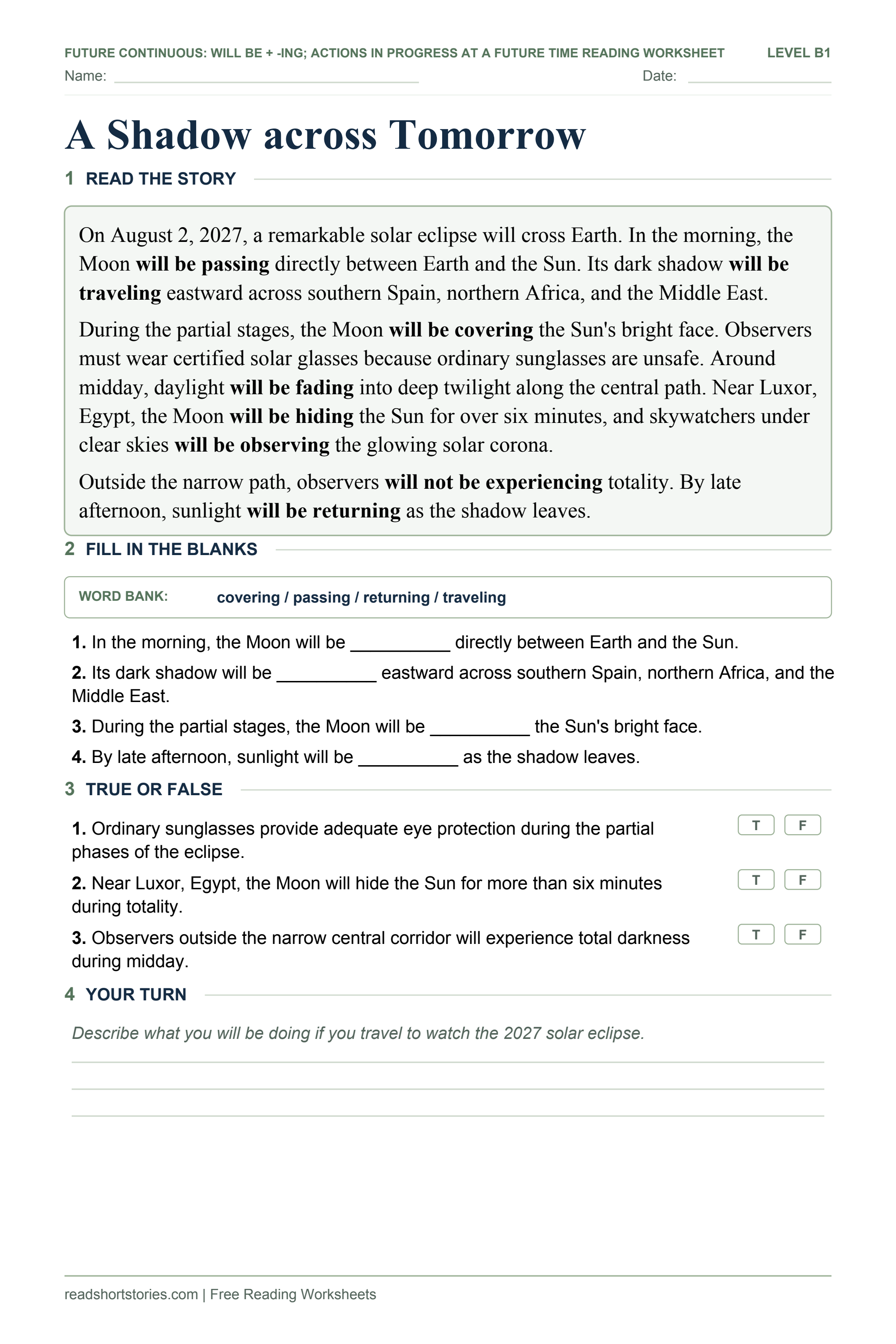
On August 2, 2027, a remarkable solar eclipse will cross Earth. In the morning, the Moon will be passing directly between Earth and the Sun. Its dark shadow will be traveling eastward across southern Spain, northern Africa, and the Middle East.
During the partial stages, the Moon will be covering the Sun’s bright face. Observers must wear certified solar glasses because ordinary sunglasses are unsafe. Around midday, daylight will be fading into deep twilight along the central path. Near Luxor, Egypt, the Moon will be hiding the Sun for over six minutes, and skywatchers under clear skies will be observing the glowing solar corona.
Outside the narrow path, observers will not be experiencing totality. By late afternoon, sunlight will be returning as the shadow leaves.
Fill in the Blanks
Words: passing, traveling, covering, returning
- In the morning, the Moon will be __________ directly between Earth and the Sun. Answer: passing
- Its dark shadow will be __________ eastward across southern Spain, northern Africa, and the Middle East. Answer: traveling
- During the partial stages, the Moon will be __________ the Sun’s bright face. Answer: covering
- By late afternoon, sunlight will be __________ as the shadow leaves. Answer: returning
True or False
- Ordinary sunglasses provide adequate eye protection during the partial phases of the eclipse. False. Ordinary sunglasses are unsafe, so observers must wear certified solar glasses. Evidence: Observers must wear certified solar glasses because ordinary sunglasses are unsafe.
- Near Luxor, Egypt, the Moon will hide the Sun for more than six minutes during totality. True. Evidence: Near Luxor, Egypt, the Moon will be hiding the Sun for over six minutes, and skywatchers under clear skies will be observing the glowing solar corona.
- Observers outside the narrow central corridor will experience total darkness during midday. False. Observers outside the narrow path will not experience totality. Evidence: Outside the narrow path, observers will not be experiencing totality.
Describe what you will be doing if you travel to watch the 2027 solar eclipse.
Sample answer: If I travel to Egypt in August 2027, I will be standing near Luxor with my protective glasses ready. When midday arrives, I will be watching the bright desert sky turn dark as the corona appears.
The Bakery Window
The morning air outside the bakery smelled of river mist and cold stone, but inside, the kitchen was already warm. Rina tied her dark apron tight and set two metal trays on the long wooden counter. Her aunt Marta had trusted her with the dawn shift before the front doors opened at seven. Across the room, her cousin Ari was setting up a small tripod and adjusting the lens of his camera. He needed sharp pictures of their whole-wheat rolls for the bakery’s new printed menu. “We need to plan our minutes carefully,” Aunt Marta said, checking her kitchen clock. “At six o’clock, the ovens will be heating to four hundred degrees, and I will be mixing the rye dough in the back room. You two must share the front.”
Rina nodded and wiped the smooth counter. “That sounds simple,” she said. “While Aunt Marta mixes the rye, I’ll be wiping the glass cases and arranging the pastry baskets. But what will you be doing around six thirty, Ari?”
Ari tapped the wooden counter near the front window with his notebook. “At six thirty, I will be setting up my light board right here,” he answered confidently. “The dawn sun will be rising above the street, and soft light will be pouring through that glass. I’ll be taking close-up shots of the crusts on this exact spot until quarter to seven.”
Rina looked at the counter, then at the delivery clipboard hanging on the wall. “That won’t work, Ari,” she said with a dry laugh. “Look at the order sheet. At six thirty, Aunt Marta will be sliding forty steaming baguettes onto this table. I will be packing twenty breakfast boxes for the harbor ferry crew. Warm steam will be rising everywhere, and you won’t be getting any clean pictures with crumbs scattering across your glass lens!”
Ari paused and lowered his camera. He looked at the wide tabletop, imagining warm steam, rattling paper boxes, and crust crumbs across the boards. “You’re right,” he admitted. “My camera bag will be sitting in your way, and you’ll be rushing past me every twenty seconds. Where can I set up?”
They both studied the waking room. Near the corner sat a sturdy oak shelf beneath a tall angled skylight. Rina pointed toward it. “At six thirty, morning sunlight will also be shining through that high roof pane,” she suggested. “The light will be steady, and nobody will be carrying hot pans past that quiet wall.”
Ari carried his tripod over to test the angle under the warm ceiling lamp. The sturdy oak shelf stood clean and wide, completely separated from the main baking path. “If the sky clears, early dawn light will be reaching this corner nicely,” he said, smiling. “While you and Aunt Marta pack the ferry delivery, I’ll be photographing each loaf in peace. And at seven o’clock, when the first customers walk through the front door, we will all be standing ready.”
Questions
- Why does Ari need to take pictures of the bakery’s whole-wheat rolls?
- Why can Ari not photograph bread on the front counter at six thirty?
- Why do Rina and Ari choose the corner oak shelf as the new photography spot?
- What can you infer about how Ari responds when his original photography plan cannot work?
Future Continuous Practice
- Complete the sentence with the future continuous form of ‘mix’: At six o’clock, Aunt Marta __________ the rye dough in the back room.
- Choose the correct verb form: What __________ around six thirty?
- will you be doing
- will you doed
- are you do
- were you doing
- Put the words in order to form a future continuous sentence: [packing / will / Rina / be / breakfast / boxes]
- packing
- will
- Rina
- be
- breakfast
- boxes
- Which sentence describes an action in progress at a specific future time?
- Ari will be taking close-up shots at six thirty.
- Ari took pictures yesterday morning.
- Ari plans to buy a camera tomorrow.
- Ari always eats bread before dawn.
- Complete the negative future continuous sentence using ‘not’ and ‘get’: Ari __________ clean pictures if crumbs scatter across his lens.
Click to see the answers
Reading Answers
- Ari needs sharp pictures of the rolls for the bakery’s new printed menu. Evidence: He needed sharp pictures of their whole-wheat rolls for the bakery’s new printed menu.
- The counter is needed for hot bread and delivery boxes, leaving no clear space for photography. Evidence: At six thirty, Aunt Marta will be sliding forty steaming baguettes onto this table. I will be packing twenty breakfast boxes for the harbor ferry crew.
- The shelf offers a clear space away from the baking path, with expected light from the skylight. Evidence: The light will be steady, and nobody will be carrying hot pans past that quiet wall.
- He is willing to adjust his plan and test another place instead of insisting on the counter. Evidence: Ari carried his tripod over to test the angle under the warm ceiling lamp.
Practice Answers
- will be mixing
- will you be doing
- Rina will be packing breakfast boxes.
- Ari will be taking close-up shots at six thirty.
- will not be getting
Your turn: Describe two things you and a friend will be doing tomorrow at eight o’clock in the morning.
Listen to this story (audio)
Click to see the short worksheet text and answers
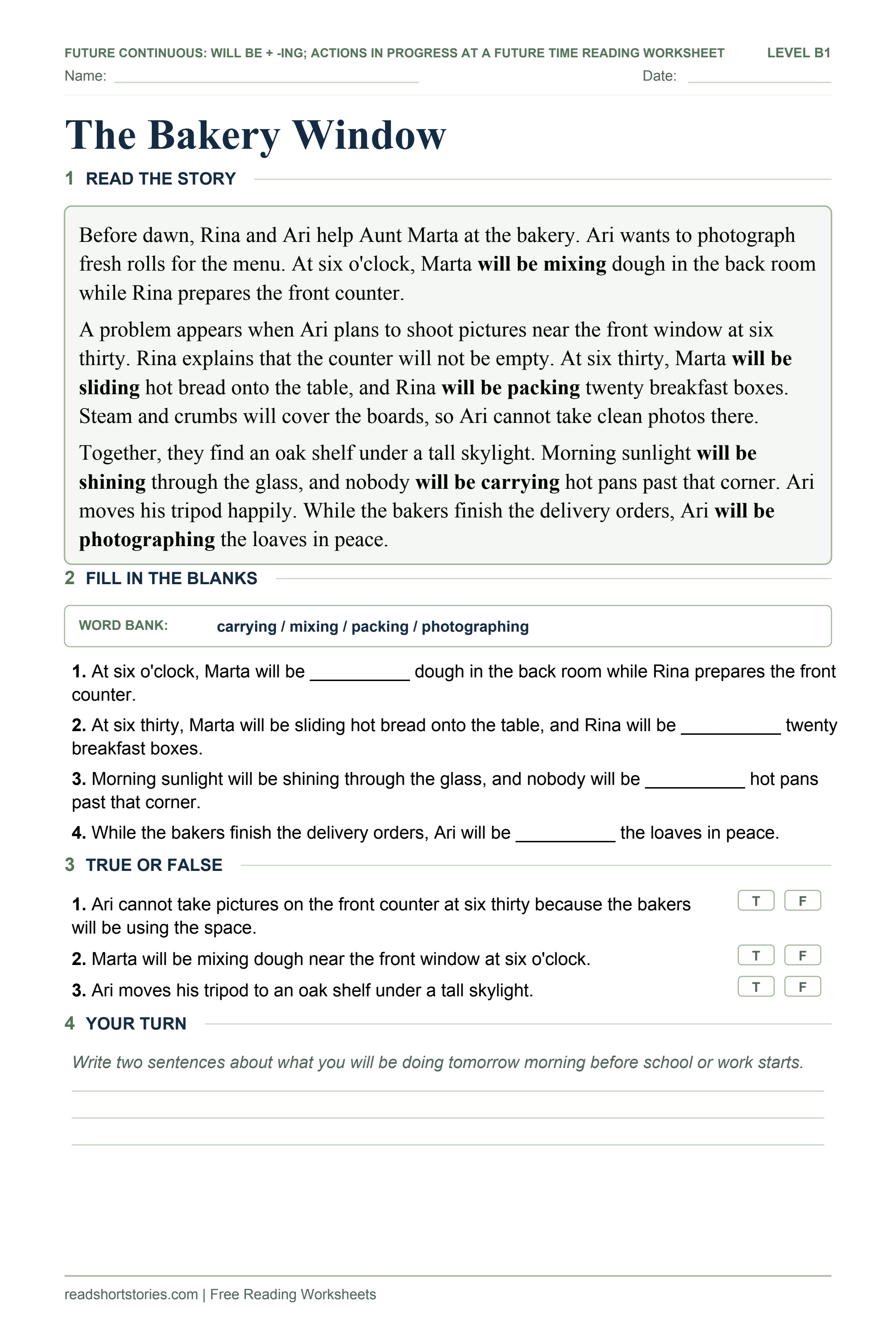
Before dawn, Rina and Ari help Aunt Marta at the bakery. Ari wants to photograph fresh rolls for the menu. At six o’clock, Marta will be mixing dough in the back room while Rina prepares the front counter.
A problem appears when Ari plans to shoot pictures near the front window at six thirty. Rina explains that the counter will not be empty. At six thirty, Marta will be sliding hot bread onto the table, and Rina will be packing twenty breakfast boxes. Steam and crumbs will cover the boards, so Ari cannot take clean photos there.
Together, they find an oak shelf under a tall skylight. Morning sunlight will be shining through the glass, and nobody will be carrying hot pans past that corner. Ari moves his tripod happily. While the bakers finish the delivery orders, Ari will be photographing the loaves in peace.
Fill in the Blanks
Words: mixing, packing, carrying, photographing
- At six o’clock, Marta will be __________ dough in the back room while Rina prepares the front counter. Answer: mixing
- At six thirty, Marta will be sliding hot bread onto the table, and Rina will be __________ twenty breakfast boxes. Answer: packing
- Morning sunlight will be shining through the glass, and nobody will be __________ hot pans past that corner. Answer: carrying
- While the bakers finish the delivery orders, Ari will be __________ the loaves in peace. Answer: photographing
True or False
- Ari cannot take pictures on the front counter at six thirty because the bakers will be using the space. True. Evidence: At six thirty, Marta will be sliding hot bread onto the table, and Rina will be packing twenty breakfast boxes.
- Marta will be mixing dough near the front window at six o’clock. False. Marta will be mixing dough in the back room, not near the front window. Evidence: At six o’clock, Marta will be mixing dough in the back room while Rina prepares the front counter.
- Ari moves his tripod to an oak shelf under a tall skylight. True. Evidence: Together, they find an oak shelf under a tall skylight.
Write two sentences about what you will be doing tomorrow morning before school or work starts.
Sample answer: Tomorrow at six thirty, I will be eating breakfast with my family. At seven o’clock, I will be packing my backpack and walking to the bus stop.
Download the Free PDF
Print all 6 stories and their activities. The answer key follows the student pages.
Frequently Asked Questions
What level are these stories for?
These stories are written for B1 English learners. Read with support when needed.
What does the PDF include?
6 stories, reading questions, future continuous exercises, writing tasks, and a separate answer key.
When do we use the future continuous?
Use will be plus an -ing verb for an activity in progress at a stated future time, or simultaneous future activities. Use will not be (won’t be) for negatives and Will + subject + be + -ing for questions. Use the present simple in ordinary future time clauses with when or while.