- Be Going To Stories with Exercises and Answers (Free PDF)
- Be Going To: A Quick Reminder
- Plans and Intentions
- Predictions from Present Evidence
- Negatives, Questions, and Will
- About the True Story
- Be Going To Stories
- Dessert Before Dinner
- Questions
- Be Going To Practice
- Reading Answers
- Practice Answers
- Fill in the Blanks
- True or False
- The Wall with No Faces
- Questions
- Be Going To Practice
- Reading Answers
- Practice Answers
- Fill in the Blanks
- True or False
- The Spacecraft That Planned to Crash: A True Story
- Questions
- Be Going To Practice
- Reading Answers
- Practice Answers
- Fill in the Blanks
- True or False
- Download the Free PDF
- Frequently Asked Questions
- What level are these stories for?
- What does the PDF include?
- When do we use be going to?
- More Short Stories and Reading Activities
Listen and read along: Audio versions are available for 3 stories on this page. Use the players below.
You can download the free be going to stories PDF below.
Listen to the web stories and read along. The PDF also includes 3 bonus stories.
Be Going To: A Quick Reminder
Plans and Intentions
Use am, is, or are + going to + a base verb for plans and intentions. An earlier decision often explains the plan: ‘We planned the dinner yesterday. We are going to serve dessert first.’
Predictions from Present Evidence
Use be going to when evidence now points to a future result: ‘Look at the tilting tray! That glass is going to fall.’ The warning describes a likely result, even if someone prevents it.
Negatives, Questions, and Will
Put not after am/is/are: ‘She is not going to paint faces.’ For questions, put am/is/are before the subject: ‘Are you going to help?’ — ‘Yes, I am.’ Will is common for immediate decisions, offers, promises, and predictions. Be going to often signals an earlier intention or present evidence; some predictions allow either form.
About the True Story
The DART story retells NASA’s documented 2022 mission in simple English. Sources: NASA’s pre-impact plan, NASA: DART mission ; the successful impact, NASA: DART mission ; and the measured orbit change, NASA: DART mission
Be Going To Stories
Dessert Before Dinner
Sora set four cloth placemats on the dining table. Beside each placemat, she placed a dessert spoon. Emre carried a pitcher of cold water from the kitchen. The apartment smelled of fresh mint and warm rice. Their two friends were already on the bus.
“Tonight, we are going to do something unusual,” Sora said, checking the clock on the wall. “Our friends are going to arrive at six, and everything is ready.”
Emre smiled, but he looked a little nervous. “Are we really going to serve dessert first?” he asked. “People usually eat dinner in the normal way.”
“Yes, we are going to start with berry pudding,” Sora explained. “Next, we are going to bring out baked rice. Finally, we are going to offer hot tomato soup as the last course of dinner.”
At six o’clock, the doorbell rang. Their friends walked into the warm apartment and hung their coats. They sat down at the table and saw the small dessert spoons.
One friend frowned at his spoon. “Wait, are we going to eat dessert now?” he asked. “Where is the dinner?”
“You are not going to get soup first today,” Sora smiled. “Emre and I made a plan. We are going to eat our dinner backward.”
Emre walked into the dining room carrying a heavy wooden tray. On the tray sat four tall glasses of chilled blueberry pudding topped with cream. Emre held the tray with one hand because he tried to close the door with his foot. The smooth tray tilted sharply toward the floor.
“Watch out! That glass is going to fall!” the other friend shouted, pointing at the wobbling pudding.
“Look at the edge! It is going to slide right off!” the first friend said, jumping up from his chair.
Emre stopped instantly. He used both hands and leveled the tray. The glass stopped near the wooden rim. “Whew,” Emre said with relief. “Nothing is going to spill on my floor tonight.”
He set the four puddings safely on the table. The purple berries looked sweet and fresh. “Now then,” Emre said, “who is going to try the first bite?”
“I am going to taste it right now,” the second friend said, picking up a spoon. “Sweet berries first. I like this idea.”
After they finished the pudding, Sora cleared the table. “Now we are going to eat the main dish,” she announced. She served four plates of warm baked rice with roasted peppers.
“This backward dinner is fun,” the first friend said as he finished his rice. “So, what are you going to serve for the last course?”
“Emre is going to bring the soup now,” Sora answered. “Soup is the final course of our dinner.” Emre brought four steaming cups of tomato soup. The warm broth was pleasant after the rice.
After the soup, Emre brought a teapot and mugs. Beside the tea, he placed a small surprise: a bowl of crunchy breakfast cereal with cold milk.
The other friend laughed and pointed at the bowl. “Are you going to eat breakfast cereal at nine in the evening?”
“Of course,” Emre smiled, pouring the herbal tea. “It is a playful extra treat. Since we started with dessert, we are going to finish with morning cereal.”
Questions
- Why did the tray of blueberry puddings tilt sharply toward the floor?
- What did Emre do immediately after his friends warned him that the dessert was going to fall?
- What made the friends realize that dinner would not begin in the usual way?
- Why did Emre decide to serve breakfast cereal at the end of the evening?
Be Going To Practice
- In the sentence ‘Emre and I made a plan; we are going to eat our dinner backward,’ what is the function of ‘are going to’?
- A prior plan or intention
- A prediction from present evidence
- An instant decision made while speaking
- The wooden tray tilts sharply toward the floor and the pudding wobbles near the edge. Which sentence makes a prediction based on this visible evidence?
- That glass is going to fall!
- We are going to bring out baked rice next.
- Our friends arrived at six o’clock.
- Sora already arranged the schedule before the guests arrived: ‘Our friends __________ going to arrive at six.’
- Look at the tray tilting toward the floor! The dessert glass __________ going to slide right off.
- Unscramble the words to make a prediction based on present evidence:
- fall!
- is
- That
- to
- glass
- going
Click to see the answers
Reading Answers
- The tray tilted because Emre tried to close the door with his foot while holding the tray with only one hand. Evidence: Emre held the tray with one hand because he tried to close the door with his foot.
- He stopped at once and used both hands to level the tray. Evidence: Emre stopped instantly. He used both hands and leveled the tray.
- They sat at the table and noticed small dessert spoons placed beside their placemats. Evidence: They sat down at the table and saw the small dessert spoons.
- He served it as a playful final treat because they had planned to eat their entire dinner backward. Evidence: “It is a playful extra treat. Since we started with dessert, we are going to finish with morning cereal.”
Practice Answers
- A prior plan or intention
- That glass is going to fall!
- are
- is
- That glass is going to fall!
Your turn: Write 3–4 sentences about a special meal or party you planned with a friend. Use ‘be going to’ at least twice: once for a prior plan, and once for a prediction based on what you see happening right now.
Listen to this story (audio)
Click to see the short worksheet text and answers
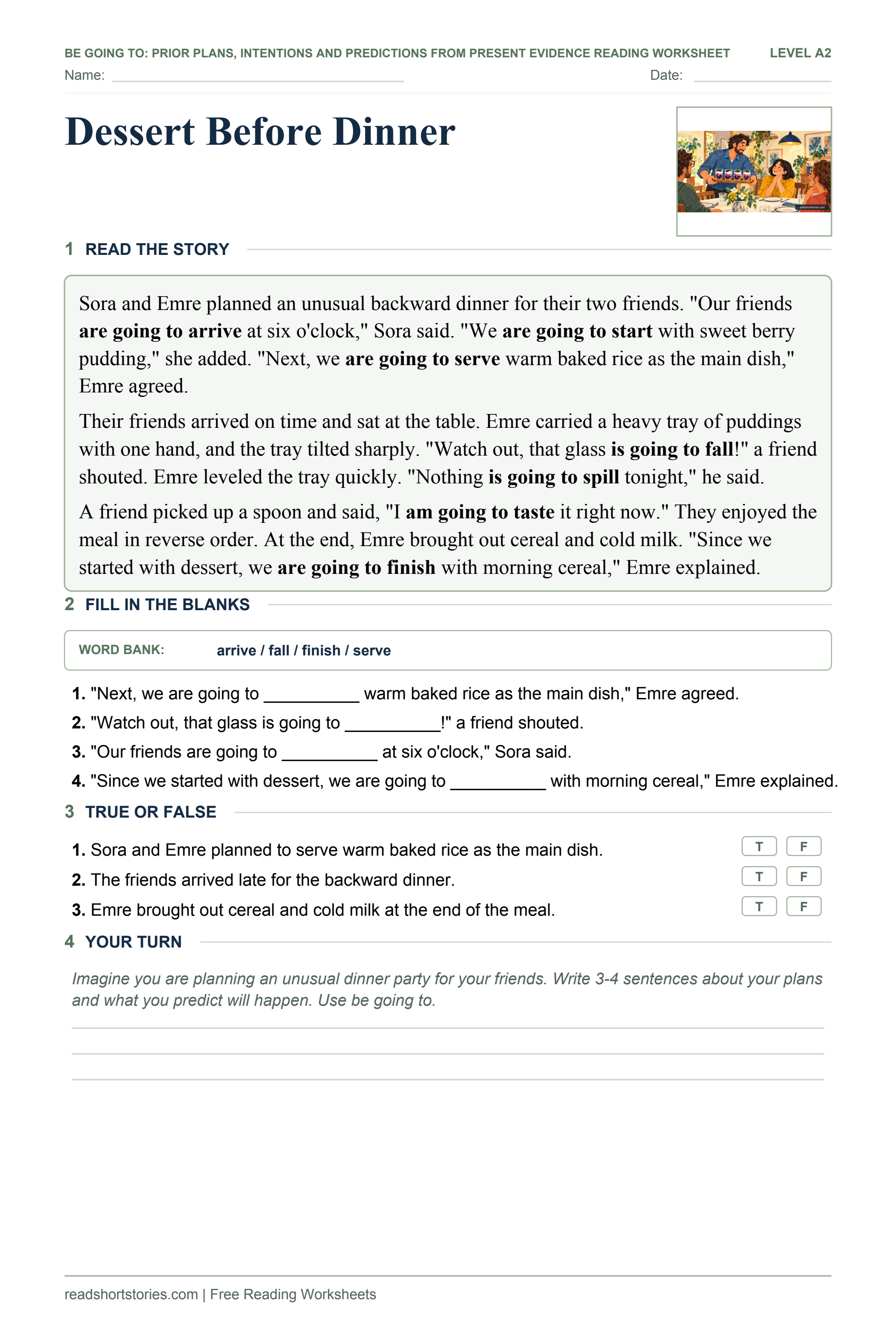
Sora and Emre planned an unusual backward dinner for their two friends. “Our friends are going to arrive at six o’clock,” Sora said. “We are going to start with sweet berry pudding,” she added. “Next, we are going to serve warm baked rice as the main dish,” Emre agreed.
Their friends arrived on time and sat at the table. Emre carried a heavy tray of puddings with one hand, and the tray tilted sharply. “Watch out, that glass is going to fall!” a friend shouted. Emre leveled the tray quickly. “Nothing is going to spill tonight,” he said.
A friend picked up a spoon and said, “I am going to taste it right now.” They enjoyed the meal in reverse order. At the end, Emre brought out cereal and cold milk. “Since we started with dessert, we are going to finish with morning cereal,” Emre explained.
Fill in the Blanks
Words: serve, fall, arrive, finish
- “Next, we are going to __________ warm baked rice as the main dish,” Emre agreed. Answer: serve
- “Watch out, that glass is going to __________!” a friend shouted. Answer: fall
- “Our friends are going to __________ at six o’clock,” Sora said. Answer: arrive
- “Since we started with dessert, we are going to __________ with morning cereal,” Emre explained. Answer: finish
True or False
- Sora and Emre planned to serve warm baked rice as the main dish. True. Evidence: “Next, we are going to serve warm baked rice as the main dish,” Emre agreed.
- The friends arrived late for the backward dinner. False. The friends arrived on time, not late. Evidence: Their friends arrived on time and sat at the table.
- Emre brought out cereal and cold milk at the end of the meal. True. Evidence: At the end, Emre brought out cereal and cold milk.
Imagine you are planning an unusual dinner party for your friends. Write 3–4 sentences about your plans and what you predict will happen. Use be going to.
Sample answer: I am going to host a breakfast-for-dinner party this Friday. We are going to eat sweet pancakes and eggs at eight o’clock. My friend loves pancakes, so he is going to smile when he sees the table. We are going to have a wonderful evening together.
The Wall with No Faces
Selma unlocked the community room at eight in the morning. Sunlight touched the bare plaster wall. On Tuesday, the building manager gave her permission to paint it. She set jars of navy, mint, and cream paint on a table. “Today, I’m going to paint our community mural,” Selma said. She unrolled three large paper templates. “I am not going to paint ordinary faces. I am going to show our neighbors through their working hands.”
Bora walked in with two cups of coffee. He managed the community library down the hall. He stopped and stared at the paper sheets taped to the wall. “Good morning, Selma,” Bora said. “What are you going to do with these huge sheets? They look like strange trees. Are you going to paint a forest on our wall?” Selma laughed and took a cup. “No, I’m not,” she answered. “They are not trees. Look at the curved shapes again.”
Bora stepped closer to the wall. The long shape was not a tree trunk. It was a strong arm with a rolled sleeve. “I see fingers now,” Bora said. “Whose hands are these?” “That is our neighborhood bike repairer,” Selma explained. “He fixed my bicycle last week. Right here, his hands are going to tighten a silver wire on a wheel. Next to him, our baker is going to shape fresh bread.” “Is anyone going to play music?” Bora asked. “Yes, they are,” Selma smiled. “In the middle, our guitar player is going to tune a wooden guitar.”
Bora looked at the paint jars on the table. “What colors are you going to use for the wall?” “I am going to use mint green for the background and navy for the shadows,” Selma replied. Suddenly, a cool draft blew through the open window. Blue tape on the top template curled, and the paper sagged forward. “Watch out!” Bora pointed. “The tape is loose, and the template is going to fall!” “Oh no,” Selma said. “It is going to drop into the open paint jars!”
Bora quickly pressed his hands against the falling paper. Selma climbed the stepladder with a roll of masking tape. She pressed three wide strips across the top corner until the paper sat flat. “There,” Bora said, stepping back. “That paper isn’t going to move now.” “Thank you,” Selma said. “Are you still going to help me this morning?” “Yes, I am,” Bora answered. “The library does not open until noon, so I am going to stir the navy paint.”
Selma dipped her brush into the navy paint. For three hours, they worked side by side in the quiet room. Selma carefully painted the thin silver wire between the bike repairer’s fingers. Bora stepped back and wiped his hands on a clean cloth. “What are you going to paint tomorrow?” he asked. “Tomorrow, I am going to add the baker’s hands,” Selma answered with a smile. She cleaned her brush and set it on the wooden table. On the plaster wall, the bicycle wheel showed its clean, dark circle.
Questions
- Why does Selma decide to paint working hands instead of ordinary faces?
- What causes the paper template to peel away from the wall?
- Why is Bora able to help Selma with the mural this morning?
- What does Selma plan to paint on the mural tomorrow?
Be Going To Practice
- Bora sees the tape peeling and shouts, “The template is going to fall!” Why does he use “is going to” here?
- To make a prediction based on present evidence
- To talk about a plan made yesterday
- To describe a past event
- Selma says, “Tomorrow, I am going to add the baker’s hands.” What does “am going to” express in this sentence?
- A prior plan or intention
- A prediction based on what she sees right now
- An action happening at the exact moment of speaking
- Complete the sentence with ONE word: Bora has free time before noon, so he __________ going to help Selma stir the paint.
- Put the words in order to form a question:
- paint?
- are
- What
- to
- going
- you
- Look at the corner of the paper slipping off the wall! It __________ onto the floor!
- is going to fall
- fell
- falls
Click to see the answers
Reading Answers
- Selma wants to represent the community members through their daily work rather than traditional portraits. Evidence: “I am not going to paint ordinary faces. I am going to show our neighbors through their working hands.”
- A cool draft blowing through the open window loosens the tape on the paper template. Evidence: Suddenly, a cool draft blew through the open window. Blue tape on the top template curled, and the paper sagged forward.
- Bora has time to help because the library where he works does not open until noon. Evidence: “The library does not open until noon, so I am going to stir the navy paint.”
- Selma plans to add the baker’s hands on the mural tomorrow. Evidence: “Tomorrow, I am going to add the baker’s hands,” Selma answered with a smile.
Practice Answers
- To make a prediction based on present evidence
- A prior plan or intention
- is
- What are you going to paint?
- is going to fall
Your turn: Write 3–4 sentences about a project in your community, school, or home. Include at least one prior plan using ‘be going to’ and at least one prediction based on present evidence (something you can see right now).
Listen to this story (audio)
Click to see the short worksheet text and answers
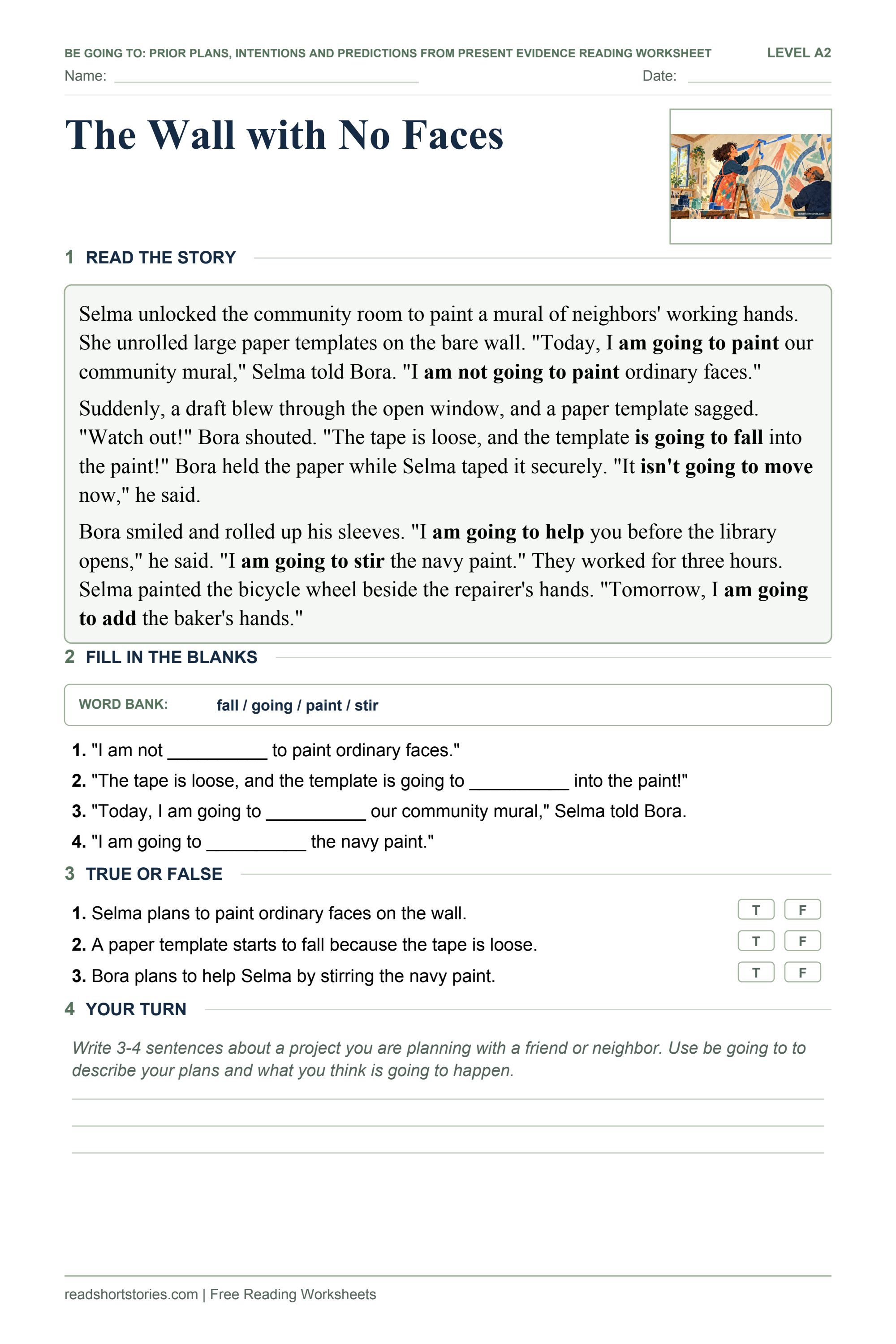
Selma unlocked the community room to paint a mural of neighbors’ working hands. She unrolled large paper templates on the bare wall. “Today, I am going to paint our community mural,” Selma told Bora. “I am not going to paint ordinary faces.”
Suddenly, a draft blew through the open window, and a paper template sagged. “Watch out!” Bora shouted. “The tape is loose, and the template is going to fall into the paint!” Bora held the paper while Selma taped it securely. “It isn’t going to move now,” he said.
Bora smiled and rolled up his sleeves. “I am going to help you before the library opens,” he said. “I am going to stir the navy paint.” They worked for three hours. Selma painted the bicycle wheel beside the repairer’s hands. “Tomorrow, I am going to add the baker’s hands.”
Fill in the Blanks
Words: going, fall, paint, stir
- “I am not __________ to paint ordinary faces.” Answer: going
- “The tape is loose, and the template is going to __________ into the paint!” Answer: fall
- “Today, I am going to __________ our community mural,” Selma told Bora. Answer: paint
- “I am going to __________ the navy paint.” Answer: stir
True or False
- Selma plans to paint ordinary faces on the wall. False. Selma is going to paint neighbors’ working hands, not ordinary faces. Evidence: “I am not going to paint ordinary faces.”
- A paper template starts to fall because the tape is loose. True. Evidence: “The tape is loose, and the template is going to fall into the paint!”
- Bora plans to help Selma by stirring the navy paint. True. Evidence: “I am going to stir the navy paint.”
Write 3–4 sentences about a project you are planning with a friend or neighbor. Use be going to to describe your plans and what you think is going to happen.
Sample answer: My neighbor and I are going to build a small wooden planter for our garden this weekend. I am going to buy the wood and screws tomorrow. He has many tools, so he is going to cut the boards. The weather is sunny, so we are going to finish the project outside quickly.
The Spacecraft That Planned to Crash: A True Story
In late 2021, NASA launched a small, uncrewed spacecraft named DART. By September 2022, it has traveled through deep space for nearly ten months and is approaching its destination. Two distant asteroids travel together in space. The smaller asteroid, Dimorphos, orbits around the larger asteroid, Didymos. An orbit is one complete trip around the larger rock. Neither space rock threatens Earth. Instead, NASA scientists have an exciting plan, and in September 2022 they are ready to explain exactly what the mission is going to do.
NASA is not going to land the spacecraft gently on the asteroid. DART is not going to collect rock samples. It is not going to carry human astronauts. So, what is the uncrewed spacecraft going to do? It is going to strike Dimorphos at high speed. Engineers planned every step of this mission long before the event. The intentional crash is going to test an important question: can a deliberate collision change the movement of an asteroid? The scientists expect the impact to shorten the time of Dimorphos’s orbit around Didymos, and the telescopes are going to confirm whether that actually happens.
On July 27, 2022, DART’s camera already spotted the Didymos system from millions of miles away. Now, in early September, NASA shares more details about the coming September 26 impact. During the final four hours of the approach, engineers on Earth are not going to steer the spacecraft. Instead, smart navigation software on the craft is going to guide the flight automatically. The camera is going to lock its view directly onto Dimorphos. It is going to send detailed pictures back to Earth right up until the moment of impact. The mission team is going to use these images to study the surface before the collision.
After the impact, scientists are going to begin their next planned steps. How are they going to know if the test succeeded? They are going to track both space rocks with powerful telescopes for several weeks. Astronomers are going to calculate the exact time of the new orbit. They are going to compare these new measurements with the original orbit time. Only then will the data show whether the collision changed anything.
On September 26, 2022, DART approaches its target at four miles per second. The final pictures arrive from space. Dimorphos grows larger and larger in the camera view. Gray boulders and dark shadows fill the entire frame. Then the radio signal from DART stops. The uncrewed spacecraft has struck Dimorphos after ten months in space, right on target.
On October 11, 2022, NASA announced the official results. Before the test, Dimorphos completed one orbit in eleven hours and fifty-five minutes. After the test, the orbit took eleven hours and twenty-three minutes. The collision successfully shortened the orbit by thirty-two minutes. DART did not destroy the asteroid, and it did not push it toward Earth. Instead, the mission proved that a planned impact can change an asteroid’s motion in space.
Questions
- Why did NASA plan an intentional crash into Dimorphos?
- Why were engineers on Earth not going to steer DART during the final four hours?
- How did astronomers plan to determine if the collision changed the asteroid’s motion?
- What consequence did the collision have on Dimorphos’s orbit around Didymos?
Be Going To Practice
- NASA engineers scheduled every step of the mission in 2021. In the sentence ‘Smart software is going to guide the flight,’ what does ‘is going to guide’ express?
- a prior plan
- a prediction from present evidence
- Look at the live monitor! Dimorphos is filling the camera frame right now. Which use of ‘is going to crash’ is emphasized by the speaker’s attention to this growing image?
- a prediction from present evidence
- a prior plan
- NASA planned an intentional crash, not a soft landing. DART is __________ going to land gently on the asteroid.
- The scientists arranged their schedule months before the test. They __________ going to track the asteroids with powerful telescopes.
- Put the words in the correct order to express the scientists’ plan:
- track
- going
- They
- Didymos.
- are
- to
Click to see the answers
Reading Answers
- NASA planned the crash to test whether a deliberate collision could change the movement of an asteroid. Evidence: The intentional crash is going to test an important question: can a deliberate collision change the movement of an asteroid?
- Engineers were not going to steer the spacecraft because smart navigation software on the craft was going to guide the flight automatically. Evidence: Instead, smart navigation software on the craft is going to guide the flight automatically.
- Astronomers planned to measure the new orbit time and compare it with the original orbit time. Evidence: Astronomers are going to calculate the exact time of the new orbit. They are going to compare these new measurements with the original orbit time.
- The collision successfully shortened Dimorphos’s orbit around Didymos by thirty-two minutes. Evidence: The collision successfully shortened the orbit by thirty-two minutes.
Practice Answers
- a prior plan
- a prediction from present evidence The planned impact also has a prior intention, but this statement emphasizes the growing image as present evidence.
- not
- are
- They are going to track Didymos.
Your turn: Imagine a new science or space mission. Write 3–4 sentences about it. Use ‘be going to’ at least twice: once to describe a prior plan and once to make a prediction based on what you see right now.
Listen to this story (audio)
Click to see the short worksheet text and answers
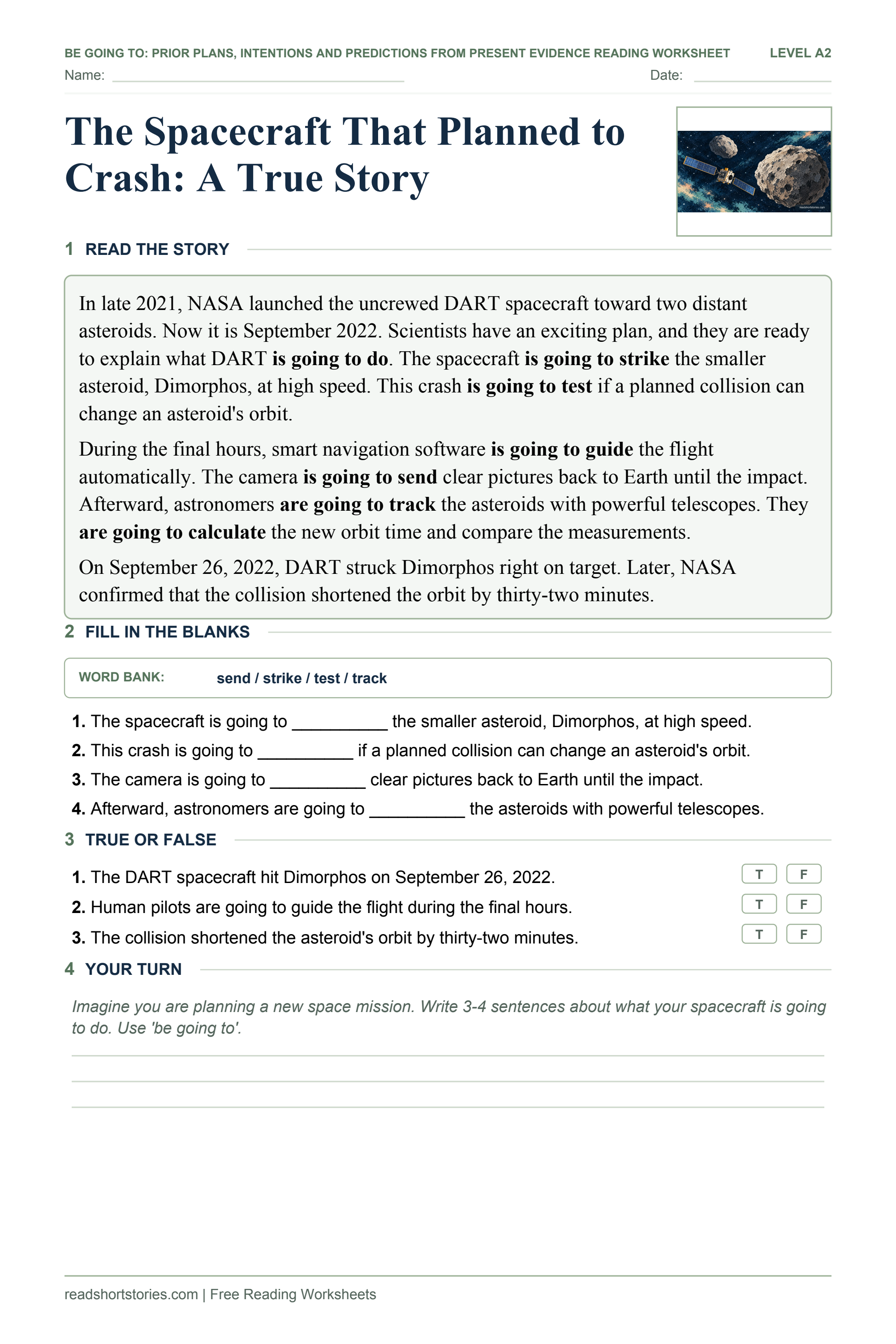
In late 2021, NASA launched the uncrewed DART spacecraft toward two distant asteroids. Now it is September 2022. Scientists have an exciting plan, and they are ready to explain what DART is going to do. The spacecraft is going to strike the smaller asteroid, Dimorphos, at high speed. This crash is going to test if a planned collision can change an asteroid’s orbit.
During the final hours, smart navigation software is going to guide the flight automatically. The camera is going to send clear pictures back to Earth until the impact. Afterward, astronomers are going to track the asteroids with powerful telescopes. They are going to calculate the new orbit time and compare the measurements.
On September 26, 2022, DART struck Dimorphos right on target. Later, NASA confirmed that the collision shortened the orbit by thirty-two minutes.
Fill in the Blanks
Words: strike, test, send, track
- The spacecraft is going to __________ the smaller asteroid, Dimorphos, at high speed. Answer: strike
- This crash is going to __________ if a planned collision can change an asteroid’s orbit. Answer: test
- The camera is going to __________ clear pictures back to Earth until the impact. Answer: send
- Afterward, astronomers are going to __________ the asteroids with powerful telescopes. Answer: track
True or False
- The DART spacecraft hit Dimorphos on September 26, 2022. True. Evidence: On September 26, 2022, DART struck Dimorphos right on target.
- Human pilots are going to guide the flight during the final hours. False. Smart navigation software is going to guide the flight automatically. Evidence: During the final hours, smart navigation software is going to guide the flight automatically.
- The collision shortened the asteroid’s orbit by thirty-two minutes. True. Evidence: Later, NASA confirmed that the collision shortened the orbit by thirty-two minutes.
Imagine you are planning a new space mission. Write 3–4 sentences about what your spacecraft is going to do. Use ‘be going to’.
Sample answer: My team is going to launch a new rover to Mars next year. The rover is going to explore a deep crater. It is going to look for water under the red rocks. We are going to study the pictures every day.
Download the Free PDF
Print all 6 stories and their activities. The answer key follows the student pages.
Frequently Asked Questions
What level are these stories for?
These stories are written for A2 English learners. Read with support when needed.
What does the PDF include?
6 stories, reading questions, be going to exercises, writing tasks, and a separate answer key.
When do we use be going to?
Use am, is, or are + going to + a base verb for plans and intentions, and for predictions based on present evidence. Will is also common for predictions, and is used for immediate decisions, offers, and promises. Context matters; some predictions allow either form.