- Future Perfect Stories with Exercises and Answers (Free PDF)
- Future Perfect: A Quick Reminder
- Form: Will Have + Past Participle
- Completed or Still Happening?
- By the Time and Future Milestones
- About the True Story
- Future Perfect Stories
- The Last Line before the Film
- Questions
- Future Perfect Practice
- Reading Answers
- Practice Answers
- Fill in the Blanks
- True or False
- Eight Days to the Moon and Back
- Questions
- Future Perfect Practice
- Reading Answers
- Practice Answers
- Fill in the Blanks
- True or False
- The Parcel That Travels Twice
- Questions
- Future Perfect Practice
- Reading Answers
- Practice Answers
- Fill in the Blanks
- True or False
- Download the Free PDF
- Frequently Asked Questions
- What level are these stories for?
- What does the PDF include?
- When do we use the future perfect?
- More Short Stories and Reading Activities
Listen and read along: Audio versions are available for 3 stories on this page. Use the players below.
You can download the free future perfect stories PDF below.
Listen to the web stories and read along. The PDF also includes 3 bonus stories.

Future Perfect: A Quick Reminder
Form: Will Have + Past Participle
Use will have + past participle to describe completion before a future point:
Example: By six tomorrow, we will have tested the projection.
Use will not have (won’t have) for negatives:
Example: The pots won’t have cooled by noon.
For questions, put will before the subject:
Example: Will you have finished everything before lunch?
Completed or Still Happening?
The future perfect emphasizes a completed result:
Example: By Sunday morning, the salad will have chilled overnight.
The future continuous describes an activity in progress at a future time:
Example: At eight, we will be cooking.
Choose the form that matches your meaning; other tenses provide background and current actions.
By the Time and Future Milestones
Use the present simple or present perfect in ordinary future time clauses with when, before, or by the time:
Example: By the time the doors open, we will have checked every card.
By introduces a completion deadline. Future plans and delivery dates can be expectations rather than guarantees; keep conditions clear.
About the True Story
Eight Days to the Moon and Back is a factual historical timeline viewed forward from July 16, 1969. Its outcomes are documented history, not invented astronaut predictions. Times use UTC, generally rounded to minutes. Sources: NASA mission data NASA: Apollo 11 ; NASA timeline NASA: Apollo 11 ; NASA overview NASA: Apollo 11 ; National Archives National Archives .
Future Perfect Stories
The Last Line before the Film
By two o’clock on Saturday afternoon, Bela and her Uncle Doru had printed frame grabs of all thirteen handwritten title cards from the family film and laid them across the kitchen table. The silent film ran for eleven minutes. It had been shot on a handheld camera sometime in the 1970s, and the original filmmaker had placed handwritten cards between scenes the way early cinema used intertitles. Uncle Doru was going to show it to relatives tomorrow evening, and he wanted accurate English captions so everyone could follow the cards.
“By the time the door opens tomorrow,” Uncle Doru said, scrolling through the caption file on his laptop, “we will have checked every card at least twice and exported the finished version.” He paused at the last entry. “I just want that one right.”
The last card was the problem. The handwriting on it was small and close together, and the filmed copy had a faint shadow crossing the first letter of the third word. Bela had typed what she thought it said, but she was not certain.
Her cousin Radu leaned over her shoulder. He was fourteen, a year older than Bela, and he liked to decide things quickly. “It says ‘surprised,'” he said. “You can see part of the curve at the top.”
“Maybe,” Bela said. She did not want to argue before she had checked. “By the time we finish this card, we will have read through all thirteen. Let me look at the others first.”
She went back to card four, which was sharply lit and clear. The filmmaker had used the word ‘promised’ there, in the same cramped style. The first letter dropped noticeably below the printed line, the way a lowercase p does when handwritten quickly.
Bela held card four next to the printed frame grab of the last card. The blurred first letter in the last card also dipped below the line in the same place.
“Look,” she said. “In card four, the p goes under the line—here.” She pointed to it. “The first letter of the blurred word does the same thing. An s stays above the line. This one doesn’t.”
Radu leaned closer. “Okay,” he said slowly. “That does look the same.”
“And watch the next scene after the card,” Bela said. She advanced the clip. In it, a young woman held out her hand, and the man across the table placed his palm flat on top of hers, as though confirming something agreed. “If the card says ‘surprised,’ she is reacting to something unexpected. But that gesture isn’t surprise—it’s someone keeping a word. The card says ‘he had promised her.'”
Uncle Doru compared card four and the last card side by side. “She’s right,” he said. “By the picnic scene, the filmmaker will have set this up twice—once on card four and once here. That’s the small joke. The promise is the whole point.”
Radu made a face. “‘Surprised’ would have broken it.”
“It would have,” Bela said.
She typed the correction and read the full caption sequence aloud from the first card to the last. Uncle Doru ran the export. The progress bar moved steadily and finished.
“By six tomorrow evening we will have tested the projection and loaded the captions,” Uncle Doru said, closing the laptop. “That gives us a clear hour before anyone arrives. We will have done everything we need to do.”
Bela stacked the printed cards and put them in the folder with the caption file. By tomorrow the guests will have sat down, the film will have started, and card four will have quietly prepared them for the last line—the one Bela had read, compared, and gotten right.
Questions
- What type of film were Bela and Uncle Doru preparing captions for?
- Why did Bela decide to examine card four before agreeing with Radu’s guess?
- How did the action in the scene after the title card support Bela’s reading of the word?
- How does Uncle Doru’s schedule show that he wants the film ready before his relatives arrive?
Future Perfect Practice
- Choose the future perfect form: By tomorrow evening, Uncle Doru and Bela __________ all thirteen handwritten title cards.
- will have checked
- will check
- had checked
- are checking
- Complete using the future perfect of ‘finish’ (three words): By five o’clock, Bela __________ her project.
- Put the supplied words in order to make an affirmative future perfect sentence.
- have
- the
- will
- guests
- arrived
- Which sentence describes an action completed before a specific future deadline?
- By six o’clock, we will have tested the projection.
- At six o’clock, we are testing the projection.
- By six o’clock, we tested the projection.
- At six o’clock, we will test the projection.
- Complete this new example using the negative future perfect of ‘finish’ (four words, no contraction): By noon tomorrow, I __________ my new film.
Click to see the answers
Reading Answers
- They are preparing captions for a silent film. Evidence: The silent film ran for eleven minutes.
- She wants to compare the blurred word with a clear example of ‘promised’ in the same handwriting. Evidence: She went back to card four, which was sharply lit and clear. The filmmaker had used the word ‘promised’ there, in the same cramped style.
- The man’s gesture confirms an agreement, supporting ‘promised’ rather than surprise. Evidence: But that gesture isn’t surprise—it’s someone keeping a word.
- He schedules testing and caption loading for six, leaving an hour before the guests arrive. Evidence: By six tomorrow evening we will have tested the projection and loaded the captions,
Practice Answers
- will have checked Checking will be complete by tomorrow evening: will have + checked.
- will have finished Finish becomes finished after will have.
- The guests will have arrived. Use subject + will + have + past participle.
- By six o’clock, we will have tested the projection. Will have tested emphasizes completion before six.
- will not have finished Use will not have + finished for a negative completed-action prediction.
Your turn: Write two sentences describing two goals you will have achieved by this time next year.
Listen to this story (audio)
Click to see the short worksheet text and answers
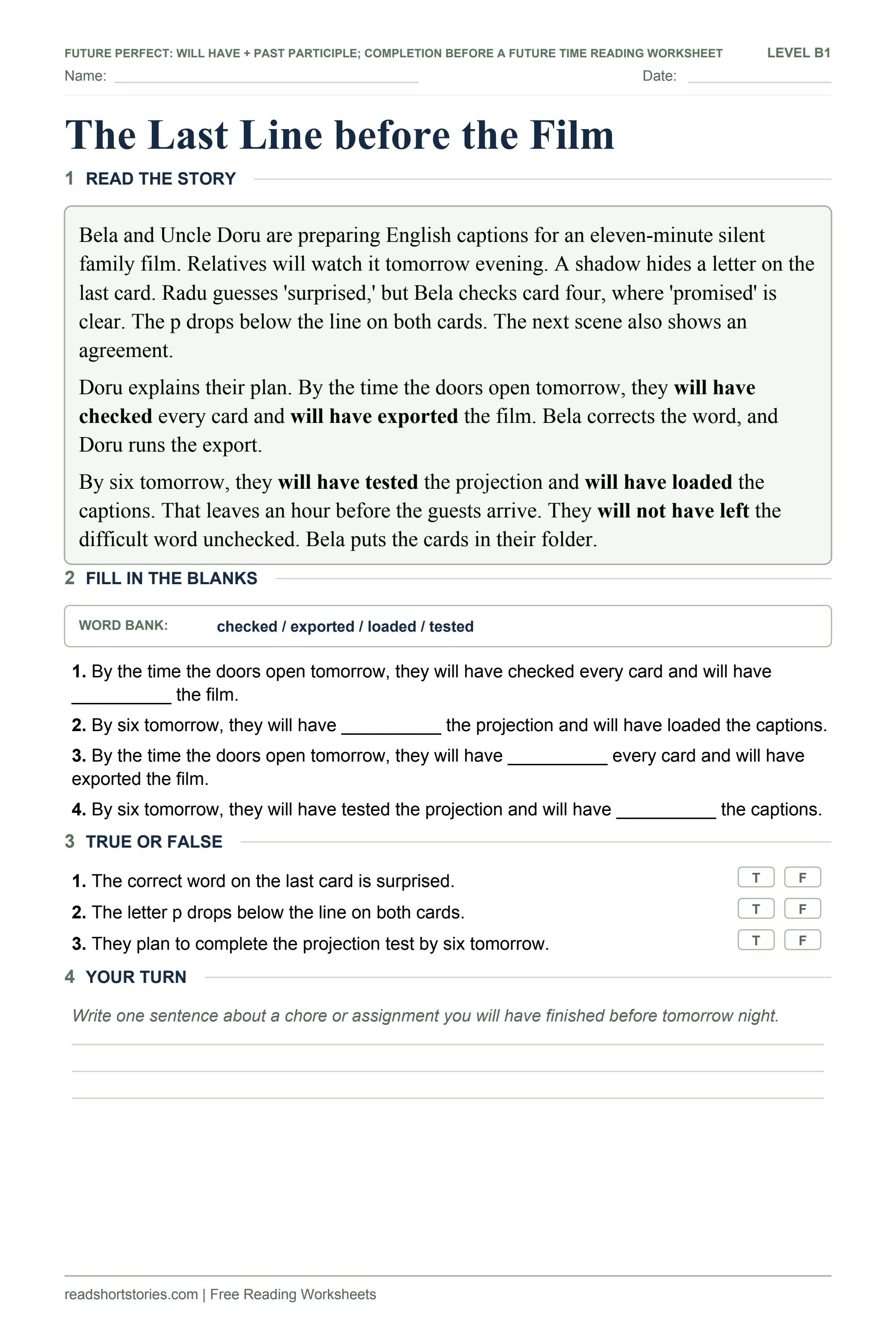
Bela and Uncle Doru are preparing English captions for an eleven-minute silent family film. Relatives will watch it tomorrow evening. A shadow hides a letter on the last card. Radu guesses ‘surprised,’ but Bela checks card four, where ‘promised’ is clear. The p drops below the line on both cards. The next scene also shows an agreement.
Doru explains their plan. By the time the doors open tomorrow, they will have checked every card and will have exported the film. Bela corrects the word, and Doru runs the export.
By six tomorrow, they will have tested the projection and will have loaded the captions. That leaves an hour before the guests arrive. They will not have left the difficult word unchecked. Bela puts the cards in their folder.
Fill in the Blanks
Words: exported, tested, checked, loaded
- By the time the doors open tomorrow, they will have checked every card and will have __________ the film. Answer: exported
- By six tomorrow, they will have __________ the projection and will have loaded the captions. Answer: tested
- By the time the doors open tomorrow, they will have __________ every card and will have exported the film. Answer: checked
- By six tomorrow, they will have tested the projection and will have __________ the captions. Answer: loaded
True or False
- The correct word on the last card is surprised. False. The correct word is promised. Evidence: Radu guesses ‘surprised,’ but Bela checks card four, where ‘promised’ is clear.
- The letter p drops below the line on both cards. True. Evidence: The p drops below the line on both cards.
- They plan to complete the projection test by six tomorrow. True. Evidence: By six tomorrow, they will have tested the projection and will have loaded the captions.
Write one sentence about a chore or assignment you will have finished before tomorrow night.
Sample answer: By tomorrow night, I will have finished my science homework.
Eight Days to the Moon and Back
On July 16, 1969, at 13:32 UTC, Apollo 11 lifts off from Kennedy Space Center in Florida. Three astronauts are aboard: Neil Armstrong, Buzz Aldrin, and Michael Collins. What follows is a documented sequence of milestones, viewed forward from that launch morning—events that history has since confirmed in full.
By 14:00 UTC on July 16, the spacecraft will have reached Earth orbit. The crew will spend time there running checks before the engines push them toward the Moon. That moment marks the true beginning of the outward journey.
Collins pilots the command module, named Columbia. Armstrong and Aldrin will later transfer to the lunar module, named Eagle, which is designed to land on the surface. Collins will not land with them; he will remain in orbit while the other two descend.
By 18:00 UTC on July 19, Apollo 11 will have entered lunar orbit. The following day brings the critical separation. At 17:44 UTC on July 20, Eagle undocks from Columbia.
By 21:00 UTC on July 20, Eagle will have landed on the lunar surface. The confirmed time is 20:17 UTC—earlier than that hour. Collins, still orbiting above in Columbia, will not have set foot on the Moon. He will have completed orbit after orbit while waiting.
The surface work begins in the early hours of July 21. Armstrong steps onto the Moon at 02:56 UTC; Aldrin follows at 03:15 UTC. By 04:00 UTC on July 21, both astronauts will have taken their first steps on the lunar surface. They collect samples and take photographs. By 06:00 UTC, both will have returned inside Eagle.
Eagle lifts off from the Moon at 17:54 UTC on July 21 and docks with Columbia at 21:35 UTC. By 23:30 UTC on July 21, all three crew members will have reunited inside the command module. The lunar module is released, and the journey home begins around 04:55 UTC on July 22.
On July 24, 1969, at 16:50 UTC, Columbia splashes down in the Pacific Ocean. By that moment, the crew will have traveled for about eight days and three hours and will have completed the flight. The timeline that looked forward from launch day on July 16 will have closed.
Questions
- Which spacecraft is designed to land on the surface of the Moon?
- Why does Michael Collins stay in orbit rather than walk on the lunar surface?
- How will Armstrong and Aldrin’s experience differ from Collins’s by 04:00 UTC on July 21?
- Why is the crew’s reunion inside Columbia given a later time than the docking?
Future Perfect Practice
- Fill in the three-word future perfect form: By 18:00 UTC on July 19, Apollo 11 __________ (enter) lunar orbit.
- Which sentence correctly uses the negative future perfect to describe Collins on July 20?
- Collins will not have set foot on the Moon.
- Collins will not setting foot on the Moon.
- Collins has not will set foot on the Moon.
- Put the supplied words in order to make an affirmative future perfect sentence. Begin with The.
- will
- Eagle
- have
- The
- landed
- module
- Complete the sentence with the past participle form: By 06:00 UTC, both astronauts will have __________ (return) inside Eagle.
- What meaning does ‘will have completed’ express in the story’s timeline?
- An action that will be finished before a specific future time.
- An action happening continuously at the present moment.
- An action that was canceled before it could begin.
Click to see the answers
Reading Answers
- The lunar module Eagle is designed to land on the surface. Evidence: Armstrong and Aldrin will later transfer to the lunar module, named Eagle, which is designed to land on the surface.
- He pilots Columbia while Armstrong and Aldrin use Eagle for landing. Evidence: Collins will not land with them; he will remain in orbit while the other two descend.
- Armstrong and Aldrin will have walked on the Moon; Collins will remain in orbit without setting foot there. Evidence: By 04:00 UTC on July 21, both astronauts will have taken their first steps on the lunar surface.
- Docking and being together inside one module are separate stages; the timeline places the reunion after docking. Evidence: docks with Columbia at 21:35 UTC. By 23:30 UTC on July 21, all three crew members will have reunited inside the command module.
Practice Answers
- will have entered Enter becomes entered after will have.
- Collins will not have set foot on the Moon. The negative pattern is will not have + past participle.
- The Eagle module will have landed. The subject is The Eagle module; the verb phrase is will have landed.
- returned Returned is the past participle of return.
- An action that will be finished before a specific future time. The form looks forward to a point by which an action is complete.
Your turn: Describe two goals your team will have completed before your science project is due next week.
Listen to this story (audio)
Click to see the short worksheet text and answers
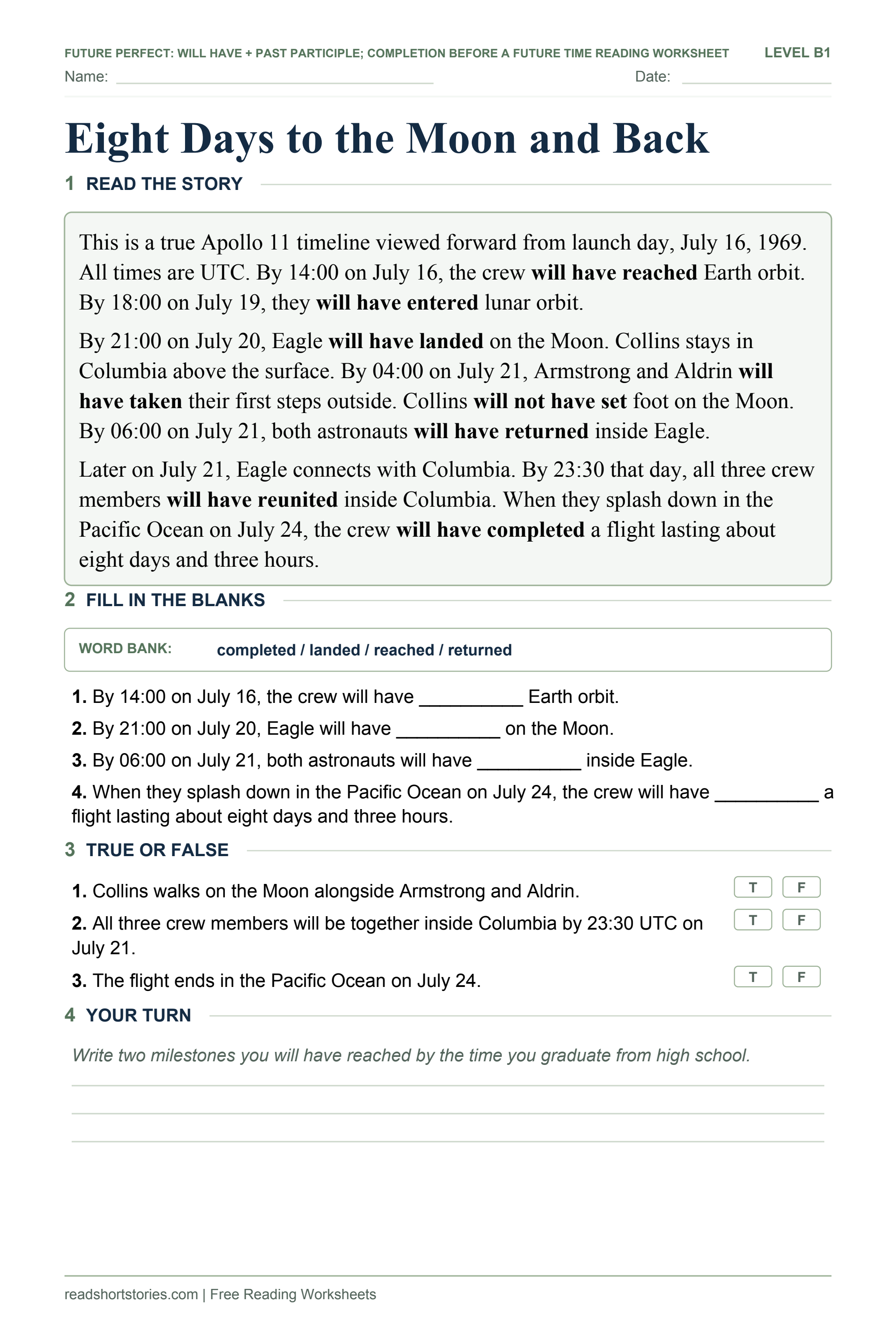
This is a true Apollo 11 timeline viewed forward from launch day, July 16, 1969. All times are UTC. By 14:00 on July 16, the crew will have reached Earth orbit. By 18:00 on July 19, they will have entered lunar orbit.
By 21:00 on July 20, Eagle will have landed on the Moon. Collins stays in Columbia above the surface. By 04:00 on July 21, Armstrong and Aldrin will have taken their first steps outside. Collins will not have set foot on the Moon. By 06:00 on July 21, both astronauts will have returned inside Eagle.
Later on July 21, Eagle connects with Columbia. By 23:30 that day, all three crew members will have reunited inside Columbia. When they splash down in the Pacific Ocean on July 24, the crew will have completed a flight lasting about eight days and three hours.
Fill in the Blanks
Words: reached, landed, returned, completed
- By 14:00 on July 16, the crew will have __________ Earth orbit. Answer: reached
- By 21:00 on July 20, Eagle will have __________ on the Moon. Answer: landed
- By 06:00 on July 21, both astronauts will have __________ inside Eagle. Answer: returned
- When they splash down in the Pacific Ocean on July 24, the crew will have __________ a flight lasting about eight days and three hours. Answer: completed
True or False
- Collins walks on the Moon alongside Armstrong and Aldrin. False. Collins remains in Columbia and does not walk on the Moon. Evidence: Collins will not have set foot on the Moon.
- All three crew members will be together inside Columbia by 23:30 UTC on July 21. True. Evidence: By 23:30 that day, all three crew members will have reunited inside Columbia.
- The flight ends in the Pacific Ocean on July 24. True. Evidence: When they splash down in the Pacific Ocean on July 24, the crew will have completed a flight lasting about eight days and three hours.
Write two milestones you will have reached by the time you graduate from high school.
Sample answer: By the time I graduate from high school, I will have passed all my advanced science classes. I will also have earned my driver’s license.
The Parcel That Travels Twice
Sena and her cousin have been writing to each other since they were ten, but neither of them has ever sent something made by hand. Her cousin lives two towns away—close enough for a day trip, far enough that they visit only a few times a year. One evening in October, Sena suggests an exchange: each of them will sketch the view from their own front window, mail the original, and keep a photo copy at home so neither drawing truly disappears.
Her cousin agrees immediately. “By the time November arrives, we’ll both have sent our sketches,” he types back. “And received each other’s,” Sena adds.
Sena spends a Saturday morning on her drawing. She sketches the narrow street outside—the hardware store across the road, the two oak trees with leaves already turning orange. She is careful with the window frame in the foreground, because that detail proves the view is genuinely hers. When she finishes, she photographs the postcard on the kitchen table, addresses the back, and walks it to the mailbox.
That evening she sends her cousin the photo online, just to show him what is coming. He replies within minutes. “It already feels like I have it. Does that count?”
Sena stares at the message. Sending is not the same as arriving, and arriving is not the same as displaying. She opens her notebook and writes three column headers: Sent / Arrived / Displayed. Under Sent she writes today’s date. Under Arrived she writes a few days—if delivery goes normally. By the time the card reaches him, it will have traveled through a collection box, a sorting center, and a delivery bag. That takes time. A photo won’t have gone anywhere except a screen.
She types back: “No, a photo doesn’t count. By the time your card is on my wall, it will have made a real journey.”
Her cousin sends one question: “So when do we call it done?”
Sena looks at her notebook. She counts forward three weeks and circles the third Saturday in November. By that date, if the postal system runs normally, each of them will have received the other’s original and will have had a few days to find a frame. She tells him the date and adds that it is a target, not a promise; if either card is delayed, they will simply move the date forward.
“That works,” he writes. “It’s a real finish line.”
Sena pins the photo copy of her sketch above her desk. It is a record of what she has sent, not a replacement for what she hopes to receive. Somewhere between their two towns, her cousin’s drawing is already moving—a rectangle of card with his handwriting on the back and a street she has never seen from her own window. By the third Saturday, if all goes well, she will have held it. That is what the wait is for.
Questions
- Why does Sena take a digital photo of her drawing before walking to the mailbox?
- What is the main reason Sena refuses to count a photo on a screen as an arrived postcard?
- Why does Sena describe the third Saturday in November as a target rather than a promise?
- How is the photo above Sena’s desk different from the card she is waiting for?
Future Perfect Practice
- Complete with the future perfect of ‘send’ (three words): By November, both cousins __________ their original sketches.
- Choose the future perfect form: By the third Saturday, Sena __________ her cousin’s postcard if the mail runs on time.
- will have received
- has received
- will receive
- had received
- Complete with the contracted negative future perfect of ‘go’ (three words): Before Sena prints or forwards it, the digital image __________ anywhere except a phone screen.
- Which sentence correctly describes an action completed before a deadline?
- By that date, each cousin will have had time to buy a frame.
- By that date, each cousin will had time to buy a frame.
- By that date, each cousin will having time to buy a frame.
- By that date, each cousin have had time to buy a frame.
- Put the supplied words in order to make an affirmative future perfect sentence. Begin with The.
- card
- the
- traveled
- will
- have
Click to see the answers
Reading Answers
- She wants to keep a copy of the drawing she is mailing. Evidence: each of them will sketch the view from their own front window, mail the original, and keep a photo copy at home so neither drawing truly disappears.
- Showing an image on a screen does not mean that the original card has completed its physical journey. Evidence: By the time the card reaches him, it will have traveled through a collection box, a sorting center, and a delivery bag.
- Postal delays are possible, so they can move the display date if necessary. Evidence: She tells him the date and adds that it is a target, not a promise; if either card is delayed, they will simply move the date forward.
- Her photo records her own mailed sketch; she is waiting for her cousin’s physical original. Evidence: It is a record of what she has sent, not a replacement for what she hopes to receive.
Practice Answers
- will have sent Sent is the irregular past participle of send.
- will have received The receipt is expected before the target date, subject to normal delivery.
- won’t have gone Use the contraction won’t, then have and gone.
- By that date, each cousin will have had time to buy a frame. Will have had describes time available before that date.
- The card will have traveled. The card is the subject; will have traveled is the verb phrase.
Your turn: Describe a project you plan to finish soon. Write three sentences using the future perfect (‘will have + past participle’) with specific times or deadlines.
Listen to this story (audio)
Click to see the short worksheet text and answers
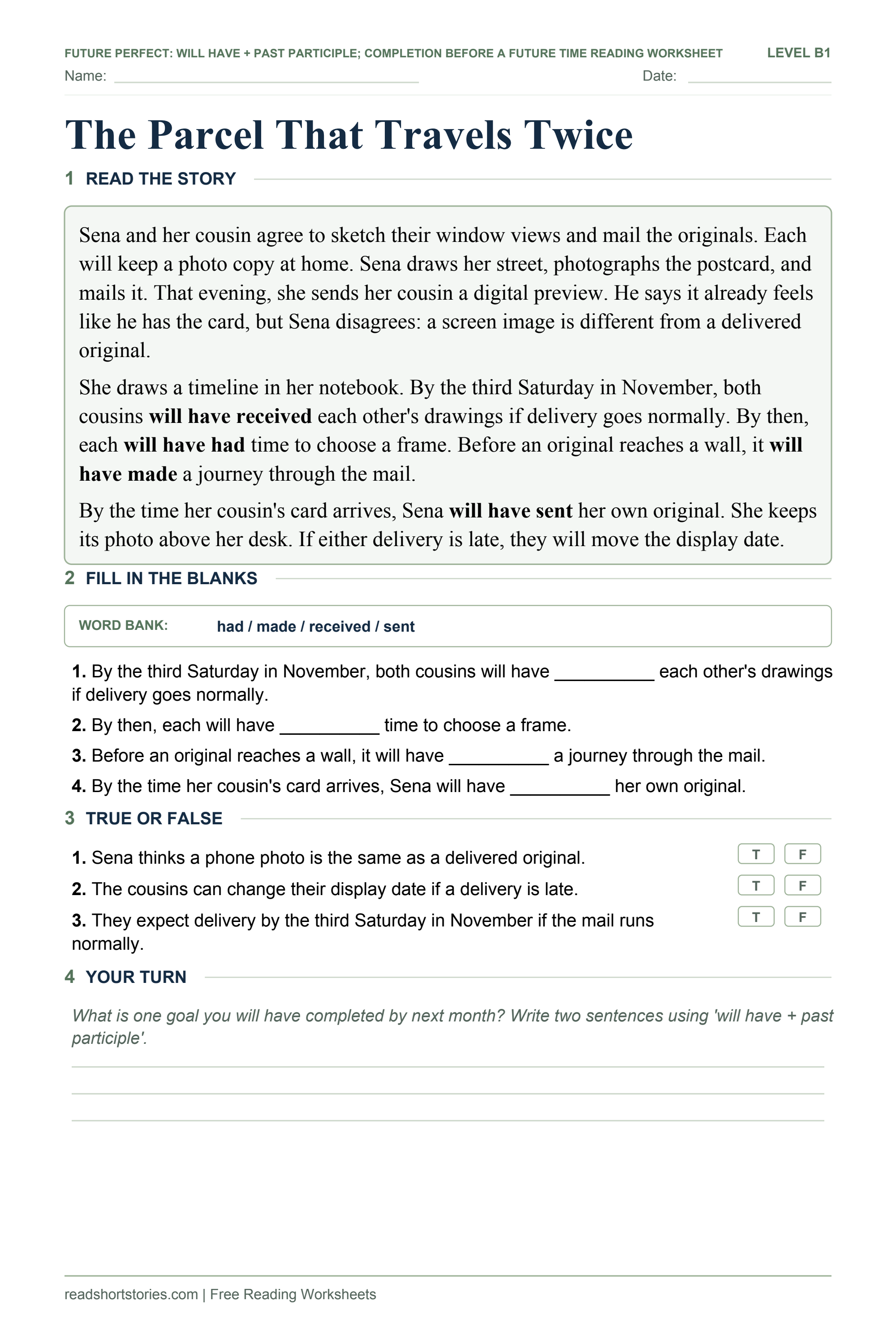
Sena and her cousin agree to sketch their window views and mail the originals. Each will keep a photo copy at home. Sena draws her street, photographs the postcard, and mails it. That evening, she sends her cousin a digital preview. He says it already feels like he has the card, but Sena disagrees: a screen image is different from a delivered original.
She draws a timeline in her notebook. By the third Saturday in November, both cousins will have received each other’s drawings if delivery goes normally. By then, each will have had time to choose a frame. Before an original reaches a wall, it will have made a journey through the mail.
By the time her cousin’s card arrives, Sena will have sent her own original. She keeps its photo above her desk. If either delivery is late, they will move the display date.
Fill in the Blanks
Words: received, had, made, sent
- By the third Saturday in November, both cousins will have __________ each other’s drawings if delivery goes normally. Answer: received
- By then, each will have __________ time to choose a frame. Answer: had
- Before an original reaches a wall, it will have __________ a journey through the mail. Answer: made
- By the time her cousin’s card arrives, Sena will have __________ her own original. Answer: sent
True or False
- Sena thinks a phone photo is the same as a delivered original. False. Sena thinks a screen image is different from a delivered original. Evidence: a screen image is different from a delivered original.
- The cousins can change their display date if a delivery is late. True. Evidence: If either delivery is late, they will move the display date.
- They expect delivery by the third Saturday in November if the mail runs normally. True. Evidence: By the third Saturday in November, both cousins will have received each other’s drawings if delivery goes normally.
What is one goal you will have completed by next month? Write two sentences using ‘will have + past participle’.
Sample answer: By next month, I will have read two English novels for my reading club. In addition, I will have written a short review for each book.
Download the Free PDF
Print all 6 stories and their activities. The answer key follows the student pages.
Frequently Asked Questions
What level are these stories for?
These stories are written for B1 English learners. Read with support when needed.
What does the PDF include?
6 stories, reading questions, future perfect exercises, writing tasks, and a separate answer key.
When do we use the future perfect?
Use will have plus a past participle for an action that will be completed before a specific future time or reference point. Use will not have (won’t have) for negatives and Will + subject + have + past participle for questions. In ordinary future time clauses with when or by the time, use present tenses rather than will.