Each story has a clear setting, natural dialogue, and an ending that makes sense. Students can read on their own or listen as you read aloud. Either way, the context clues are easy to find, so backing up an answer with evidence feels doable.
Listen and read along: Audio versions are available for 4 stories on this page. Use the players below.
You can download the free short stories for 4th graders PDF below.
Short Stories for 4th Graders
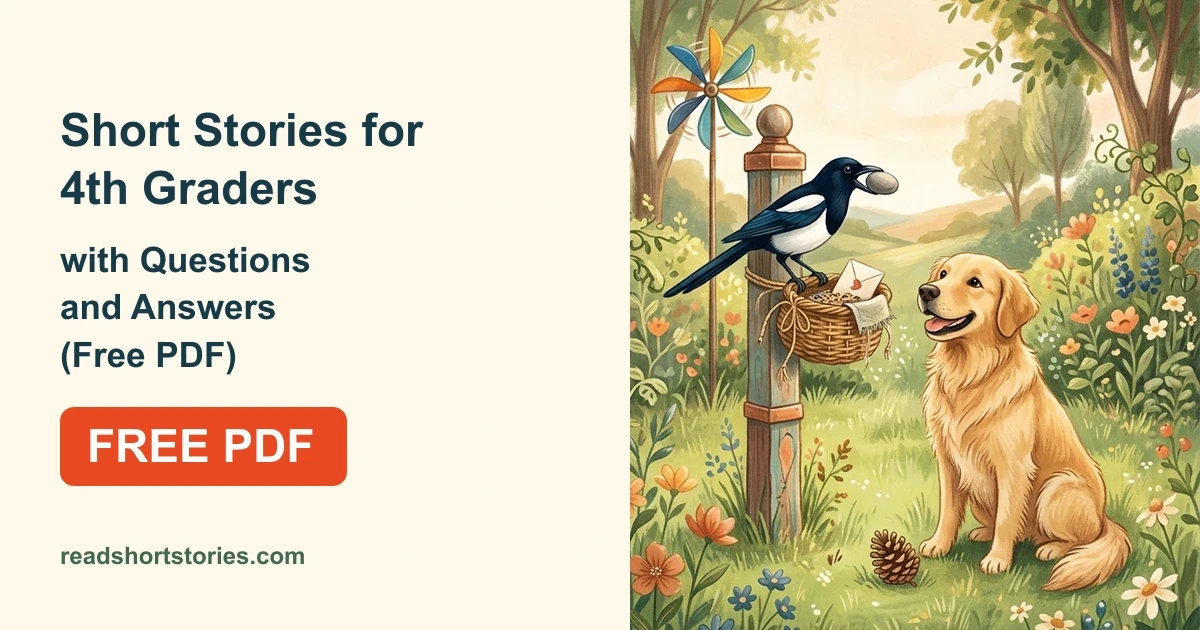
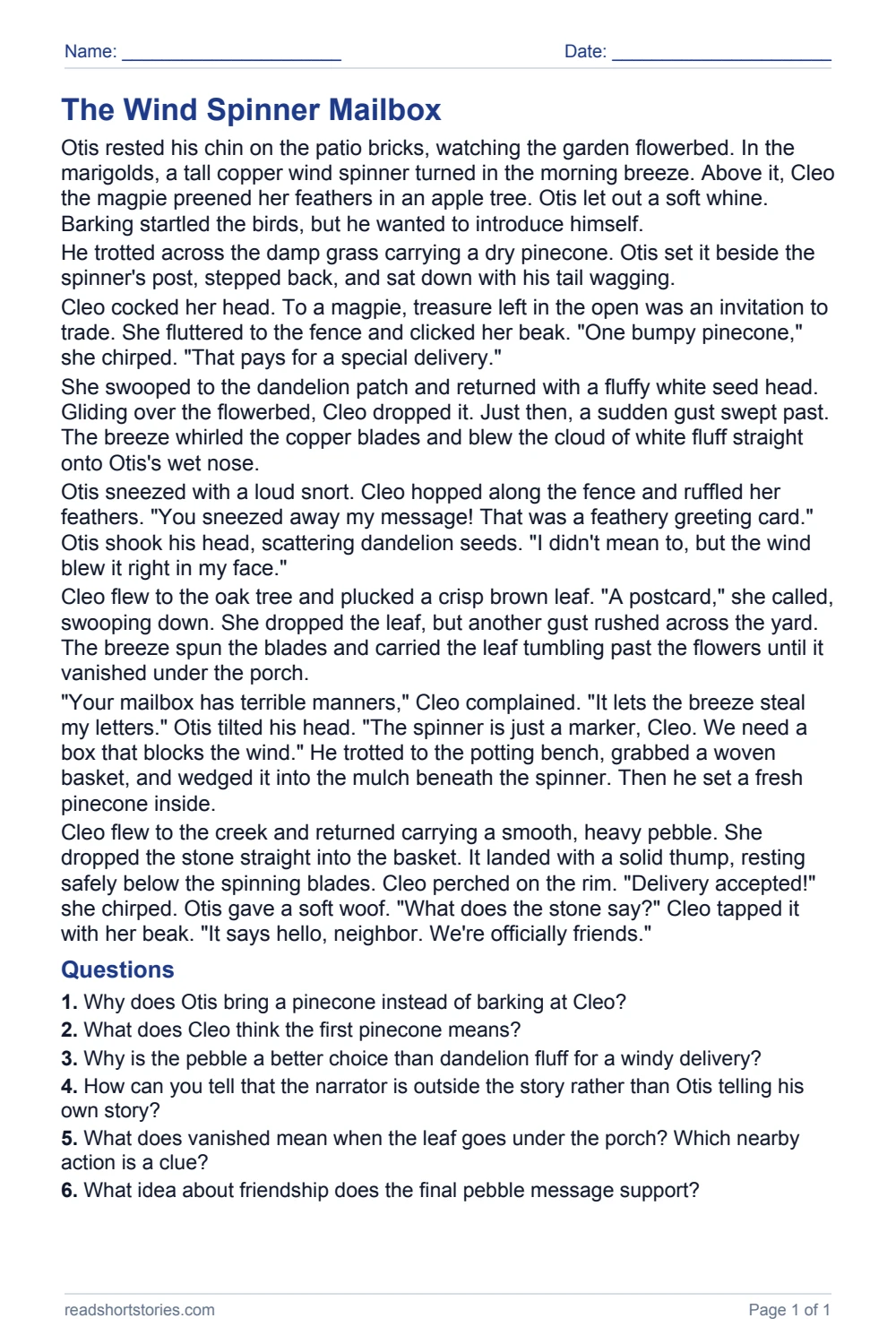
The Wind Spinner Mailbox
Otis rested his chin on the patio bricks, watching the garden flowerbed. In the marigolds, a tall copper wind spinner turned in the morning breeze. Above it, Cleo the magpie preened her feathers in an apple tree. Otis let out a soft whine. Barking startled the birds, but he wanted to introduce himself.
He trotted across the damp grass carrying a dry pinecone. Otis set it beside the spinner’s post, stepped back, and sat down with his tail wagging.
Cleo cocked her head. To a magpie, treasure left in the open was an invitation to trade. She fluttered to the fence and clicked her beak. “One bumpy pinecone,” she chirped. “That pays for a special delivery.”
She swooped to the dandelion patch and returned with a fluffy white seed head. Gliding over the flowerbed, Cleo dropped it. Just then, a sudden gust swept past. The breeze whirled the copper blades and blew the cloud of white fluff straight onto Otis’s wet nose.
Otis sneezed with a loud snort. Cleo hopped along the fence and ruffled her feathers. “You sneezed away my message! That was a feathery greeting card.” Otis shook his head, scattering dandelion seeds. “I didn’t mean to, but the wind blew it right in my face.”
Cleo flew to the oak tree and plucked a crisp brown leaf. “A postcard,” she called, swooping down. She dropped the leaf, but another gust rushed across the yard. The breeze spun the blades and carried the leaf tumbling past the flowers until it vanished under the porch.
“Your mailbox has terrible manners,” Cleo complained. “It lets the breeze steal my letters.” Otis tilted his head. “The spinner is just a marker, Cleo. We need a box that blocks the wind.” He trotted to the potting bench, grabbed a woven basket, and wedged it into the mulch beneath the spinner. Then he set a fresh pinecone inside.
Cleo flew to the creek and returned carrying a smooth, heavy pebble. She dropped the stone straight into the basket. It landed with a solid thump, resting safely below the spinning blades. Cleo perched on the rim. “Delivery accepted!” she chirped. Otis gave a soft woof. “What does the stone say?” Cleo tapped it with her beak. “It says hello, neighbor. We’re officially friends.”
Questions
- Why does Otis bring a pinecone instead of barking at Cleo?
- What does Cleo think the first pinecone means?
- Why is the pebble a better choice than dandelion fluff for a windy delivery?
- How can you tell that the narrator is outside the story rather than Otis telling his own story?
- What does vanished mean when the leaf goes under the porch? Which nearby action is a clue?
- What idea about friendship does the final pebble message support?
Click to see the answers
Answers
- He wants to introduce himself without frightening the birds. Evidence: Barking startled the birds, but he wanted to introduce himself.
- She thinks it is payment for a special delivery. Evidence: “One bumpy pinecone,” she chirped. “That pays for a special delivery.”
- The pebble is heavy, so it stays in the basket instead of blowing away like the light fluff. Evidence: Cleo flew to the creek and returned carrying a smooth, heavy pebble. She dropped the stone straight into the basket. It landed with a solid thump, resting safely below the spinning blades.
- The narrator calls the dog Otis and he, rather than telling the events using I. Evidence: He trotted across the damp grass carrying a dry pinecone. Otis set it beside the spinner’s post, stepped back, and sat down with his tail wagging.
- It means disappeared from sight. The wind carries the leaf away and under the porch, where Otis can no longer see it. Evidence: The breeze spun the blades and carried the leaf tumbling past the flowers until it vanished under the porch.
- A small friendly greeting can help a friendship begin. Accept another explanation that connects the greeting to becoming friends. Evidence: “It says hello, neighbor. We’re officially friends.”
Listen to this story (audio)
Footsteps Behind the Curtain
Behind the heavy velvet curtain of the community theater, Kavi stared down at the stage floorboards. Opening night was two days away, and the director needed a believable entrance for the friendly forest giant. When Kavi stomped his sneakers on the bare wood, the sound was a sharp, hollow clatter. It sounded like falling firewood, not the slow steps of a gentle giant.
Ravi peeked around the painted scenery with a rehearsal notebook in his hand. “The sound booth has loud thunder recorded,” Ravi said, “but the director wants the giant’s arrival live from backstage. If you stomp like that, the audience will think someone dropped a ladder.”
“A real giant wouldn’t rattle,” Kavi said. “He needs a deep, soft step, like someone walking through moss.”
Kavi walked over to the prop table near the curtain. The director had set out a box of safe practice items for their sound experiment. First, Kavi picked up two small wooden blocks and tapped them together over a tray. The sound was a loud, dry click.
Ravi shook his head from the stage edge. “Too sharp. That sounds like a tap dancer on a sidewalk.”
Next, Kavi tried two small cloth bags filled with dried beans. He patted them gently against the wooden boards. The beans made a soft rustle, like dry leaves tumbling in the wind.
“That is much too quiet,” Ravi said, walking toward the auditorium seats to listen. “A giant does not whisper when he walks.”
Kavi looked back into the prop box. At the bottom lay a pair of heavy rubber rain boots and a thick foam exercise mat. Kavi smiled. He spread the foam mat flat behind the scenery. Then he slipped his hands inside the boots, holding them by the ankles so the wide rubber soles pointed down. Instead of banging the boots, Kavi pressed the heels firmly onto the foam mat.
Thump. A low, muffled sound rose from the floor. The soft foam swallowed the sharp slap, leaving only a deep, solid step that echoed behind the curtain.
Ravi stopped in the center aisle of the auditorium and turned around. “Try a walking pattern!” he called.
Kavi pressed the boots down one after the other in a slow, steady rhythm: left heel, right heel. Thump… thump… thump.
Ravi laughed and gave a big thumbs-up from the aisle. “That is perfect! The giant is finally here.”
Questions
- Why does Kavi reject the sound of his own sneakers for the giant’s entrance?
- Which two items does Kavi find at the bottom of the prop box?
- How does the bean-bag sound differ from the loud click of the wooden blocks?
- How does listening from the auditorium help Ravi judge the final sound?
- What does muffled mean here, and how does the foam help you understand it?
- What does Ravi’s final reaction suggest makes a sound effect successful?
Click to see the answers
Answers
- Their sharp, hollow clatter sounds like falling firewood rather than the giant’s slow steps. Evidence: When Kavi stomped his sneakers on the bare wood, the sound was a sharp, hollow clatter. It sounded like falling firewood, not the slow steps of a gentle giant.
- He finds rubber rain boots and a foam exercise mat. Evidence: At the bottom lay a pair of heavy rubber rain boots and a thick foam exercise mat.
- The bags make a soft rustling sound, like leaves, instead of a sharp click. Evidence: He patted them gently against the wooden boards. The beans made a soft rustle, like dry leaves tumbling in the wind.
- It lets him judge the effect from the audience’s place, so he can tell whether it suggests a giant arriving. Evidence: Ravi stopped in the center aisle of the auditorium and turned around. “Try a walking pattern!” he called.
- It means softened or less sharp. The foam removes the sharp slap and leaves a low sound. Evidence: A low, muffled sound rose from the floor. The soft foam swallowed the sharp slap, leaving only a deep, solid step that echoed behind the curtain.
- A successful effect helps listeners imagine the character or action it represents. Evidence: “That is perfect! The giant is finally here.”
Listen to this story (audio)
The Chapter at the Middle Table
Zuri slid the mystery book across the library table. Its cover showed an iron lantern beside a stone gate. “Look at chapter one, Nola,” she whispered. “A detective follows signs through town at night. We only have thirty minutes to choose our partner book, and this has puzzles to solve.”
Nola pushed her green adventure book across the table. “Puzzles are fine, but this story happens on a park trail,” she whispered back. “A camper searches for a dropped glove before the afternoon hike ends. It has an outdoor search.”
Mrs. Lopez placed a quiet finger over her lips from the checkout desk. The library clock ticked on the brick wall, shaving minutes off their planning period. Neither girl wanted to write about a book she had not picked.
“We cannot spend the period arguing,” Zuri whispered. “Let’s read one short excerpt aloud from each book. Two minutes each. If your trail story is more exciting, we will pick yours.”
“Deal,” Nola said. She turned to a marked page and read softly: ‘Faye paused by the trail bench. Two sneaker prints pressed into the damp path, and a yellow thread caught on a pine branch. Every small mark gave her a clue.’
Zuri’s eyes brightened. “Wait. Faye tracks clues to solve a problem, exactly like a detective.”
Nola looked down at the page. “I guess she does,” she admitted. “What does your book say?”
Zuri opened her mystery to chapter three and read: ‘Beck examined the dusty garden gate. Three muddy footprints pointed toward the hedge, and a torn ribbon dangled from the latch. If he followed the trail before sunset, he could find the missing key.’
Nola leaned closer to see the sketch of the footprints. “That is the exact same challenge,” she said. “Both characters observe tiny details that others missed.”
“They really do,” Zuri agreed. “So which one should we use? We still have to pick one title for the worksheet.”
Nola flipped through Zuri’s book, noticing the short chapters and clear gate sketches. “Let’s use the garden mystery for our report because the picture clues will help us explain how the detective solves the mystery,” Nola said. “We can check out the trail book too, and I will read it first tonight.”
“Deal,” Zuri said with a grin. She picked up her pencil and wrote the mystery title across the top of their assignment sheet.
Questions
- What does Zuri do after the girls agree to report on the mystery book?
- Why do Zuri and Nola feel pressure during their library planning time?
- Why does Faye’s excerpt make Nola’s adventure book more interesting to Zuri?
- What does Zuri’s suggestion to read excerpts aloud reveal about her approach to solving disagreements?
- What theme about cooperation is shown when the girls choose their project book?
- What does the word observe mean as it is used in the story?
Click to see the answers
Answers
- Zuri uses her pencil to write down the mystery book’s title for their project. Evidence: She picked up her pencil and wrote the mystery title across the top of their assignment sheet.
- The library clock shows that their limited time to choose a book is quickly slipping away. Evidence: The library clock ticked on the brick wall, shaving minutes off their planning period.
- Zuri recognizes a detective-like search for clues, which connects the adventure to the puzzles she enjoys in mysteries. Evidence: “Wait. Faye tracks clues to solve a problem, exactly like a detective.”
- She tries a fair comparison by listening to both choices instead of continuing the argument. Evidence: Let’s read one short excerpt aloud from each book. Two minutes each.
- Listening to different preferences can reveal shared interests and help partners agree on a plan. Accept a similar idea supported by their discussion and final choice. Evidence: “Let’s use the garden mystery for our report because the picture clues will help us explain how the detective solves the mystery,” Nola said. “We can check out the trail book too, and I will read it first tonight.”
- It means to watch carefully and notice small details that are easily overlooked. Evidence: “That is the exact same challenge,” she said. “Both characters observe tiny details that others missed.”
Listen to this story (audio)
The Reverse Trail Guide
Soren tapped his walking stick against a flat rock. He and his cousin Idris were hiking along a winding dirt path at Pine Ridge Nature Reserve with their aunt, Rhea. The afternoon air smelled like dry pine needles, and their goal was to reach the high overlook before sunset.
“Look, the Cedar Loop guide,” Soren said, pointing toward a wide wooden post where the path split in two directions. A painted board showed a list of numbered stops alongside a simple carved trail map.
Idris stepped closer to read the painted lines. “Step two says: ‘Cross the wooden footbridge over the creek, then walk straight to the twin cedar tree.’ But that does not make sense. We walked past that split twin cedar tree near our car, and there was no bridge at all.”
Soren studied the right-hand path. Thick bushes lined the dirt, but the ground was dry and silent. “Maybe the bridge was taken down,” he guessed, looking around for water.
Aunt Rhea stopped beside them and pointed to the carved circle map above the list. “Take a closer look at the map,” she suggested. “Where does the route begin?”
Idris traced a painted red line with his finger. Near the top of the loop, a painted star was labeled North Parking Entrance. A small arrow followed the loop in a clockwise circle, leading first to the footbridge and then to the twin cedar. Below the cedar, a yellow dot marked You Are Here right at the fork.
“We did not start at the north lot,” Idris realized, turning to Soren. “Aunt Rhea drove us to the south gate. That means we are walking along the loop in reverse!”
“So the list is not wrong,” Soren said, checking the map again. “It was just written for people walking from the opposite direction. Since we came from the south gate, we reached the twin cedar first. The map shows the left fork loops back across the creek footbridge before climbing toward the overlook.”
Aunt Rhea looked at the wooden signpost next to the left branch. A carved label read Creek Bridge Trail. “That matches the map,” she agreed. “Good detective work, boys. Let’s head that way together.”
The cousins grinned and followed the left path beside Aunt Rhea. Within a few minutes, the gentle sound of rushing water drifted through the trees, and the sturdy wooden planks of the footbridge came into view around the bend.
Questions
- Where do Soren, Idris, and Aunt Rhea want to go before sunset?
- Why does Idris first believe the instructions on the trail board do not make sense?
- What leads the cousins to realize they are walking the loop in reverse?
- What does the phrase “Idris realized” tell you about the narrator’s view of Idris?
- What does opposite mean when Soren explains which direction the guide was written for? Use clues from their starting place.
- What theme about solving an unexpected puzzle is shown through the characters’ actions?
Click to see the answers
Answers
- They want to reach the high overlook at Pine Ridge Nature Reserve before sunset. Evidence: The afternoon air smelled like dry pine needles, and their goal was to reach the high overlook before sunset.
- He already passed the twin cedar tree near their parked car without crossing any footbridge, which conflicts with step two’s order. Evidence: We walked past that split twin cedar tree near our car, and there was no bridge at all.
- They compare the guide’s north starting point with their own south entrance and realize that they are following the loop in reverse. Evidence: “We did not start at the north lot,” Idris realized, turning to Soren. “Aunt Rhea drove us to the south gate. That means we are walking along the loop in reverse!”
- The narrator tells us that Idris understands a new idea, so we learn about his thinking as well as his visible actions. Evidence: “We did not start at the north lot,” Idris realized, turning to Soren.
- It means moving in the reverse direction along the trail rather than the forward path described on the guide. Evidence: It was just written for people walking from the opposite direction. Since we came from the south gate, we reached the twin cedar first.
- Checking available facts carefully helps people understand confusing information instead of assuming it is wrong. Evidence: “So the list is not wrong,” Soren said, checking the map again.
Listen to this story (audio)
Download the Free PDF
The workbook includes 10 stories: the 4 stories above and 6 bonus stories, with questions and a separate answer key.
Frequently Asked Questions
How long are the stories?
The web stories have 379–408 words each. Read together when a child needs support.
Does the PDF include answers?
Yes. All 10 stories have questions, and the answer key is on separate pages.
How can we use these stories?
Read or listen, answer the questions, and look back at the story for clues. Print the US Letter or A4 pages for home or classroom reading.