- Short Stories for ESL Students – PDF
- 1. Raj’s First Day at Work
- Words to Know
- Comprehension Questions
- Answer Key
- 2. Sarah’s Birthday Party
- Words to Know
- Comprehension Questions
- Answer Key
- 3. Jack Learns to Ride a Bike
- Words to Know
- Comprehension Questions
- Answer Key
- 4. Anna Goes Grocery Shopping
- Words to Know
- Comprehension Questions
- Answer Key
- 5. Lily’s Trip to the Zoo
- Words to Know
- Comprehension Questions
- Answer Key
- Practice with the Stories
- What to Read Next
Read five short stories for ESL students about starting a job, celebrating a birthday, learning a new skill, shopping, and visiting the zoo. Each story includes everyday conversations, useful vocabulary, and comprehension questions with answers.
Reading level: Approximately A1–A2, with most passages closer to A2. This is an editorial estimate. Selected verbs and verb phrases appear in bold to help you follow the actions. Read each story once for meaning, then return to the vocabulary and questions.
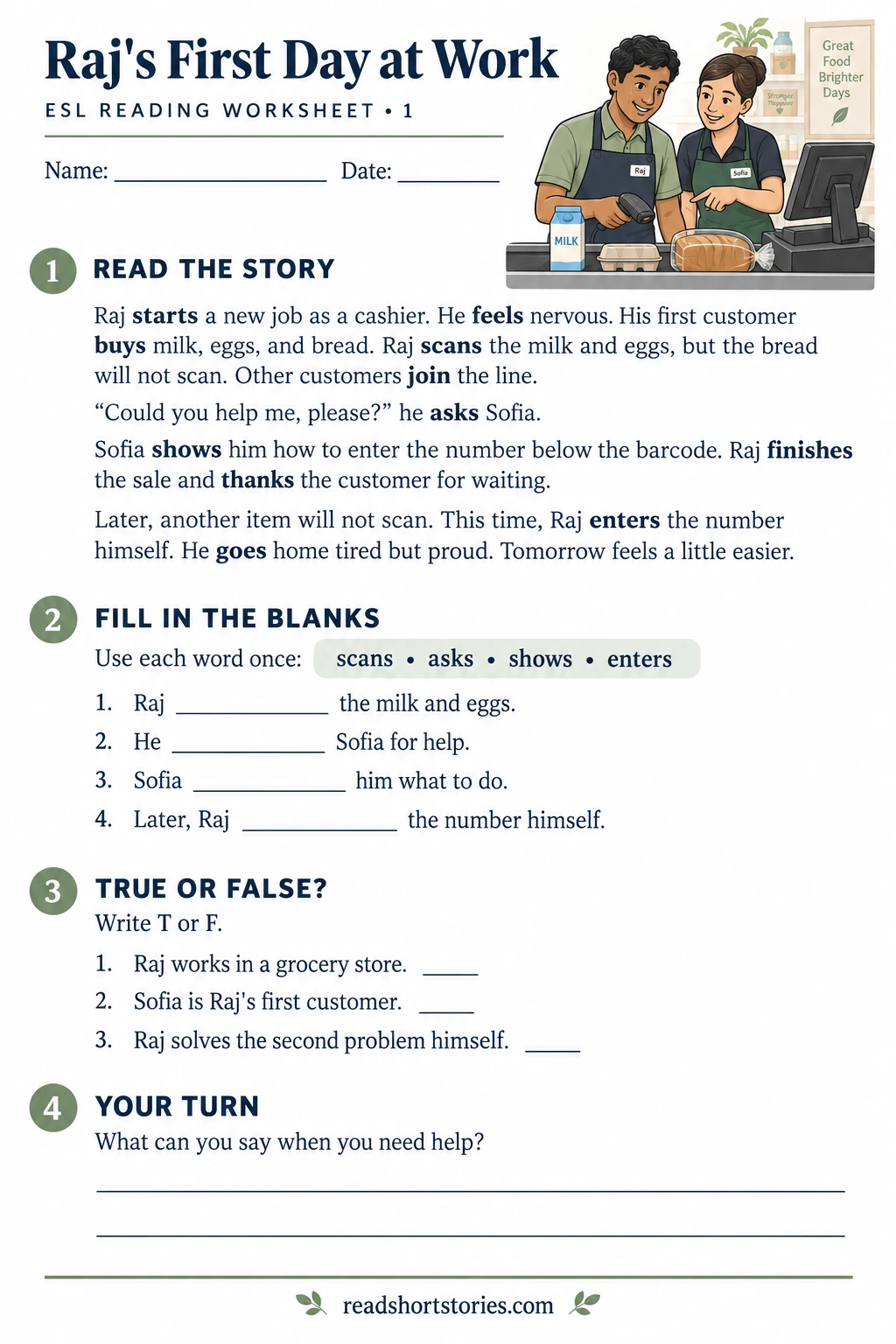
1. Raj’s First Day at Work
Raj wakes up before his alarm. Today is his first day as a cashier at a grocery store. He puts on a clean shirt and black shoes, but he hardly touches his breakfast.
“Are you nervous?” his mother asks.
“A little,” Raj says. “What if I make a mistake?”
“Then you can ask for help.” She hands him his lunch. “Nobody knows everything on the first day.”
Raj takes the bus and arrives ten minutes early. Inside the store, Mr. Smith, the manager, welcomes him.
“First, I’ll show you the cash register,” he says.
Raj watches carefully as Mr. Smith scans a box of cereal. Then Raj tries. He scans the box, checks the price, and presses the button for the total.
“Good,” Mr. Smith says. “Take your time. Sofia will be at the next register if you need help.”
At nine o’clock, an older woman comes to Raj’s register. She has milk, eggs, and bread.
“Good morning,” Raj says. He scans the milk and eggs. Then he moves the bread past the scanner. Nothing happens.
He tries again. Still nothing.
Two more customers join the line. Raj’s face feels warm. For a moment, he wants to press any button and hope it works. Instead, he looks at Sofia.
“Could you help me, please? The bread won’t scan.”
Sofia shows him how to enter the number below the barcode. The price appears on the screen.
“Thank you for waiting,” Raj tells the customer.
“That’s all right,” she says. “You’re doing fine.”
Raj takes her money and carefully counts her change. When she leaves, he breathes out slowly.
During lunch, he sits with Sofia, who is from Mexico. She tells him about her first day.
“I asked so many questions,” she says. “I even forgot where we kept the shopping bags!”
Raj laughs. He feels less alone.
That afternoon, another item will not scan. This time, Raj knows what to do. He enters the number and finishes the sale.
Before he goes home, Mr. Smith thanks him for his work.
At dinner, his mother asks, “Did you make any mistakes?”
“I needed help,” Raj says, “but I learned something.” He smiles and takes another bite. Tomorrow, he thinks, breakfast will be easier to eat.
Words to Know
- Cashier: a person who takes customers’ payments in a store. Example: The cashier gives me my receipt.
- Cash register: a machine used to record sales and handle payments. Example: Maya opens the cash register.
- Scan: to read a product’s code with a machine. Example: Please scan this bottle of water.
- Barcode: a pattern of lines on a product that a machine can read. Example: The barcode is on the back of the box.
- Change: money returned when you pay more than the price. Example: The book costs eight dollars, so I get two dollars in change.
Comprehension Questions
- Where does Raj work, and what is his job?
- What three things does his first customer buy?
- What does Raj do when the bread will not scan?
- How does Sofia help Raj feel less alone during lunch?
- What shows that Raj becomes more confident during the day?
Answer Key
- He works as a cashier at a grocery store.
- She buys milk, eggs, and bread.
- He asks Sofia for help. She shows him how to enter the number below the barcode.
- She tells him that she also asked many questions on her first day.
- Suggested answer: When another item will not scan in the afternoon, he enters the number and completes the sale himself.
2. Sarah’s Birthday Party
Sarah stands by the living room window in her pink dress and favorite shoes. Her birthday party starts in half an hour.
Behind her, her father hangs the last string of colorful lights. Her mother carries a cake into the kitchen. Sarah has already helped them put plates, cups, and snacks on the table.
“Everything is ready,” her father says.
Sarah counts the chairs. “One for everyone,” she says.
Soon, the doorbell rings. Two friends arrive together, and then three more come. The room fills with voices.
But Anna, Sarah’s closest friend, is not there.
Sarah checks her phone. There is a message: “The bus is very slow. I’m sorry. Please start without me.”
“Is something wrong?” her mother asks.
“Anna is late,” Sarah says. “She always helps me choose the games.”
Her mother points toward the living room. “Your other friends are here. Perhaps they can help today.”
Sarah puts her phone away and joins her guests. They play musical chairs. Then they try to pin a paper tail on a picture of a donkey. One tail lands near its nose, and everyone laughs.
Sarah enjoys the games, but she still looks toward the door between turns.
Just before cake time, the doorbell rings again.
Anna stands outside with a large gift bag. Her hair is wet from the rain.
“I’m so sorry!” she says.
Sarah brings her a towel. “You’re here now. Come in!”
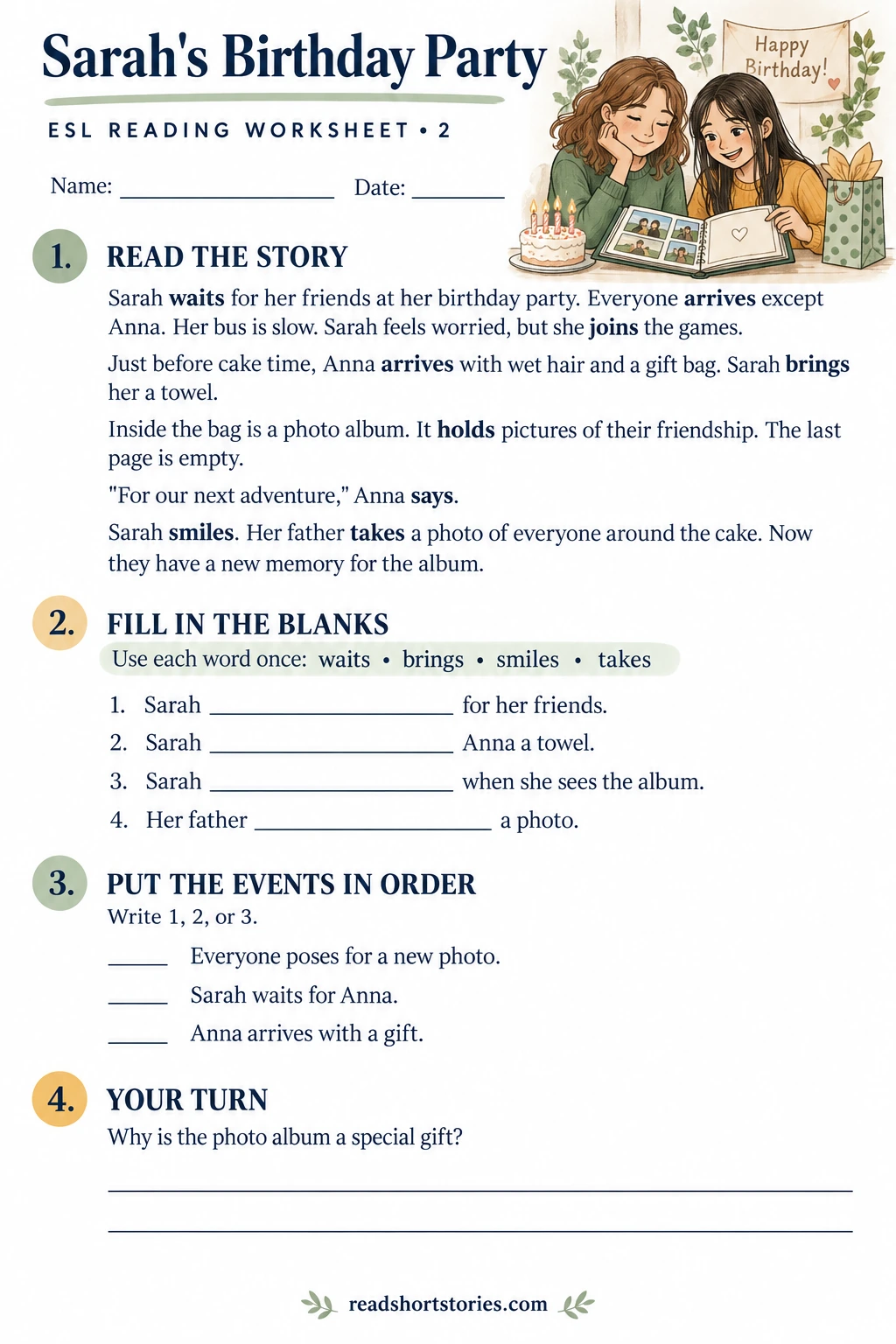
Inside the bag is a photo album. On the first page, Sarah sees a picture of herself and Anna on their first day at school. There are pictures of picnics, school projects, and funny faces.
The last page is empty. Under it, Anna has written, “For our next adventure.”
“We can start with today,” Sarah says.
Her father takes a picture of all the friends around the cake. Sarah makes a wish and blows out the candles.
Later, when the guests leave, she places the album beside her bed. She no longer remembers how many times she checked the window. She remembers Anna at the door, everyone laughing, and the empty page waiting for a new photograph.
Words to Know
- Guest: someone invited to a home or event. Example: We have four guests for dinner.
- Decorate: to make a place look special by adding things. Example: We decorate the room with paper flowers.
- Towel: a piece of cloth used to dry something. Example: Ben dries his hair with a towel.
- Album: a book for keeping photographs. Example: This album has pictures of our family.
- Empty: with nothing inside or on it. Example: I write my name on the empty page.
Comprehension Questions
- Why is Anna late for the party?
- Which two games do the guests play?
- What does Sarah do when she sees that Anna is wet?
- What is special about the last page of Anna’s gift?
- How do Sarah’s feelings change from the beginning to the end?
Answer Key
- Her bus is very slow.
- They play musical chairs and pin the tail on the donkey.
- She brings Anna a towel and invites her inside.
- It is empty, with the words “For our next adventure” written underneath.
- Suggested answer: At first, Sarah is worried about Anna’s absence. By the end, she is happy and thinks about the memories they have made together.
3. Jack Learns to Ride a Bike
Jack pushes his bike into the yard. His father follows with a helmet.
“Ready?” his father asks.
Jack looks at the two wheels. Yesterday, his father removed the small training wheels from the back.
“I think so,” Jack says quietly.
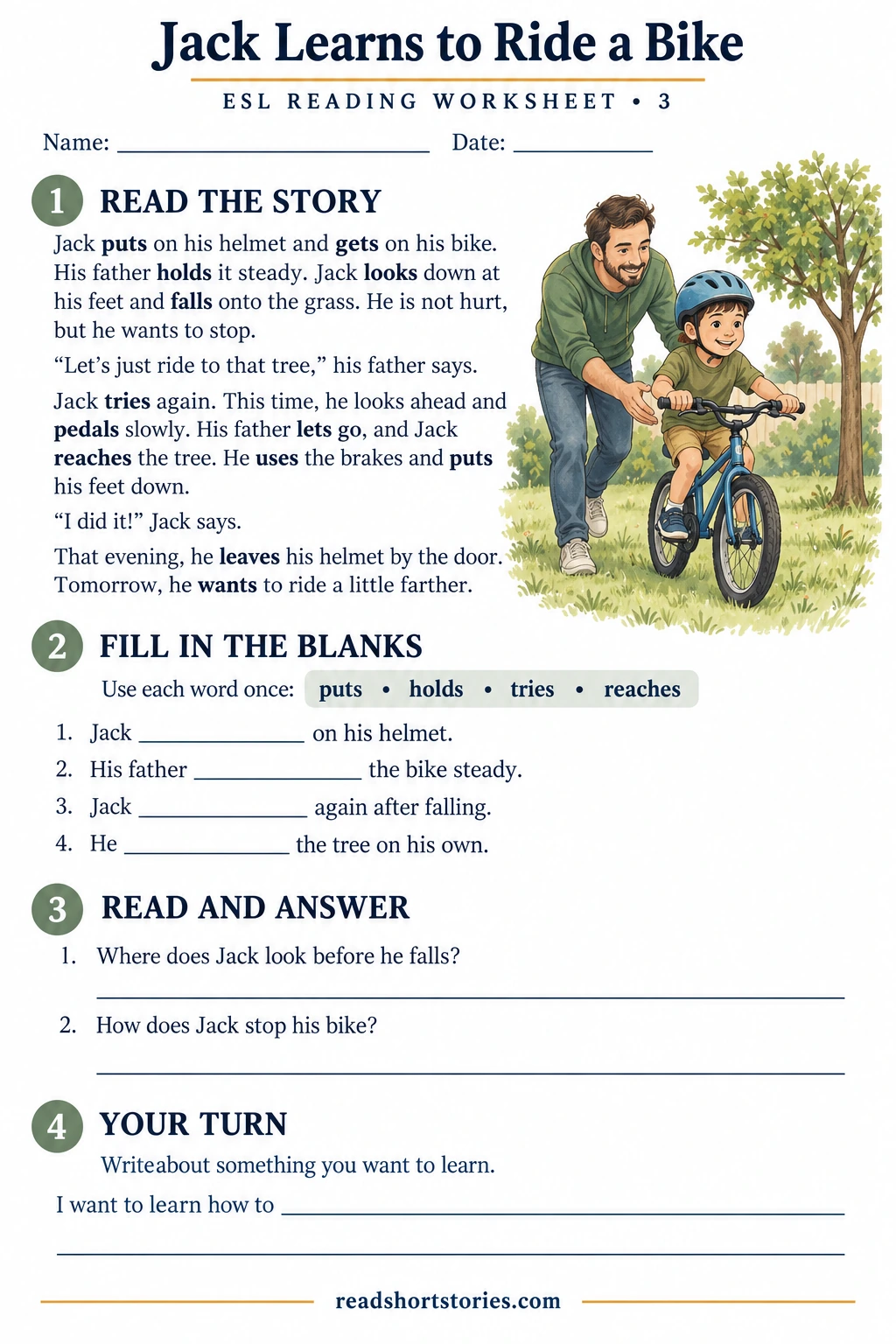
He puts on the helmet, and his father checks it. Then Jack sits on the bike while his father holds it steady.
“Look ahead,” his father says. “I’m right beside you.”
Jack pushes one pedal, then the other. The bike moves, but he looks down at his feet. It turns toward the grass. Jack falls onto his side.
His father helps him up and checks that he is not hurt.
“I don’t want to do it,” Jack says. He brushes grass from his trousers. “It’s too hard.”
They sit on the garden bench for a moment.
“Which part feels hardest?” his father asks.
“Everything happens at once. I have to pedal, look, and keep the bike straight.”
His father nods. “Then we’ll go slowly. We don’t have to ride across the whole yard.”
He points to a small tree a short distance away. “Let’s just try to reach that tree.”
Jack takes a breath and gets back on the bike.
This time, he looks at the tree. His father walks beside him and holds the bike. Jack pedals slowly.
“You’re keeping it straight,” his father says. “Can I let go for a moment?”
“Okay,” Jack says.
For a few seconds, nobody is holding the bike. Jack keeps pedaling. The tree gets closer.
“I’m doing it!” he calls.
He reaches the tree, uses the brakes, and puts his feet down. His father runs over with a wide smile.
Jack tries again. He does not ride perfectly every time, but each short journey feels a little easier.
When his mother comes outside, he calls, “Watch me!” He rides from the bench to the tree and stops beside her.
That evening, Jack puts his helmet next to the back door.
“For tomorrow?” his father asks.
Jack nods. “Tomorrow, I want to go a little farther.”
Words to Know
- Helmet: a hard hat that protects your head. Example: I wear a helmet when I ride my bike.
- Steady: firm and not moving from side to side. Example: Please hold the chair steady.
- Pedal: to move a bicycle by pushing its pedals with your feet. Example: We pedal slowly up the hill.
- Brakes: parts of a bicycle or vehicle that slow or stop it. Example: She uses the brakes before the corner.
- Farther: a greater distance away. Example: Today, we walk farther than yesterday.
Comprehension Questions
- What is different about Jack’s bike today?
- Where does Jack look just before he falls?
- What smaller goal does his father suggest?
- How does Jack stop when he reaches the tree?
- Why does Jack leave his helmet beside the back door?
Answer Key
- It no longer has training wheels.
- He looks down at his feet.
- His father suggests riding a short distance to the tree.
- He uses the brakes and puts his feet down.
- Suggested answer: He wants to practice again the next day. He says that he wants to ride a little farther.
4. Anna Goes Grocery Shopping
Anna opens the refrigerator and looks inside. There is a small piece of cheese, but there are not enough vegetables for dinner.
Her brother, Leo, is coming home after a week away. Anna wants to make his favorite vegetable soup.
She writes a shopping list: carrots, tomatoes, potatoes, bread, cheese, and milk. Then she takes two shopping bags and walks to the grocery store.
Inside, Anna finds the carrots and potatoes quickly. She chooses a loaf of bread and puts it carefully in her basket.
But the shelf for fresh tomatoes is empty.
Anna checks her list again. Without tomatoes, the soup will be different. She looks at the clock on the wall. There is not enough time to visit another store.
A store worker is putting onions on a nearby shelf.
“Excuse me,” Anna says. “Do you have any more fresh tomatoes?”
The worker shakes his head. “Not today, I’m sorry. What are you making?”
“Vegetable soup.”
“We have canned tomatoes in aisle four. They might work for your soup.”
Anna thanks him and finds the aisle. She chooses a can, then collects the cheese and milk.
At the checkout, the cashier asks, “Do you have a loyalty card?”
“No, I don’t,” Anna says.
She pays with cash, puts her change in her purse, and packs her bags. Before leaving, she checks the list one more time.
At home, Anna washes and cuts the fresh vegetables. She adds them to a pot with the canned tomatoes and some water. Soon, the kitchen smells warm and welcoming.
When Leo arrives, he puts down his bag.
“Is that your vegetable soup?” he asks.
“Almost,” Anna says. “I had to change one ingredient.”
They sit down with bowls of soup and slices of bread. Leo tastes a spoonful.
“Can I have some more?” he asks.
Anna laughs. “You haven’t finished your first bowl!”
After dinner, she adds a note to her recipe: “Fresh or canned tomatoes.” Then she puts the recipe away and joins her brother to hear about his week.
Words to Know
- Ingredient: one of the foods used to make a dish. Example: Eggs are an ingredient in this cake.
- Canned: kept in a sealed metal container. Example: We use canned beans for lunch.
- Aisle: a passage between rows of shelves in a store. Example: The rice is in aisle three.
- Checkout: the place where you pay in a store. Example: There are two people at the checkout.
- Recipe: instructions for making a dish. Example: This recipe tells us how to make soup.
Comprehension Questions
- Why does Anna want to make vegetable soup?
- Which fresh ingredient is unavailable?
- What does the store worker suggest?
- How does Anna pay for her shopping?
- What suggests that Leo enjoys the soup?
Answer Key
- Her brother is coming home, and it is his favorite soup.
- Fresh tomatoes are unavailable.
- He suggests using canned tomatoes from aisle four.
- She pays with cash.
- Suggested answer: He asks for more before he has finished his first bowl.
5. Lily’s Trip to the Zoo
Lily wakes up early on Saturday and puts a small notebook in her bag. Today, she is visiting the zoo with her family.
“What’s the notebook for?” her father asks.
“Animal drawings,” Lily says. “I want to draw an elephant and a giraffe.”
At the entrance, her mother picks up a map. Lily points to the monkeys, and they follow the path together.
Two monkeys are jumping between branches. Another is sitting quietly with some food.
Lily opens her notebook, but the jumping monkeys move too quickly.
“Please stay still!” she says with a laugh.
“Perhaps draw the one that’s eating,” her father suggests.
Lily makes a quick drawing, then adds a long branch beneath the monkey.
Next, they visit the elephants. One elephant uses its trunk to pick up food. Lily watches before she begins her picture.
“I need a much longer nose,” she says, looking at her drawing.
They see giraffes reaching for leaves, and Lily fills another page. By lunchtime, she has several pictures, but she still wants to visit the penguin exhibit.
After eating, the family follows the map to the penguins.
At first, Lily sees only rocks and water.
“Where are they?” she asks. “Did we miss them?”
Her brother points toward a window beside the pool. “Let’s look down there.”
They walk to the glass. Suddenly, a penguin swims past them underwater. Then another follows.
Lily presses her hands together in excitement.
“They’re so fast!”
She tries to draw one, but it disappears before she finishes. She puts down her pencil and watches instead.
A few minutes later, a penguin climbs out of the water and waddles across the rocks. Now Lily can see its feet clearly. She starts a new drawing.
On the way home, her mother asks which animal she liked best.
“The penguins,” Lily says. “I nearly thought there weren’t any!”
At home, she shows her family the notebook. Her penguin picture has two parts: one bird on the rocks and another below the water.
Underneath, she writes, “Sometimes you need to look in a different place.” Then she turns to a clean page, ready for another trip.
Words to Know
- Branch: a part of a tree that grows out from its trunk. Example: A bird sits on the branch.
- Trunk: an elephant’s long nose. Example: The elephant lifts food with its trunk.
- Exhibit: an area where visitors can see animals or objects on display. Example: We visit the butterfly exhibit.
- Underwater: below the surface of water. Example: I can see a fish swimming underwater.
- Waddle: to walk with short steps while moving from side to side. Example: The ducks waddle toward the pond.
Comprehension Questions
- Why does Lily bring a notebook?
- Why does she choose to draw the monkey that is eating?
- What does the elephant do with its trunk?
- Where does Lily finally see the swimming penguins?
- What does Lily learn from her visit to the penguin exhibit?
Answer Key
- She wants to draw the animals.
- It is sitting quietly, while the other monkeys are moving too quickly.
- It uses its trunk to pick up food.
- She sees them underwater through a window beside the pool.
- Suggested answer: She learns that looking from another place can help her notice something she missed. The penguins are visible through the underwater window.
Practice with the Stories
Choose one story and retell it in four short sentences. Explain who the main character is, what problem happens, what the character does, and how the story ends.
Next, choose three bold verbs from that story and write your own sentences. For example, you can change “Raj takes the bus” to “I take the bus to class.”
For speaking practice, read Raj’s conversation with Sofia or Anna’s conversation with the store worker aloud with a partner. Then change the item or the problem and try the conversation again.
What to Read Next
To practice the verb forms used in much of the narration, try our simple present tense stories with exercises. For another collection with word explanations, continue with A1–A2 English stories with vocabulary.