
- Short Stories for 1st Graders with Questions and Answers (Free PDF)
- Short Stories for 1st Graders
- Otto's New Badge
- Questions
- Answers
- A Dry Spot on the Porch
- Questions
- Answers
- Paper Shapes for Cora
- Questions
- Answers
- The Yellow Bucket Toss
- Questions
- Answers
- Download the Free PDF
- Frequently Asked Questions
- How long are the stories?
- Does the PDF include answers?
- How can we use these stories?
- More Short Stories and Reading Activities
As a teacher, I know that first graders need short stories they can actually enjoy: simple words, familiar situations, and a little success at the end. That is exactly what these short stories for 1st graders offer. Each of the four stories on this page has about 150 words and six questions, so children can read, think, and talk about what happened.
Every story also comes with an audio version. Listening while following the text helps early readers hear how words sound, pick up smooth, expressive reading, and understand the story more easily. It’s also a gentle way to build confidence for children who aren’t quite ready to read alone.
Try this routine: listen first, read together, then answer the questions and go back to the story to find the clues. Open the answers when you’re done.
Want more? The free printable PDF has all four stories plus six bonus stories, with a separate answer key, in A4 and US Letter.
You can download the free short stories for 1st graders PDF below.
Short Stories for 1st Graders
Otto’s New Badge
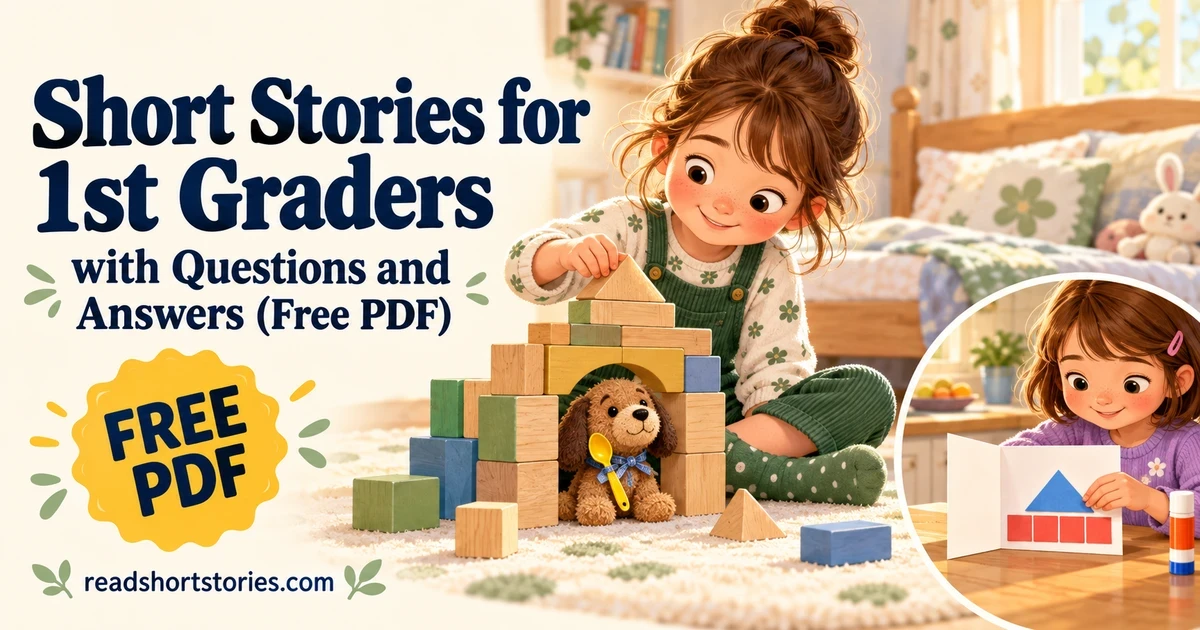
Otto was a small plush dog with floppy brown ears. He sat inside the toy box on the rug. Otto wanted a busy pretend job in the bedroom. The box held only wooden blocks and a yellow plastic spoon.
Penny walked into the room in her green socks. She tipped the box gently. The blocks tumbled onto the rug. “Good morning, Otto,” Penny said. “We need to build a morning tower.”
Otto leaned forward on his cloth paws. He could not stack the heavy blocks. Penny stacked the blocks into a high wall. She left a small opening at the bottom. “Our tower needs a gate,” Penny said.
Penny picked up the yellow plastic spoon. She slid the handle under Otto’s ribbon collar. The spoon stood up like a bright badge. “You are the tower guardian,” Penny said. “Your job is to watch the gate.” Otto sat proudly and guarded the new tower.
Questions
- What else is in the box besides blocks?
- Why can Otto not stack the blocks?
- What does Penny do after picking up the spoon?
- How does Otto feel about his new job?
- What does tumbled mean here?
- What is this story mostly about?
Answers
Answers
- A yellow plastic spoon is in the box. Evidence: The box held only wooden blocks and a yellow plastic spoon.
- The blocks are too heavy for him. Evidence: He could not stack the heavy blocks.
- She slides its handle under Otto’s collar. Evidence: Penny picked up the yellow plastic spoon. She slid the handle under Otto’s ribbon collar.
- He feels proud. Evidence: Otto sat proudly and guarded the new tower.
- It means fell or rolled out. Evidence: She tipped the box gently. The blocks tumbled onto the rug.
- Otto gets a job watching the tower gate. Evidence: “You are the tower guardian,” Penny said. “Your job is to watch the gate.”
A Dry Spot on the Porch
Miles laced his clean shoes. The morning rain had stopped, and he was ready for the park.
Miles stepped onto the front porch. Big water drops fell from the roof. Drip, drop, plop! Water splashed on the front mat. “The mat is soaked,” Miles said.
Miles looked down at his shoes. He wanted them to stay dry.
Mom opened the screen door. “Find a safe spot while I get my keys,” she said.
Miles knelt on the porch. He touched the floorboards with his fingers. The wood near the step was cold and wet.
Then Miles checked beside the wooden bench. The roof hung wide over that corner. He touched the boards there. They were completely dry.
Miles stood by the bench and smiled. “I found a dry spot, Mom!” he called.
Mom stepped outside and closed the door. Miles had kept his shoes clean and dry. Together, they walked to the park.
Questions
- Where does Miles want to go?
- Why is the corner by the bench dry?
- What does Miles do after kneeling on the porch?
- Why does Miles smile by the bench?
- What does soaked mean here?
- What is this story mostly about?
Answers
Answers
- He wants to go to the park. Evidence: The morning rain had stopped, and he was ready for the park.
- The wide roof covers that corner. Evidence: The roof hung wide over that corner.
- He touches the floorboards with his fingers. Evidence: Miles knelt on the porch. He touched the floorboards with his fingers.
- He has found a dry spot. Evidence: Miles stood by the bench and smiled. “I found a dry spot, Mom!” he called.
- It means very wet. Evidence: Water splashed on the front mat. “The mat is soaked,” Miles said.
- Miles keeps his shoes dry before his walk. Evidence: Miles had kept his shoes clean and dry. Together, they walked to the park.
Paper Shapes for Cora
Cora sat at the kitchen table with a folded card. She had a pile of paper shapes and a glue stick. Cora wanted to make a birthday card for her mother.
First, Cora stacked four red squares in a straight line. The squares made a tall tower in the center. Cora smiled and tried to fold the card shut. The top square stuck out over the edge.
The tower was too tall for the little paper. Cora did not want the top piece to bend. She picked up the squares before the glue dried.
She placed the four red squares side by side. Now the shapes made a wide cottage. She set a blue triangle on top as a roof.
Cora pressed each paper shape flat. She folded the white card shut. The roof and the cottage fit neatly inside. Cora smiled at her finished card.
Questions
- Who is the birthday card for?
- How does Cora first place the squares?
- Why does Cora change the tall tower?
- How does Cora make the squares fit?
- What does cottage mean here?
- What is this story mostly about?
Answers
Answers
- The card is for her mother. Evidence: Cora wanted to make a birthday card for her mother.
- She puts them in a tall straight line. Evidence: First, Cora stacked four red squares in a straight line. The squares made a tall tower in the center.
- It is too tall, and she does not want the top piece to bend. Evidence: The tower was too tall for the little paper. Cora did not want the top piece to bend.
- She puts the squares side by side. Evidence: She placed the four red squares side by side.
- It means a small house. Evidence: Now the shapes made a wide cottage. She set a blue triangle on top as a roof.
- Cora makes a paper picture that fits inside a card. Evidence: She folded the white card shut. The roof and the cottage fit neatly inside.
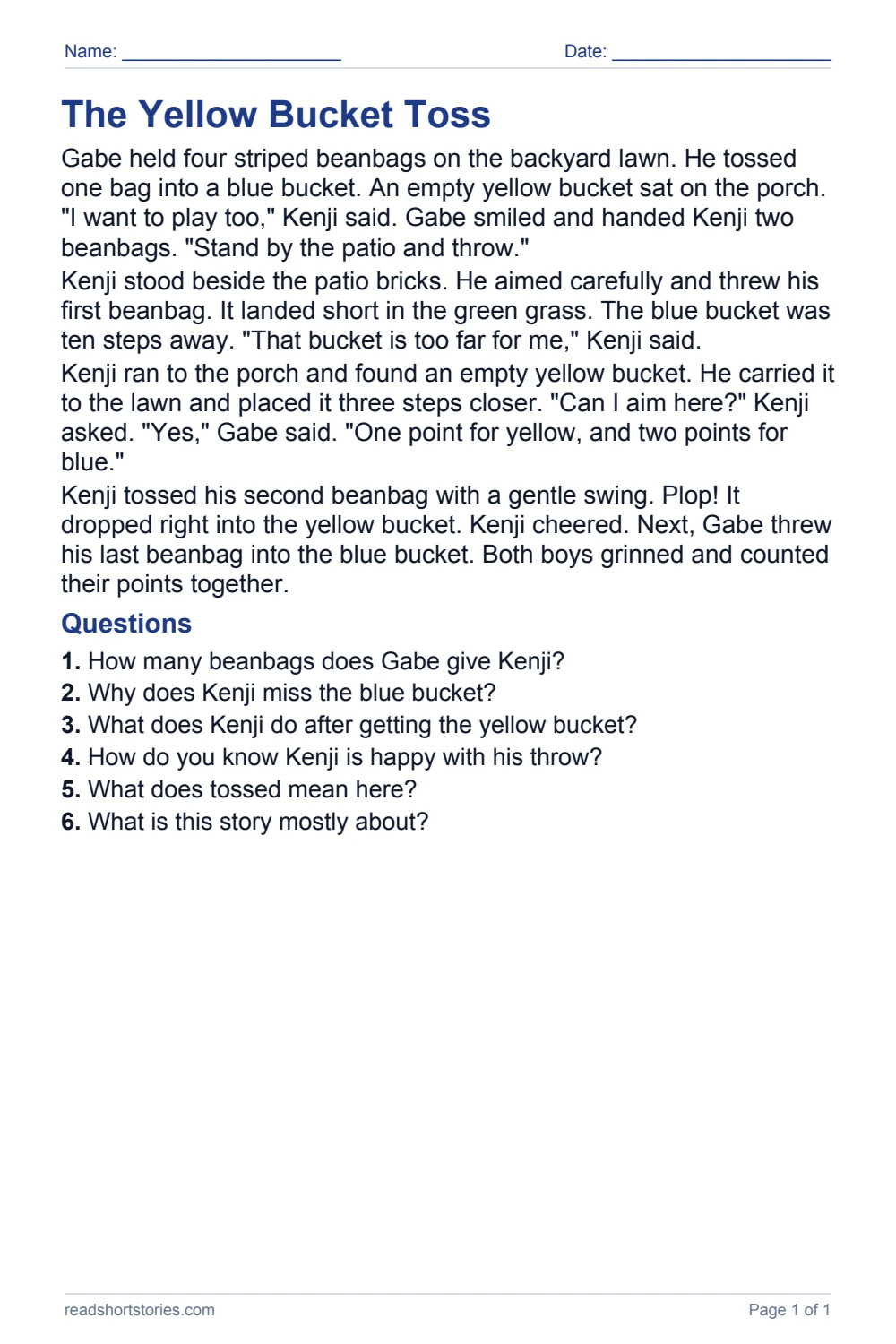
The Yellow Bucket Toss
Gabe held four striped beanbags on the backyard lawn. He tossed one bag into a blue bucket. An empty yellow bucket sat on the porch. “I want to play too,” Kenji said. Gabe smiled and handed Kenji two beanbags. “Stand by the patio and throw.”
Kenji stood beside the patio bricks. He aimed carefully and threw his first beanbag. It landed short in the green grass. The blue bucket was ten steps away. “That bucket is too far for me,” Kenji said.
Kenji ran to the porch and found an empty yellow bucket. He carried it to the lawn and placed it three steps closer. “Can I aim here?” Kenji asked. “Yes,” Gabe said. “One point for yellow, and two points for blue.”
Kenji tossed his second beanbag with a gentle swing. Plop! It dropped right into the yellow bucket. Kenji cheered. Next, Gabe threw his last beanbag into the blue bucket. Both boys grinned and counted their points together.
Questions
- How many beanbags does Gabe give Kenji?
- Why does Kenji miss the blue bucket?
- What does Kenji do after getting the yellow bucket?
- How do you know Kenji is happy with his throw?
- What does tossed mean here?
- What is this story mostly about?
Answers
Answers
- He gives Kenji two beanbags. Evidence: Gabe smiled and handed Kenji two beanbags.
- It is too far away for him. Evidence: The blue bucket was ten steps away. “That bucket is too far for me,” Kenji said.
- He puts it on the lawn, three steps closer. Evidence: He carried it to the lawn and placed it three steps closer.
- He cheers when the bag goes into the bucket. Evidence: It dropped right into the yellow bucket. Kenji cheered.
- It means threw lightly. Evidence: Kenji tossed his second beanbag with a gentle swing.
- Kenji and Gabe find a way to enjoy a throwing game together. Evidence: Next, Gabe threw his last beanbag into the blue bucket. Both boys grinned and counted their points together.
Download the Free PDF
The workbook includes 10 stories: the 4 stories above and 6 bonus stories, with questions and a separate answer key.
Frequently Asked Questions
How long are the stories?
The web stories have 146–160 words each. Read together when a child needs support.
Does the PDF include answers?
Yes. All 10 stories have questions, and the answer key is on separate pages.
How can we use these stories?
Read or listen, answer the questions, and look back at the story for clues. Print the US Letter or A4 pages for home or classroom reading.


