- Short Stories for 2nd Graders with Questions and Answers (Free PDF)
- Short Stories for 2nd Graders
- Gus and the Squeaky Parade
- Questions
- Answers
- The Secret Berry Cookie
- Questions
- Answers
- The Moving Shadow
- Questions
- Answers
- The Carnival Ticket
- Questions
- Answers
- Download the Free PDF
- Frequently Asked Questions
- How long are the stories?
- Does the PDF include answers?
- How can we use these stories?
- More Short Stories and Reading Activities
You can download the free short stories for 2nd graders PDF below.
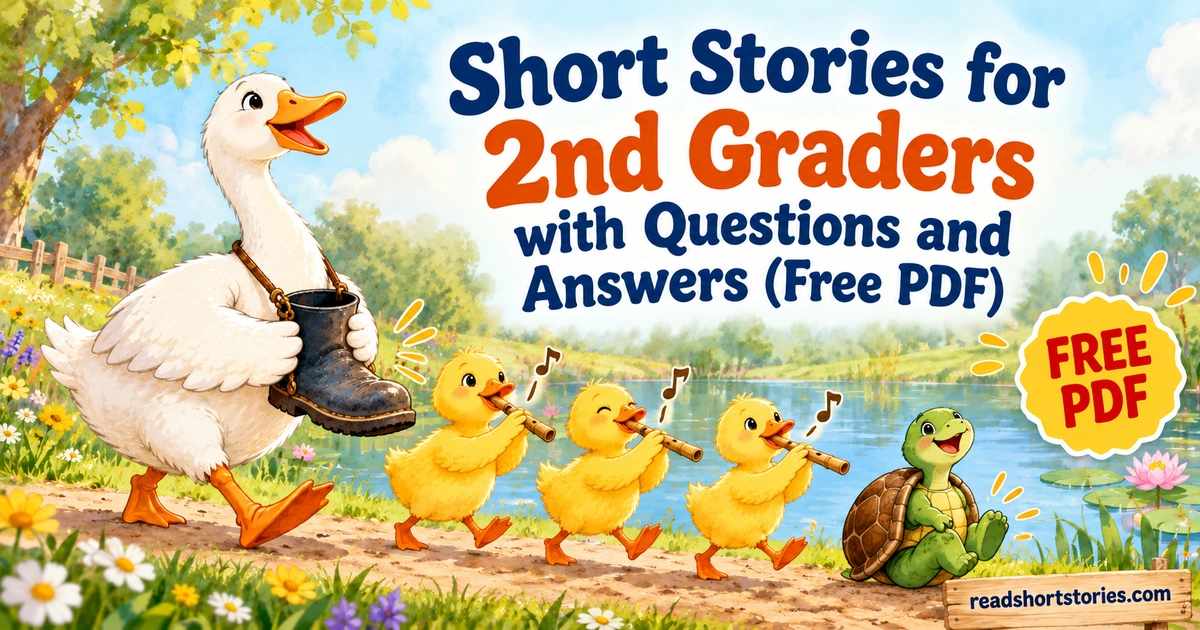
Short Stories for 2nd Graders
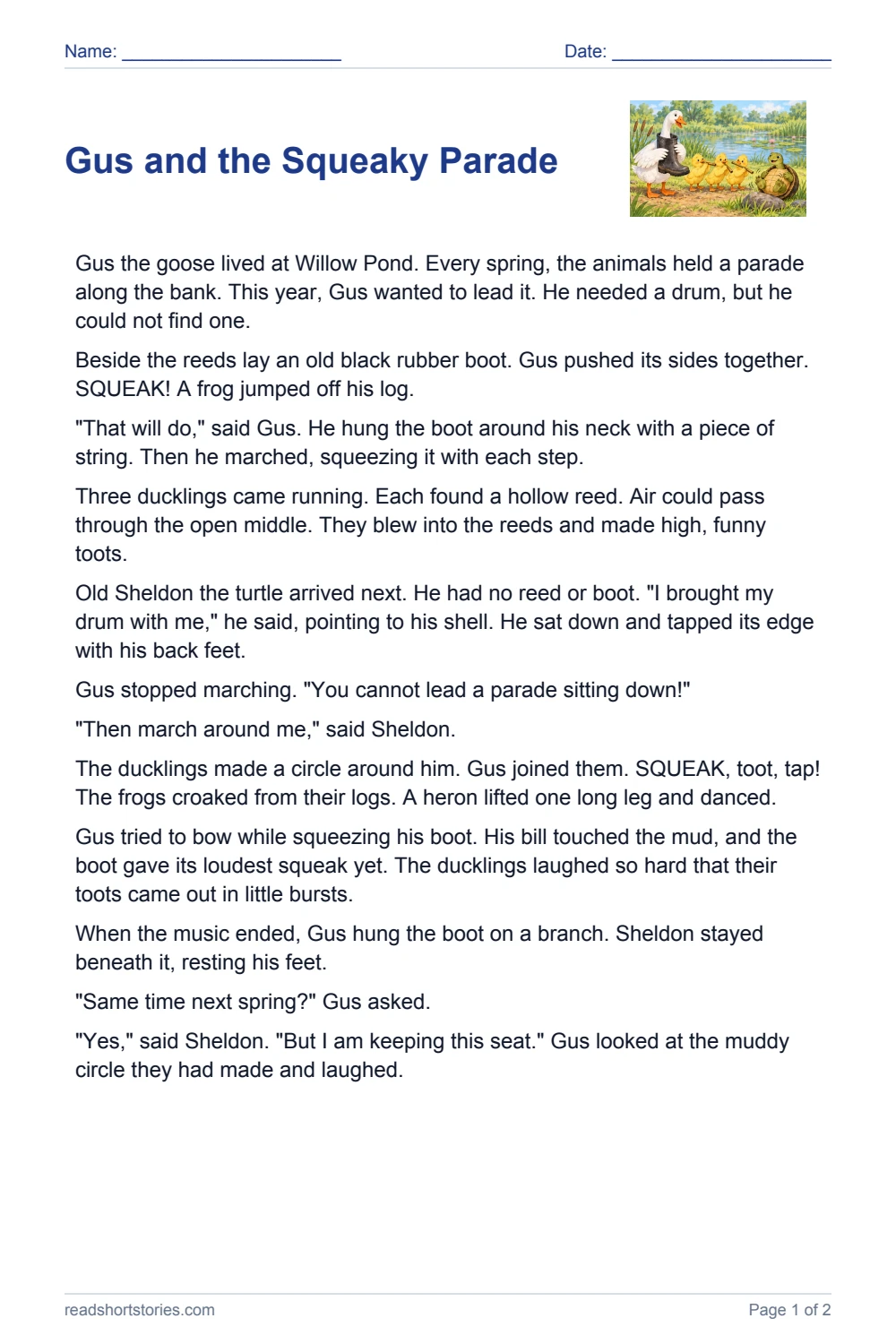
Gus and the Squeaky Parade
Gus the goose lived at Willow Pond. Every spring, the animals held a parade along the bank. This year, Gus wanted to lead it. He needed a drum, but he could not find one.
Beside the reeds lay an old black rubber boot. Gus pushed its sides together. SQUEAK! A frog jumped off his log.
“That will do,” said Gus. He hung the boot around his neck with a piece of string. Then he marched, squeezing it with each step.
Three ducklings came running. Each found a hollow reed. Air could pass through the open middle. They blew into the reeds and made high, funny toots.
Old Sheldon the turtle arrived next. He had no reed or boot. “I brought my drum with me,” he said, pointing to his shell. He sat down and tapped its edge with his back feet.
Gus stopped marching. “You cannot lead a parade sitting down!”
“Then march around me,” said Sheldon.
The ducklings made a circle around him. Gus joined them. SQUEAK, toot, tap! The frogs croaked from their logs. A heron lifted one long leg and danced.
Gus tried to bow while squeezing his boot. His bill touched the mud, and the boot gave its loudest squeak yet. The ducklings laughed so hard that their toots came out in little bursts.
When the music ended, Gus hung the boot on a branch. Sheldon stayed beneath it, resting his feet.
“Same time next spring?” Gus asked.
“Yes,” said Sheldon. “But I am keeping this seat.” Gus looked at the muddy circle they had made and laughed.
Questions
- What did Gus use instead of a drum?
- Who arrived after the three ducklings?
- Why did the animals march in a circle around Sheldon?
- Why does Gus ask about meeting next spring?
- What does hollow mean when the ducklings find reeds?
- What is this story mostly about?
Answers
Answers
- He used an old black rubber boot. Evidence: Beside the reeds lay an old black rubber boot. Gus pushed its sides together. SQUEAK!
- Old Sheldon the turtle arrived next. Evidence: Old Sheldon the turtle arrived next.
- Sheldon could tap his shell while sitting, so they marched around him. Evidence: Old Sheldon the turtle arrived next. He had no reed or boot. “I brought my drum with me,” he said, pointing to his shell. He sat down and tapped its edge with his back feet.Gus stopped marching. “You cannot lead a parade sitting down!”
“Then march around me,” said Sheldon.
The ducklings made a circle around him. Gus joined them. SQUEAK, toot, tap! The frogs croaked from their logs. A heron lifted one long leg and danced.
- He wants to enjoy another parade together. Evidence: “Same time next spring?” Gus asked.
- It means there is an open space inside. Air can pass through the reeds. Evidence: Each found a hollow reed. Air could pass through the open middle.
- Animals make a funny parade using the sounds they can make. Evidence: SQUEAK, toot, tap! The frogs croaked from their logs. A heron lifted one long leg and danced.
The Secret Berry Cookie
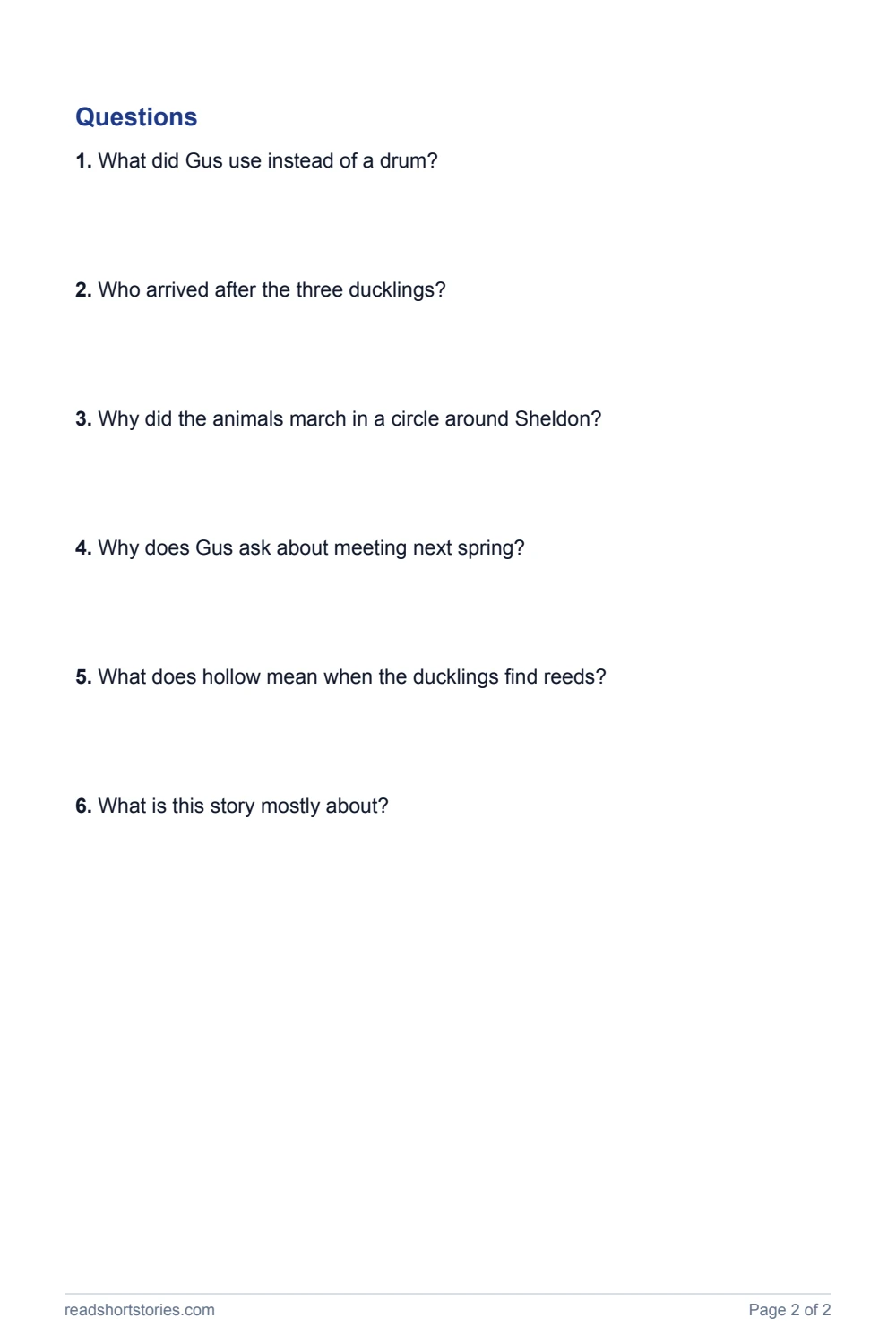
Emma and her brother Liam were getting ready for a family picnic. Mom helped them bake six star-shaped berry cookies. There was one for each person. Mom placed a small name card beside each cookie while they cooled.
Liam set the tray on the kitchen counter. “Please watch the cookies while I take the cups outside,” he said. Emma nodded. Their puppy, Buster, slept by the door.
Emma leaned close to the tray. The cookies smelled sweet. She broke a point off the star beside Liam’s name and ate it. Then she took another bite. Soon, Liam’s whole cookie was gone.
Only five cookies remained on the tray. Emma counted them twice. Her own cookie was still there, beside her name. Liam’s card had an empty space next to it. He would have no cookie unless she gave him hers.
Liam came inside. “There were six,” he said. He looked at Buster. “Did he take one?”
Emma felt her face grow warm. She could stay quiet, but that would not be fair to Buster. “No,” she said. “I ate it. I’m sorry. I should have waited.”
Liam frowned. “That was for our picnic.”
“I know,” Emma said. “Can I help make it right?” She looked in the fruit bowl. There were six ripe peaches. “We could each have a peach, too. You can have the cookie beside my name. I have already eaten one.”
Mom washed the peaches. Emma dried them and packed six napkins. Liam put the five cookies into a box. He was still upset, but he thanked Emma for telling the truth.
At the picnic, Emma passed out the peaches. Liam ate the cookie that had been beside Emma’s name. The other four people each had a cookie, too. Emma ate her peach without taking another cookie. Buster came outside and wagged his tail. He had done nothing wrong.
Questions
- How many cookies did the family bake?
- What did Emma do after eating a point from Liam’s cookie?
- Why did Emma offer Liam the cookie beside her name?
- What did Emma say when Liam wondered whether Buster took the cookie?
- What does remained mean in this story?
- What message does Emma’s choice support?
Answers
Answers
- They baked six cookies, one for each person. Evidence: Mom helped them bake six star-shaped berry cookies. There was one for each person.
- She took another bite and ate the rest of his cookie. Evidence: Then she took another bite. Soon, Liam’s whole cookie was gone.
- She had eaten his cookie, while her own was still there. Giving hers to him left him a cookie. Evidence: Emma leaned close to the tray. The cookies smelled sweet. She broke a point off the star beside Liam’s name and ate it. Then she took another bite. Soon, Liam’s whole cookie was gone.Only five cookies remained on the tray. Emma counted them twice. Her own cookie was still there, beside her name. Liam’s card had an empty space next to it. He would have no cookie unless she gave him hers.
- She admitted eating it and apologized. Evidence: “No,” she said. “I ate it. I’m sorry. I should have waited.”
- It means were still left. There were five cookies on the tray after one was eaten. Evidence: Only five cookies remained on the tray. Emma counted them twice. Her own cookie was still there, beside her name.
- Be honest about a mistake and do something to put it right. Evidence: “We could each have a peach, too. You can have the cookie beside my name. I have already eaten one.”
The Moving Shadow
Nia stopped beside the school flagpole at morning recess. Its long shadow lay across the sidewalk. The dark shape reached almost to the fence. Nia put one shoe on its tip.
“Look! The pole can touch my foot,” she told her friend Luis. He stepped beside her, and their shadows joined the long line.
The teacher gave them chalk. Nia drew a small circle around the tip of the pole’s shadow. Luis wrote MORNING beside it. They left room for people to walk past.
After lunch, Nia hurried back. The flagpole was in the same place. Her chalk circle was there, too. But the shadow did not reach it. It fell on a different part of the sidewalk.
“Did someone move it?” Luis asked. He checked the thick bolts at the bottom of the pole. Nothing had changed.
Ms. Hall stood with them in the shade. “The sun lights the pole from a different place in the sky now,” she said. “We can watch the shadow without looking at the sun.”
Nia used her chalk to mark the new tip. This time, Luis wrote AFTERNOON. The two circles were far apart.
Nia held a ruler upright, with one end on the ground and the other pointing up. Luis shone a small flashlight on it. When he moved the light, the ruler’s shadow moved. The ruler stayed still.
“So the light can move a shadow!” Nia said. She tried it herself, sliding the flashlight slowly from one side to the other.
Before going inside, Nia looked at both circles again. She wanted to check the pole’s shadow the next morning. She put the chalk in her pocket. Tomorrow, the sidewalk would have another clue.
Questions
- What did Nia mark during morning recess?
- What did Luis write beside the second mark?
- Why was the shadow in a different place after lunch?
- How does Nia show that she is curious?
- What does upright mean when Nia holds the ruler?
- What do Nia and Luis discover?
Answers
Answers
- She marked the tip of the flagpole’s shadow. Evidence: Nia drew a small circle around the tip of the pole’s shadow.
- He wrote AFTERNOON. Evidence: This time, Luis wrote AFTERNOON.
- The sunlight reached the pole from a different place in the sky. Evidence: “The sun lights the pole from a different place in the sky now,” she said.
- She wants to check the shadow again the next morning. Evidence: She wanted to check the pole’s shadow the next morning.
- It means standing up rather than lying flat. The ruler stands still while its shadow moves. Evidence: Nia held a ruler upright, with one end on the ground and the other pointing up. Luis shone a small flashlight on it. When he moved the light, the ruler’s shadow moved. The ruler stayed still.
- Changing where the light comes from can move a shadow even when an object stays still. Evidence: When he moved the light, the ruler’s shadow moved. The ruler stayed still.
The Carnival Ticket
Leo held one red ticket at the school carnival. He had earned it by helping put books away. Each game cost one ticket. He could choose only one game before it was time to go home.
He stopped at a fishing game. Paper fish lay in a small pool. Each fish had a loop on its back. Players used a toy fishing pole to lift one out. If Leo caught a fish, he could choose a sticker.
Then he saw a booth full of funny hats. A family could use one ticket to take a picture there. Leo’s little sister Penny pointed at a hat shaped like a banana. “That one is for Dad!” she said.
Dad laughed. “You can choose either game, Leo. It’s your ticket.” Penny did not ask him to change his mind. She waited beside Mom.
Leo watched the fishing game. He really wanted a green dinosaur sticker. He watched the picture booth, too. A family came out carrying a photo. Everyone in it wore a silly hat.
Leo reached for his ticket. He paused, holding it between two fingers. He had dinosaur stickers at home. He did not have a picture of his whole family wearing funny hats.
“Let’s take a picture,” he said.
Penny chose the banana hat for Dad. Mom wore a hat with three tall feathers. Penny picked a frog hat, and Leo chose a hat shaped like a boat.
“Say banana!” called the person with the camera. They all laughed. Soon, Leo held their new photo.
At home, he put the photo beside his bed. His ticket was gone, but he could enjoy the picture again and again. Each time he saw Dad’s banana hat, he smiled.
Questions
- How did Leo earn his ticket?
- What did Leo do just before choosing the photo?
- Why did Leo choose the picture booth?
- What did Dad let Leo do?
- What does paused mean here?
- Why is the photo special to Leo?
Answers
Answers
- He earned it by helping put books away. Evidence: He had earned it by helping put books away.
- He paused with the ticket between his fingers. Evidence: He paused, holding it between two fingers.
- He already had dinosaur stickers but no family photo in funny hats. Evidence: He had dinosaur stickers at home. He did not have a picture of his whole family wearing funny hats.
- Dad let Leo choose either activity. Evidence: Dad laughed. “You can choose either game, Leo. It’s your ticket.”
- It means stopped for a short time to think before choosing. Evidence: He paused, holding it between two fingers. He had dinosaur stickers at home.
- He can enjoy the funny family picture again and again. Evidence: His ticket was gone, but he could enjoy the picture again and again. Each time he saw Dad’s banana hat, he smiled.
Download the Free PDF
The workbook includes 10 stories: the 4 stories above and 6 bonus stories, with questions and a separate answer key.
Frequently Asked Questions
How long are the stories?
The web stories have 262–313 words each. Read together when a child needs support.
Does the PDF include answers?
Yes. All 10 stories have questions, and the answer key is on separate pages.
How can we use these stories?
Read or listen, answer the questions, and look back at the story for clues. Print the US Letter or A4 pages for home or classroom reading.