- Future Perfect Continuous Stories with Exercises and Answers (Free PDF)
- Future Perfect Continuous: A Quick Reminder
- Form and Ongoing Duration
- Future Time Clauses and Repeated Habits
- Comparing Future Continuous, Future Perfect, and Stative Verbs
- About the True Story
- Future Perfect Continuous Stories
- Two Instruments, One Tune
- Questions
- Future Perfect Continuous Practice
- Reading Answers
- Practice Answers
- Fill in the Blanks
- True or False
- The Experiment That Refused to Hurry
- Questions
- Future Perfect Continuous Practice
- Reading Answers
- Practice Answers
- Fill in the Blanks
- True or False
- The Patch We Leave Uncut
- Questions
- Future Perfect Continuous Practice
- Reading Answers
- Practice Answers
- Fill in the Blanks
- True or False
- Download the Free PDF
- Frequently Asked Questions
- What level are these stories for?
- What does the PDF include?
- When do we use the future perfect continuous?
- More Short Stories and Reading Activities
The future perfect continuous helps you explain how long an activity will have continued by a future point. These future perfect continuous stories with exercises practice will have been + verb-ing, for and since, negatives, and questions. Read three stories here and listen to their audio; the free PDF includes all six stories, reading questions, grammar practice, writing tasks, and a separate answer key. Five narratives are fictional, and one follows the documented history of a slow-moving science experiment. The stories are about 300-420 words long. Read first, try the activities, then check your answers.
Listen and read along: Audio versions are available for 3 stories on this page. Use the players below.
You can download the free future perfect continuous stories PDF below. The PDF also includes 3 bonus stories.

Future Perfect Continuous: A Quick Reminder
Form and Ongoing Duration
Form the future perfect continuous with will have been plus the -ing form of the main verb (e.g., ‘will have been practicing’). Use it to describe how long an action will continue up to a specific reference point in the future. Example: ‘By next Saturday, Lale will have been practicing the duet with her grandfather for six weeks.’
We often use ‘for’ to show total duration and ‘since’ to name a starting point.
In negative sentences, place ‘not’ after ‘will’ (‘will not have been’ or ‘won’t have been’). Example: ‘By two o’clock, they will not have been playing for a full hour.’
For questions, put ‘will’ before the subject. Example: ‘Will Lale have been practicing for six weeks by then?’ or ‘How long will she have been practicing?’
Future Time Clauses and Repeated Habits
Use the present simple or present perfect in ordinary future time clauses with when, before, or by the time: When next Friday arrives, Zita will have been riding this route for six weeks. Use for with a period (for six weeks) and since with a starting point (since September). Repeated weekly or daily activities can count toward a duration; they do not have to happen nonstop.
Comparing Future Continuous, Future Perfect, and Stative Verbs
Will be practicing describes an activity in progress at a future moment. Will have finished emphasizes a completed result. Will have been practicing emphasizes duration up to a future point. State verbs such as know, seem, and belong usually take simple forms in their state meanings: By next year, they will have known each other for ten years.
About the True Story
The Experiment That Refused to Hurry is a documented historical timeline viewed forward from 1927, not invented predictions or speech. Year durations are approximate. Sources: UQ School of Mathematics and Physics, UQ Physics Museum, UQ News explainer.
Future Perfect Continuous Stories
Two Instruments, One Tune
Every Saturday since mid-September, Lale has walked to her grandfather’s house with her wooden flute. Today is their sixth session, five weeks after their start. By next Saturday afternoon, when the family gathers for tea, Lale and her grandfather will have been practicing their duet for six full weeks. By that seventh meeting, they will have been meeting in this kitchen every weekend since mid-September, learning one simple folk melody.
Lale sits on a wooden chair while her grandfather tunes his guitar. At home, she practices alone until her fingers move easily. Yet playing louder during rehearsals does not create a true duet. Her sharp notes often cover his gentle strumming completely.
They begin at half past one. “Let us check the tempo,” her grandfather says, tapping the guitar frame. “By two o’clock, we will have been working on this piece for thirty minutes. We will not have been playing for all thirty minutes, since we stopped to tune and talk, but steady practice is best.”
Lale looks at the music stand. “By next Saturday, will we have been trying to play at the exact same second for six weeks and still sound crowded?” she asks. “When I push my notes forward, the tune feels crowded, like two people speaking at once.”
“A duet is a conversation, not a speech,” her grandfather answers. “By next weekend, you will have been playing this melody since September, so trust your fingers. Watch my hands on the strings. When my rhythm slows down, that is your signal to step into the open space.”
They restart the middle section. Lale takes a soft breath and waits half a beat. She lets the warm guitar chord fill the room before lifting her flute. Instead of forcing her sound, she guides her melody into the space he creates. The two parts move together without competing.
Her grandfather adjusts his tempo to match her breath, nodding as the chords resolve. By the end of today’s rehearsal, Lale will have been practicing that single pause for twenty minutes, but the change is already clear. Leaving room for another instrument does not weaken her sound.
By next Saturday afternoon, the two musicians will have been preparing this modest piece together for six full weeks. They will not have been practicing nonstop every day, but their weekly meetings have taught them to share sound. When their relatives sit down next weekend, Lale and her grandfather will have been learning how to listen, breathe, and play as one.
Questions
- How long will Lale and her grandfather have been practicing their duet by next Saturday afternoon?
- Why did the duet feel crowded when Lale first played her flute with her grandfather?
- Why does Lale wait half a beat before lifting her flute?
- What does the grandfather mean when he tells Lale that a duet is ‘a conversation, not a speech’?
Future Perfect Continuous Practice
- Choose the future perfect continuous form. By next Saturday afternoon, Lale and her grandfather __________ their folk piece for six full weeks.
- will have been practicing
- will be practicing
- have been practicing
- practiced
- Complete the sentence with the future perfect continuous of ‘work’: By two o’clock, the two musicians __________ on this piece for thirty minutes. Use four words.
- Put the words in order to form a statement: learning / will / together / have / they / been
- Choose the correct word to express the starting point in time: ‘By next weekend, you will have been playing this melody __________ September.’
- since
- for
- during
- until
- Complete the sentence with the negative future perfect continuous of ‘play’: By two o’clock, we __________ for the full thirty minutes because of our pauses to tune. Use five words; do not use a contraction.
Click to see the answers
Reading Answers
- By next Saturday afternoon, Lale and her grandfather will have been practicing their duet for six full weeks. Evidence: By next Saturday afternoon, when the family gathers for tea, Lale and her grandfather will have been practicing their duet for six full weeks.
- Lale plays too loudly, so her sharp flute notes cover her grandfather’s gentle guitar. Evidence: Yet playing louder during rehearsals does not create a true duet. Her sharp notes often cover his gentle strumming completely.
- She leaves room for the guitar chord before adding her flute melody. Evidence: Lale takes a soft breath and waits half a beat. She lets the warm guitar chord fill the room before lifting her flute.
- He means that two musicians must listen and leave room for each other’s sound rather than trying to play over one another. Evidence: Watch my hands on the strings. When my rhythm slows down, that is your signal to step into the open space.
Practice Answers
- will have been practicing. Use will have been + verb-ing for duration up to a future point.
- will have been working. Use will have been + verb-ing for duration up to a future point.
- They will have been learning together. The words keep the order will + have + been + verb-ing.
- since. Use since with a starting point.
- will not have been playing. In a negative sentence, put not after will.
Your turn: Write 2-3 sentences about a skill you are currently practicing. Describe how long you will have been doing it by the end of this year using the future perfect continuous.
Click to see the short worksheet text and answers
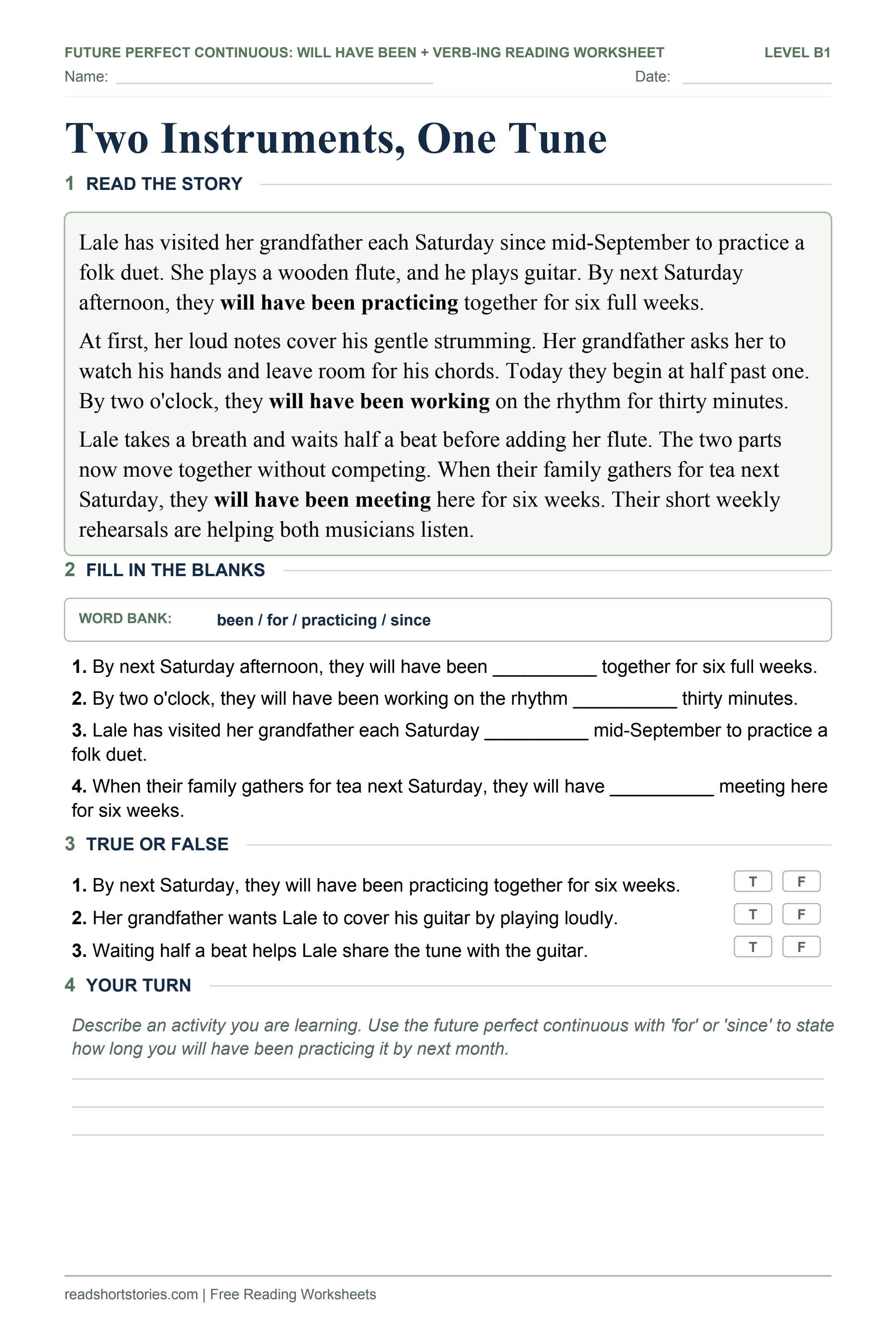
Lale has visited her grandfather each Saturday since mid-September to practice a folk duet. She plays a wooden flute, and he plays guitar. By next Saturday afternoon, they will have been practicing together for six full weeks.
At first, her loud notes cover his gentle strumming. Her grandfather asks her to watch his hands and leave room for his chords. Today they begin at half past one. By two o’clock, they will have been working on the rhythm for thirty minutes.
Lale takes a breath and waits half a beat before adding her flute. The two parts now move together without competing. When their family gathers for tea next Saturday, they will have been meeting here for six weeks. Their short weekly rehearsals are helping both musicians listen.
Fill in the Blanks
Words: practicing, for, since, been
- By next Saturday afternoon, they will have been __________ together for six full weeks. Answer: practicing
- By two o’clock, they will have been working on the rhythm __________ thirty minutes. Answer: for
- Lale has visited her grandfather each Saturday __________ mid-September to practice a folk duet. Answer: since
- When their family gathers for tea next Saturday, they will have __________ meeting here for six weeks. Answer: been
True or False
- By next Saturday, they will have been practicing together for six weeks. True. Evidence: By next Saturday afternoon, they will have been practicing together for six full weeks.
- Her grandfather wants Lale to cover his guitar by playing loudly. False. He wants her to leave room for the guitar. Evidence: Her grandfather asks her to watch his hands and leave room for his chords.
- Waiting half a beat helps Lale share the tune with the guitar. True. Evidence: Lale takes a breath and waits half a beat before adding her flute. The two parts now move together without competing.
Describe an activity you are learning. Use the future perfect continuous with ‘for’ or ‘since’ to state how long you will have been practicing it by next month.
Sample answer: By next month, I will have been practicing the acoustic guitar for five months. I will have been taking lessons every weekend since winter to prepare for our school show.
The Experiment That Refused to Hurry
In 1927, Professor Thomas Parnell begins an unusual physics demonstration at the University of Queensland. He wants to show that pitch, a dark substance that feels solid to the touch, is actually an extremely slow-moving liquid. Parnell heats a sample of pitch and pours it into a glass funnel with a sealed stem, allowing it to cool and settle. Viewed forward from this 1927 starting point, the historical timeline measures decades of patient physical change. When Parnell cuts the stem in October 1930, the pitch will have been resting in the glass for three years.
After Parnell cuts the stem, gravity pulls the thick substance downward into a stretching neck. Seasonal temperature changes affect the speed of the descent. Summer warmth softens the pitch, while winter cold slows it down. Because the weather shifts throughout each year, the pitch will not have been moving at a constant speed. By 1938, when the first drop finally separates and falls, the pitch will have been flowing through the stem for about eight years.
The demonstration continues quietly in the physics building, with no one trying to speed it up. By 1970, the slow-moving pitch will have been traveling downward since October 1930. By April 1979, when the sixth drop separates from the stem, the dark liquid will have been dripping for about forty-nine years. By July 1988, when the seventh drop lands below, the substance will have been descending for nearly fifty-eight years.
Each fallen drop marks a completed, countable result, but the slow descent of the pitch continues. Observers record the distinct drops after long intervals of waiting. Meanwhile, the unfallen pitch above keeps pressing toward the stem. Decades after the initial cut, the pitch will have been moving through the funnel since 1930. It clearly demonstrates the fluid behavior of a material that appears solid.
Questions
- What does Professor Thomas Parnell intend to prove with his physics demonstration?
- Why does the pitch not move downward at a steady speed throughout the year?
- What does a ‘completed, countable result’ mean in this experiment?
- How does cutting the stem change what the pitch can do?
Future Perfect Continuous Practice
- Choose the future perfect continuous form. When Parnell cuts the stem in October 1930, the pitch __________ in the glass for three years.
- will have been resting
- has been resting
- will be resting
- is resting
- Complete the negative future perfect continuous form (two words): Because temperatures shift, the pitch will not have __________ __________ at a constant speed.
- Put the scrambled words in order to form a sentence: flowing / will / pitch / have / the / been
- Choose the correct time preposition: By 1970, the slow-moving pitch will have been traveling downward __________ October 1930.
- since
- for
- during
- until
- Complete the future perfect continuous structure with one auxiliary verb: By July 1988, the substance will __________ been descending for nearly fifty-eight years.
Click to see the answers
Reading Answers
- Parnell wants to demonstrate that pitch is actually an extremely slow-moving liquid even though it feels solid to the touch. Evidence: He wants to show that pitch, a dark substance that feels solid to the touch, is actually an extremely slow-moving liquid.
- The pitch changes speed because seasonal weather shifts cause summer warmth to soften it and winter cold to slow it down. Evidence: Summer warmth softens the pitch, while winter cold slows it down.
- An individual drop has finished falling and can be counted, while the remaining pitch continues its slow movement. Evidence: Each fallen drop marks a completed, countable result, but the slow descent of the pitch continues.
- Before the cut, the pitch rests in the sealed funnel. Afterward, gravity pulls it downward through the open stem. Evidence: After Parnell cuts the stem, gravity pulls the thick substance downward into a stretching neck.
Practice Answers
- will have been resting. Use will have been + verb-ing for duration up to a future point.
- been moving. In a negative sentence, put not after will.
- The pitch will have been flowing. The words keep the order will + have + been + verb-ing.
- since. Use since with a starting point.
- have. The structure is will + have + been + verb-ing.
Your turn: Imagine you are tracking an ongoing science experiment or long study habit. Write two sentences using the future perfect continuous with ‘for’ or ‘since’ to describe how long it will have been continuing by a future date.
Click to see the short worksheet text and answers
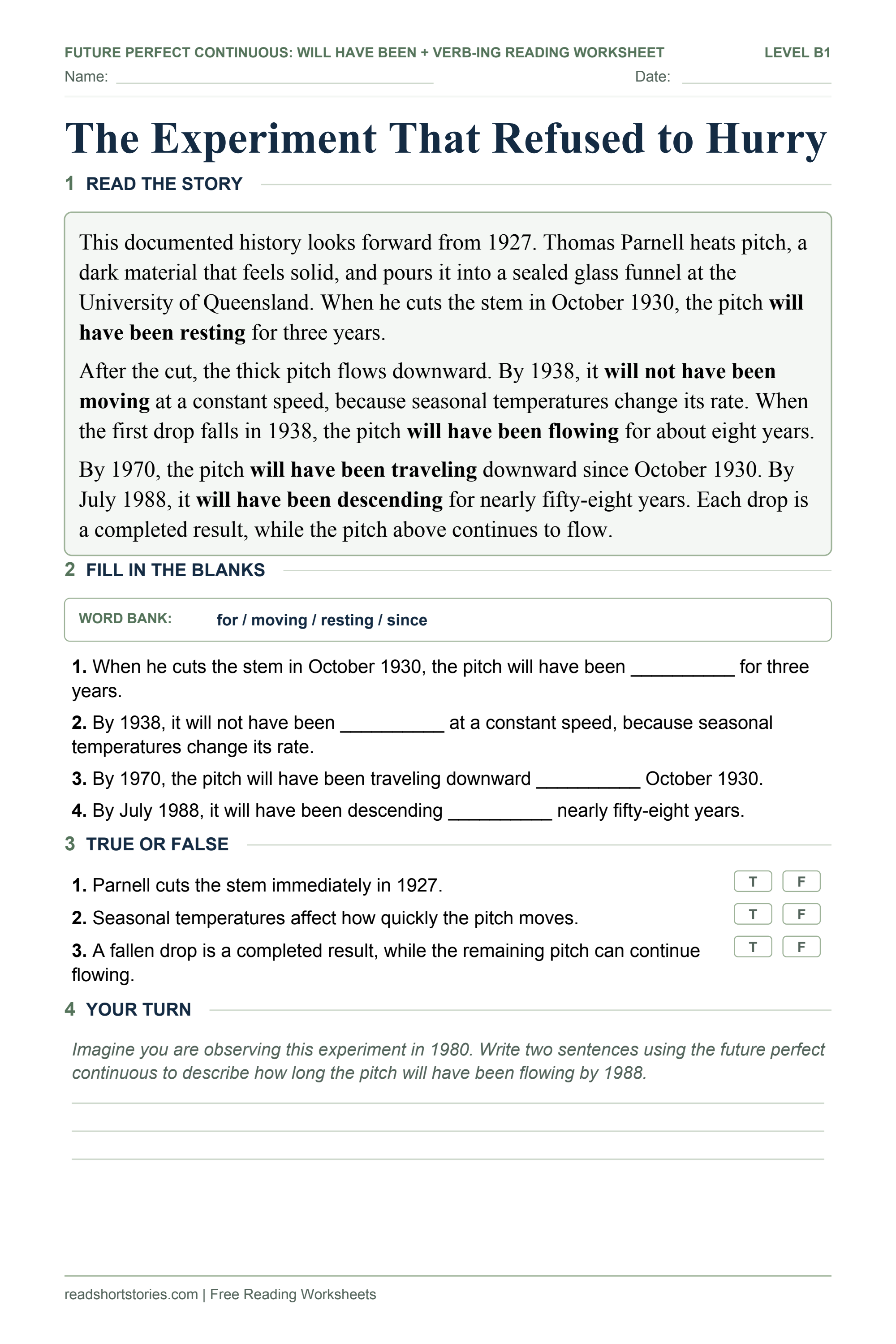
This documented history looks forward from 1927. Thomas Parnell heats pitch, a dark material that feels solid, and pours it into a sealed glass funnel at the University of Queensland. When he cuts the stem in October 1930, the pitch will have been resting for three years.
After the cut, the thick pitch flows downward. By 1938, it will not have been moving at a constant speed, because seasonal temperatures change its rate. When the first drop falls in 1938, the pitch will have been flowing for about eight years.
By 1970, the pitch will have been traveling downward since October 1930. By July 1988, it will have been descending for nearly fifty-eight years. Each drop is a completed result, while the pitch above continues to flow.
Fill in the Blanks
Words: resting, moving, since, for
- When he cuts the stem in October 1930, the pitch will have been __________ for three years. Answer: resting
- By 1938, it will not have been __________ at a constant speed, because seasonal temperatures change its rate. Answer: moving
- By 1970, the pitch will have been traveling downward __________ October 1930. Answer: since
- By July 1988, it will have been descending __________ nearly fifty-eight years. Answer: for
True or False
- Parnell cuts the stem immediately in 1927. False. He cuts it in October 1930, after three years. Evidence: When he cuts the stem in October 1930, the pitch will have been resting for three years.
- Seasonal temperatures affect how quickly the pitch moves. True. Evidence: By 1938, it will not have been moving at a constant speed, because seasonal temperatures change its rate.
- A fallen drop is a completed result, while the remaining pitch can continue flowing. True. Evidence: Each drop is a completed result, while the pitch above continues to flow.
Imagine you are observing this experiment in 1980. Write two sentences using the future perfect continuous to describe how long the pitch will have been flowing by 1988.
Sample answer: By July 1988, the pitch will have been flowing through the stem for nearly fifty-eight years. It will not have been moving at a constant speed, because seasonal temperatures affect its rate.
The Patch We Leave Uncut
Every Saturday morning, Neve walks to the Oak Street community garden with a spiral notebook. She started her project seven weeks ago in May. Today is her eighth Saturday morning in the garden. Beside the main gravel walkway, a small square patch of grass grows uncut. Neve visits for one hour each weekend, not every day. By next Saturday, Neve will have been visiting this patch weekly for eight full weeks. When she arrives next weekend to finish her project, she will have been tracking insect activity since the middle of May. Her goal is to see if an unmown patch can shelter bumblebees without blocking the path.
So far, her notes describe bumblebees on wild clover and tiny beetles beneath the stems. But this morning brings a practical problem. Neve’s grandfather walks down the gravel path, leaning lightly on his wooden walking stick. Recent June rain has made the grass grow tall, and outer blades spill across the gravel. Her grandfather must step onto damp soil to keep his walking stick from catching in the leaves.
“I like the green clover,” her grandfather says with a warm smile, “but the path has become very narrow.” Neve looks at the gravel. The walkway must stay open for older neighbors and heavy wheelbarrows. She wants to protect the clover, but she also needs to keep the path clear for her neighbors. She explains the trouble to the coordinator, who brings long border shears.
“You do not need to cut down every blade,” the coordinator advises gently. “Good gardening often means finding a tidy border.” At eleven o’clock, Neve kneels beside the path. She trims only the overhanging grass, leaving the dense center untouched. By the time the church clock strikes noon, Neve will have been clipping stems alongside the coordinator for nearly an hour. The trimmed edge looks neat, and the deep center still stands tall.
Her grandfather walks back down the path, his walking stick tapping cleanly on dry gravel. “The path is wide enough again,” he says, watching two bees hover over the clover. “By next Saturday, you will have been examining these plants every weekend for eight weeks.” Neve smiles and notes the time. “And by that final morning, I will have been recording insect numbers since May,” she replies. When she completes her project next Saturday, she will have been studying this wild square for eight full weeks. The center still shelters wildlife, and the path welcomes every visitor.
Questions
- How often does Neve visit the community garden patch?
- Why does Neve’s grandfather need to step off the gravel walkway onto damp soil?
- Why does Neve decide to trim only the edges instead of mowing the entire patch?
- What result shows that Neve and the coordinator successfully solved the path problem?
Future Perfect Continuous Practice
- Choose the future perfect continuous form: By the time the church clock strikes noon, Neve __________ overhanging grass for nearly an hour.
- will have been trimming
- has been trimming
- is trimming
- will trim
- Complete the sentence using the future perfect continuous of ‘visit’ (four words): By next Saturday, Neve __________ this community garden patch for eight full weeks.
- Put the words in order to make a future perfect continuous sentence: been / studying / she / will / plants / have
- Which preposition correctly completes the sentence to show duration: Next weekend, Neve will have been studying the uncut square __________ eight weeks.
- for
- since
- during
- until
- Complete the sentence with the correct time preposition for a starting point (one word): When she finishes her project, Neve will have been recording insect numbers __________ the middle of May.
Click to see the answers
Reading Answers
- Neve visits the community garden patch once every weekend for one hour. Evidence: Neve visits for one hour each weekend, not every day.
- He steps onto damp soil to prevent his walking stick from catching in the overhanging grass. Evidence: Her grandfather must step onto damp soil to keep his walking stick from catching in the leaves.
- She can clear the shared path while keeping the clover and insects in the central patch. Evidence: She wants to protect the clover, but she also needs to keep the path clear for her neighbors.
- The walkway becomes wide and clear again, allowing her grandfather to walk comfortably without his stick catching on leaves. Evidence: Her grandfather walks back down the path, his walking stick tapping cleanly on dry gravel.
Practice Answers
- will have been trimming. Use will have been + verb-ing for duration up to a future point.
- will have been visiting. Use will have been + verb-ing for duration up to a future point.
- She will have been studying plants. The words keep the order will + have + been + verb-ing.
- for. Use for with a period of time.
- since. Use since with a starting point.
Your turn: Write two or three sentences about a skill, sport, or hobby you practice. Use the future perfect continuous with ‘for’ or ‘since’ to describe how long you will have been doing it by a specific future date.
Click to see the short worksheet text and answers
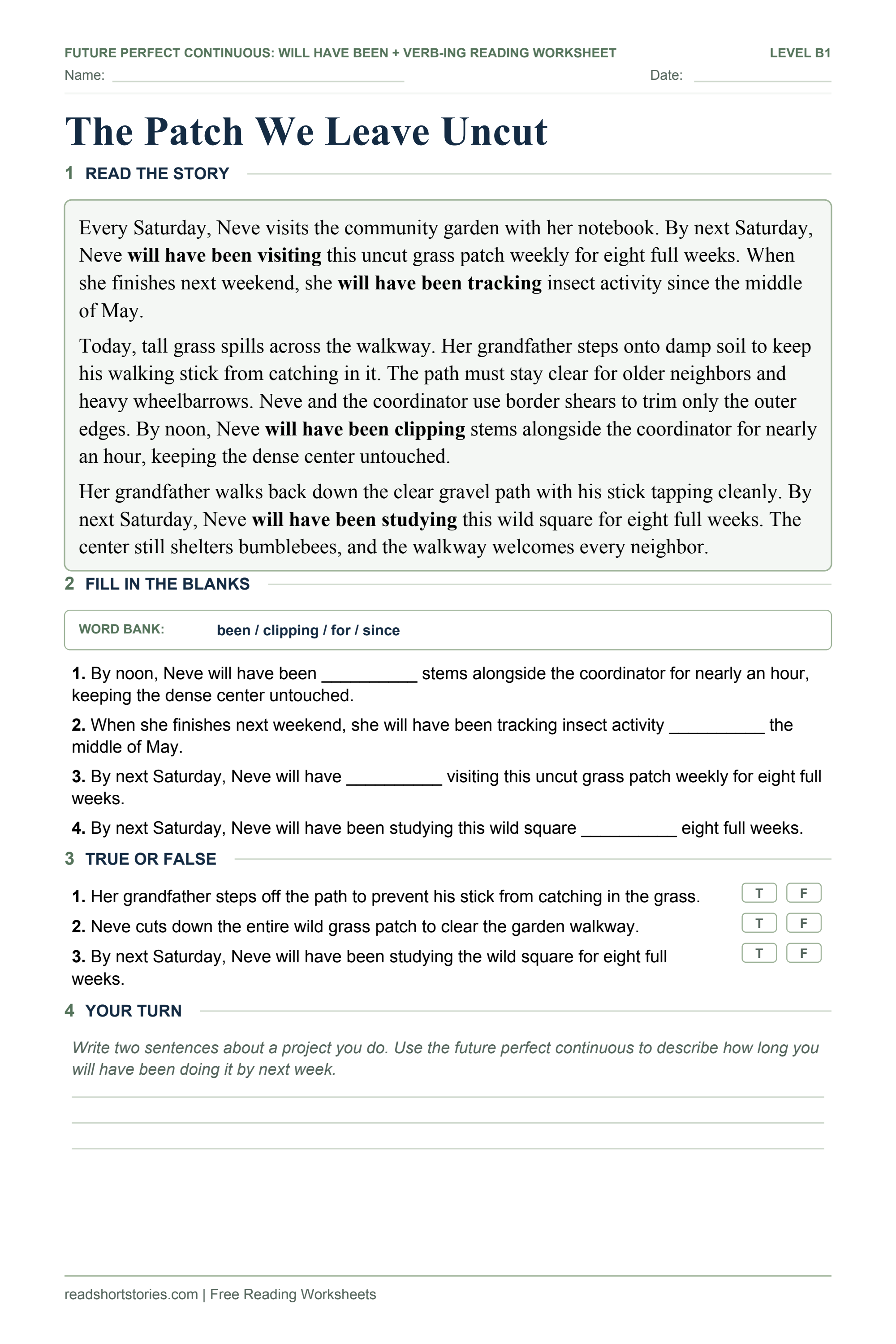
Every Saturday, Neve visits the community garden with her notebook. By next Saturday, Neve will have been visiting this uncut grass patch weekly for eight full weeks. When she finishes next weekend, she will have been tracking insect activity since the middle of May.
Today, tall grass spills across the walkway. Her grandfather steps onto damp soil to keep his walking stick from catching in it. The path must stay clear for older neighbors and heavy wheelbarrows. Neve and the coordinator use border shears to trim only the outer edges. By noon, Neve will have been clipping stems alongside the coordinator for nearly an hour, keeping the dense center untouched.
Her grandfather walks back down the clear gravel path with his stick tapping cleanly. By next Saturday, Neve will have been studying this wild square for eight full weeks. The center still shelters bumblebees, and the walkway welcomes every neighbor.
Fill in the Blanks
Words: clipping, since, been, for
- By noon, Neve will have been __________ stems alongside the coordinator for nearly an hour, keeping the dense center untouched. Answer: clipping
- When she finishes next weekend, she will have been tracking insect activity __________ the middle of May. Answer: since
- By next Saturday, Neve will have __________ visiting this uncut grass patch weekly for eight full weeks. Answer: been
- By next Saturday, Neve will have been studying this wild square __________ eight full weeks. Answer: for
True or False
- Her grandfather steps off the path to prevent his stick from catching in the grass. True. Evidence: Her grandfather steps onto damp soil to keep his walking stick from catching in it.
- Neve cuts down the entire wild grass patch to clear the garden walkway. False. Neve trims only the outer edges and leaves the dense center untouched. Evidence: Neve and the coordinator use border shears to trim only the outer edges.
- By next Saturday, Neve will have been studying the wild square for eight full weeks. True. Evidence: By next Saturday, Neve will have been studying this wild square for eight full weeks.
Write two sentences about a project you do. Use the future perfect continuous to describe how long you will have been doing it by next week.
Sample answer: By next week, I will have been practicing the guitar for four months. When Friday arrives, I will have been learning new chords since the start of term.
Download the Free PDF
Print all 6 stories and their activities. The answer key follows the student pages.
Frequently Asked Questions
What level are these stories for?
These stories are written for B1 English learners. Read with support when needed.
What does the PDF include?
6 stories, reading questions, future perfect continuous exercises, writing tasks, and a separate answer key.
When do we use the future perfect continuous?
Use will have been plus an -ing verb to emphasize the duration of an activity leading up to a specific point in the future. Use will not have been (won’t have been) for negatives and Will + subject + have been + -ing for questions. In ordinary future time clauses with when or by the time, use present tenses rather than will.