- Short Stories for 3rd Graders with Questions and Answers (Free PDF)
- Grade 3 Reading Comprehension Practice
- How to Use the Short Stories with Questions and Answers
- Story 1: The Classroom Compost Mystery (Reading Comprehension Practice)
- Listen and Read Along: The Classroom Compost Mystery
- Vocabulary in Context
- Reading Comprehension Questions
- Language Practice
- Your Turn
- Printable Grade 3 Reading Worksheet: The Classroom Compost Mystery
- Worksheet Word Bank
- Fill in the Blanks
- True or False
- Worksheet Writing Task
- Story 2: The Cardboard Bridge Challenge (Short Story with Questions and Answers)
- Listen and Read Along: The Cardboard Bridge Challenge
- Vocabulary in Context
- Reading Comprehension Questions
- Language Practice
- Your Turn
- Printable Grade 3 Reading Worksheet: The Cardboard Bridge Challenge
- Worksheet Word Bank
- Fill in the Blanks
- True or False
- Worksheet Writing Task
- Story 3: Pip and the Missing Acorns (Funny Animal Fable for Grade 3)
- Listen and Read Along: Pip and the Missing Acorns
- Vocabulary in Context
- Reading Comprehension Questions
- Language Practice
- Your Turn
- Printable Grade 3 Reading Worksheet: Pip and the Missing Acorns
- Worksheet Word Bank
- Fill in the Blanks
- True or False
- Worksheet Writing Task
- Download Short Stories for Grade 3 with Questions and Answers (Free Printable PDF)
- Three Extra Stories in the PDF
- Reading Comprehension Answer Key for Teachers and Parents
- The Classroom Compost Mystery: Questions and Answers
- Reading Answers
- Language Practice Answers
- Short Worksheet Answers
- The Cardboard Bridge Challenge: Questions and Answers
- Reading Answers
- Language Practice Answers
- Short Worksheet Answers
- Pip and the Missing Acorns: Questions and Answers
- Reading Answers
- Language Practice Answers
- Short Worksheet Answers
- Frequently Asked Questions about Grade 3 Reading Worksheets
- How long are these short stories for 3rd graders?
- How do I use the reading comprehension questions?
- Are the questions and answers included in the PDF?
- Can I print the stories for classroom or home use?
- Do these stories have a measured Lexile or Fountas & Pinnell level?
- More Short Stories and Reading Activities
Download the free printable PDF workbook
Grade 3 readers · US English · 303–374 words per web story · 6 stories in the printable workbook
Grade 3 Reading Comprehension Practice
Readers will use text details to answer questions, explain character actions and cause and effect, understand words in context, and identify the central message.
- Find details that support an answer.
- Explain why characters act and what happens next.
- Use context clues to understand vocabulary.
- Explain a story’s central message.
These activities practice skills described in CCSS RL.3.1, RL.3.2 and RL.3.3 and L.3.4. Use them alongside your classroom curriculum and adapt the support to each reader.
How to Use the Short Stories with Questions and Answers
- Read silently or listen while following the text.
- Review the vocabulary and its clues in the story.
- Answer six reading questions using text details.
- Complete the language practice and compare answers with an adult.
For independent work, print the student pages and keep the answer key separate.
Story 1: The Classroom Compost Mystery (Reading Comprehension Practice)
374 words · realistic fiction
On Monday, Mateo knelt beside the wooden compost bin behind Room 4. In his hands was a paper cup with a tiny pumpkin sprout. Science Week would begin the following Monday. Mateo wanted to show how food scraps could help plants grow. Mr. Chen had put him in charge of the compost bin. The teacher explained that compost takes many weeks to become rich soil.
Mateo lifted the lid, and a sour smell floated out. The vegetable scraps looked gray and soggy. The banana skins had not turned into dark soil. Instead, the pile sat in a puddle of brown water.
“It smells like rotten soup,” Mateo said, stepping back. The scraps would not break down well if the bin stayed so wet. Maybe dry leaves would soak up the water.
Mateo raked up crunchy brown leaves from under the oak tree on the playground. He dumped three thick layers on top of the wet scraps and pressed them down hard with his rake. He thought covering the mess would dry it faster.
Ten minutes later, his classmate Priya came by with a tray of lettuce stems from the cafeteria. She looked into the bin and frowned.
“Mateo, look at the sides,” Priya said kindly. “The leaves are packed so tightly that they block the air holes. Compost needs air. The worms and helpful bugs need it to breathe.”
Mateo bent down. Tiny worms were wriggling near the top of the bin, trying to get away from the heavy leaves. His cheeks felt warm. He had covered the puddle without knowing what the pile needed.
“I thought more dry leaves would fix everything at once,” Mateo admitted.
“They help, but we need to balance things,” Priya said. She handed him a small garden fork. “We need loose leaves mixed with chopped scraps, not a solid wall.”
Together, they stirred the pile. Mateo fluffed the leaves so air could flow through the holes. Then he added a thin sprinkle of Priya’s chopped lettuce.
On Wednesday, the sour smell was gone. The smell was better, but the scraps still needed time to become soil. Mateo smiled and set his pumpkin sprout beside it. Watching the pile and asking questions had helped him understand what it needed.
Listen and Read Along: The Classroom Compost Mystery
Vocabulary in Context
- sprout: a new, young plant that has just started to grow. A green sprout pushed up through the dirt.
- scraps: small leftover pieces of food. We put our apple scraps in the compost bin.
- soggy: heavy and wet. My shoes got soggy in the puddles.
- wriggling: twisting and turning with quick movements. The puppy was wriggling with joy.
- balance: to give the right amount of different things. It is important to balance schoolwork with time to play.
- fluffed: lifted and loosened so air can get in. Dad fluffed the pillow before putting it on the bed.
Reading Comprehension Questions
- Where was the compost bin?
- Why did Mateo cover the wet scraps with leaves?
- Why did Mateo want to care for the compost bin?
- What did Mateo learn about fixing a problem?
- What does the word “balance” mean when Priya says, “We need to balance things”?
- How did Mateo probably feel when Priya showed him the blocked air holes?
Language Practice
- Who put Mateo in charge of the compost bin?Mr. Chen / Priya / The principal
- The vegetable scraps looked gray and __________.
- Put the words in order to make a sentence.Words: needs / air / Compost
- What did Priya bring from the cafeteria?Lettuce stems / Orange peels / Banana skins
- True or False: The thick layer of leaves helped the worms breathe.True / False
Your Turn
Write two questions you would ask before caring for a plant or starting a new project.
Printable Grade 3 Reading Worksheet: The Classroom Compost Mystery
Open the full-size The Classroom Compost Mystery worksheet
Read the short worksheet text and exercises
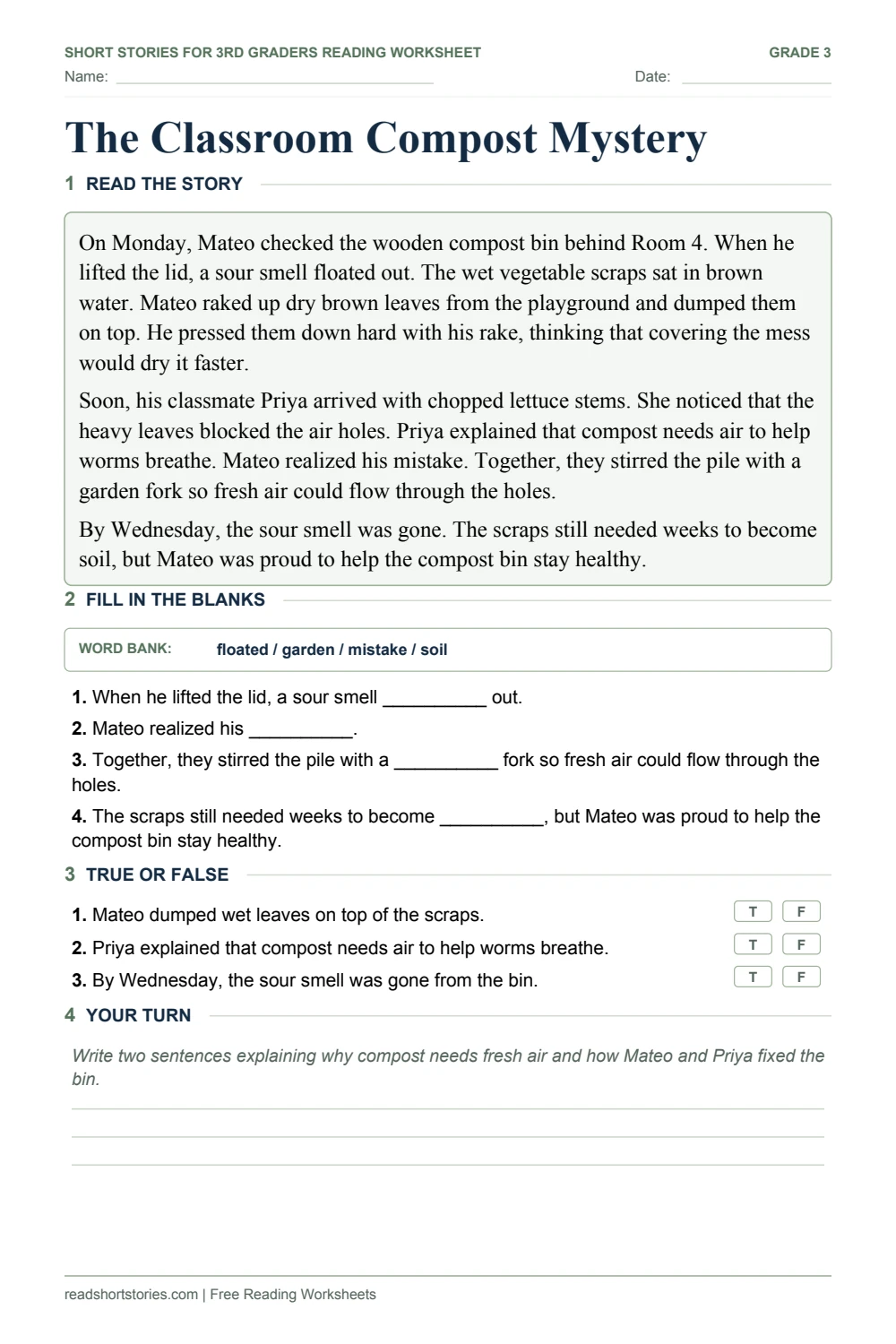
On Monday, Mateo checked the wooden compost bin behind Room 4. When he lifted the lid, a sour smell floated out. The wet vegetable scraps sat in brown water. Mateo raked up dry brown leaves from the playground and dumped them on top. He pressed them down hard with his rake, thinking that covering the mess would dry it faster.
Soon, his classmate Priya arrived with chopped lettuce stems. She noticed that the heavy leaves blocked the air holes. Priya explained that compost needs air to help worms breathe. Mateo realized his mistake. Together, they stirred the pile with a garden fork so fresh air could flow through the holes.
By Wednesday, the sour smell was gone. The scraps still needed weeks to become soil, but Mateo was proud to help the compost bin stay healthy.
Worksheet Word Bank
floated / garden / mistake / soil
Fill in the Blanks
- When he lifted the lid, a sour smell __________ out.
- Mateo realized his __________.
- Together, they stirred the pile with a __________ fork so fresh air could flow through the holes.
- The scraps still needed weeks to become __________, but Mateo was proud to help the compost bin stay healthy.
True or False
- Mateo dumped wet leaves on top of the scraps.
- Priya explained that compost needs air to help worms breathe.
- By Wednesday, the sour smell was gone from the bin.
Worksheet Writing Task
Write two sentences explaining why compost needs fresh air and how Mateo and Priya fixed the bin.
Story 2: The Cardboard Bridge Challenge (Short Story with Questions and Answers)
325 words · realistic fiction
On Friday, Maya and her partner Leo sat at a table in science lab. In front of them were cardboard strips, tape, and two wooden blocks. Mr. Alvarez had drawn a blue chalk line between the blocks to be a river.
“Your job is to build a bridge,” Mr. Alvarez said. “It must reach across twelve inches and hold this toy bus. The bus cannot touch the river.” He tore the corner off a cardboard box and showed the class the wavy fold inside. “Remember, folds can make paper strong.”
Maya opened her notebook. “Let’s fold our strips back and forth like a paper fan,” she said. “Folds will make our bridge strong.”
Leo shook his head. “Folding takes too long. We can tape three flat strips together. It will be thick, and we will finish first!”
Maya was not sure, but Leo was already taping. He set the yellow bus in the middle of the flat bridge.
Crunch! The cardboard bent in the middle, and the bus slid into the chalk river with a dusty thump.
“Oh no,” Leo groaned. “Only ten minutes are left before clean-up.”
Maya looked at the bent spot. “Flat cardboard bends when something heavy pushes on the middle,” she said. “Remember the folds in the box? Let’s try them.”
Leo nodded and handed her a new strip. Maya folded it back and forth to make tight, zigzag pleats. Leo taped flat strips on the top and bottom of the folds. The new bridge felt light, but it was very stiff.
They set it across the blocks. Leo held his breath and put the bus on top. The bridge did not bend at all.
“It worked!” Leo cheered, and he gave Maya a high five. “Taking time to do it the right way was better than rushing.”
Mr. Alvarez tapped the strong bridge with his pencil. “Great job fixing your design, team,” he said. “That is what engineers do.”
Listen and Read Along: The Cardboard Bridge Challenge
Vocabulary in Context
- pleats: folds made by bending something back and forth. She made neat pleats in the paper fan.
- stiff: firm and hard to bend. The plastic ruler stayed stiff when we pressed on it.
- rushing: moving or working too fast. I made mistakes because I was rushing.
- groaned: made a low sound because of worry or disappointment. The class groaned when it started to rain.
- design: a plan for how something will look or work. Our bridge design used folded paper.
- engineers: people who plan and build things. Engineers build bridges, roads, and machines.
Reading Comprehension Questions
- How far did the bridge have to reach across the river?
- Why did the first bridge fail?
- Why did Leo want to tape flat strips instead of folding them?
- What lesson did Leo learn from the challenge?
- What do the “pleats” probably look like? Use the clues in the sentence to explain.
- What can you tell about how Maya and Leo worked together at the end?
Language Practice
- The cardboard __________ in the middle, and the bus slid into the chalk river with a dusty thump.
- Mr. Alvarez drew a blue chalk line to be a __________.mountain / river / road / sidewalk
- Put the words in order to make a sentence.Words: make / Folds / strong / paper
- Maya folded the cardboard to make zigzag __________.wheels / pleats / blocks / ropes
- True or False: The toy bus stayed on top of the first bridge.True / False
Your Turn
Write 2–3 sentences about a time you fixed a mistake or changed a plan to make something work better.
Printable Grade 3 Reading Worksheet: The Cardboard Bridge Challenge
Open the full-size The Cardboard Bridge Challenge worksheet
Read the short worksheet text and exercises
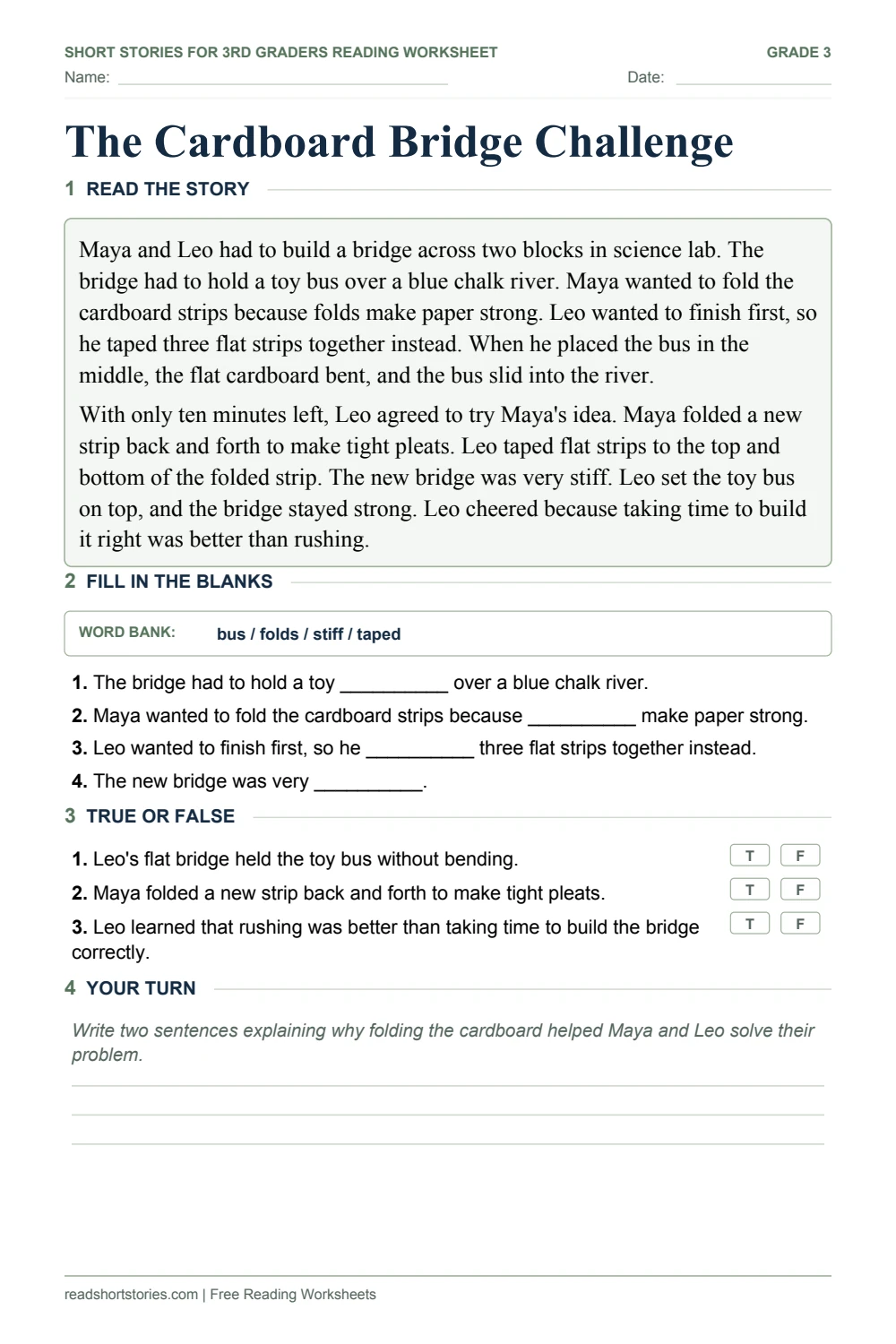
Maya and Leo had to build a bridge across two blocks in science lab. The bridge had to hold a toy bus over a blue chalk river. Maya wanted to fold the cardboard strips because folds make paper strong. Leo wanted to finish first, so he taped three flat strips together instead. When he placed the bus in the middle, the flat cardboard bent, and the bus slid into the river.
With only ten minutes left, Leo agreed to try Maya’s idea. Maya folded a new strip back and forth to make tight pleats. Leo taped flat strips to the top and bottom of the folded strip. The new bridge was very stiff. Leo set the toy bus on top, and the bridge stayed strong. Leo cheered because taking time to build it right was better than rushing.
Worksheet Word Bank
bus / folds / stiff / taped
Fill in the Blanks
- The bridge had to hold a toy __________ over a blue chalk river.
- Maya wanted to fold the cardboard strips because __________ make paper strong.
- Leo wanted to finish first, so he __________ three flat strips together instead.
- The new bridge was very __________.
True or False
- Leo’s flat bridge held the toy bus without bending.
- Maya folded a new strip back and forth to make tight pleats.
- Leo learned that rushing was better than taking time to build the bridge correctly.
Worksheet Writing Task
Write two sentences explaining why folding the cardboard helped Maya and Leo solve their problem.
Story 3: Pip and the Missing Acorns (Funny Animal Fable for Grade 3)
303 words · animal fable
Pip the squirrel loved acorns. One sunny autumn day, she gathered fifty of them. “If I hide them in lots of secret places, nobody can steal them,” she thought.
So Pip hid one acorn in an old boot. She hid one in a flower pot and one in a mailbox. She even tucked one into a bird’s nest while the bird was away. Each time, she giggled. “I am the cleverest squirrel in the forest!”
Soon winter came, and snow covered the ground. Pip was hungry. She hurried to the old boot. Empty! She checked the flower pot. Only snow! She remembered a few hiding spots, but not all fifty. “Where did I put the rest?” she cried.
Pip checked the mailbox again. Inside was a leaf shaped like a letter. “Dear Pip,” she muttered, “your supper is not here!” She gave a little laugh, then kept searching.
Pip dug and searched all day. She found only three acorns. Her tail drooped, and her tummy growled.
Her friend Bram the hedgehog saw her shivering in the snow. “Why are you digging holes everywhere?” he asked.
Pip told him about her secret places. Bram gave her half of his supper. Pip brushed snow from her whiskers and showed him a snowy mustache. They both laughed. “What would make your acorns easier to find?” Bram asked.
Pip thought about her plan and the scattered hiding spots. “One place close to my tree,” she decided. “I can mark it so I will remember.” Bram nodded, but Pip would choose the place herself.
The next autumn, Pip put all her acorns inside a hollow log. She tied a red ribbon around it so she could spot it easily. When winter came, she found every acorn at once. Then she invited Bram over for a big acorn dinner.
Listen and Read Along: Pip and the Missing Acorns
Vocabulary in Context
- giggled: laughed in a quiet, silly way. The kids giggled at the funny joke.
- drooped: hung down because of sadness or tiredness. The flowers drooped without water.
- shivering: shaking because of cold or fear. She was shivering in the cold wind.
- plan: an idea for how to do something. Our plan is to meet at the park.
- hollow: empty on the inside. The owl lives in a hollow tree.
- ribbon: a long, thin strip of colorful cloth. She tied a ribbon in her hair.
Reading Comprehension Questions
- Where did Pip put her acorns the next autumn?
- Why did Pip hide her acorns in many different places?
- Why was Pip upset in winter?
- What is the central message of this fable?
- What does the word “drooped” mean when Pip’s tail “drooped”? Use clues from the story.
- What can you tell about Bram from the way he treated Pip?
Language Practice
- What animal is Bram?A rabbit / A hedgehog / A bird / A fox
- Her tail __________, and her tummy growled.
- Put the words in order to make a sentence.Words: acorns / loved / Pip
- What did Pip tie around the hollow log?A red ribbon / A rope / A scarf
- True or False: In winter, Pip found all of her acorns in the secret places.True / False
Your Turn
Think of a time a friend gave you a good idea. What was the idea, and how did it help you?
Printable Grade 3 Reading Worksheet: Pip and the Missing Acorns
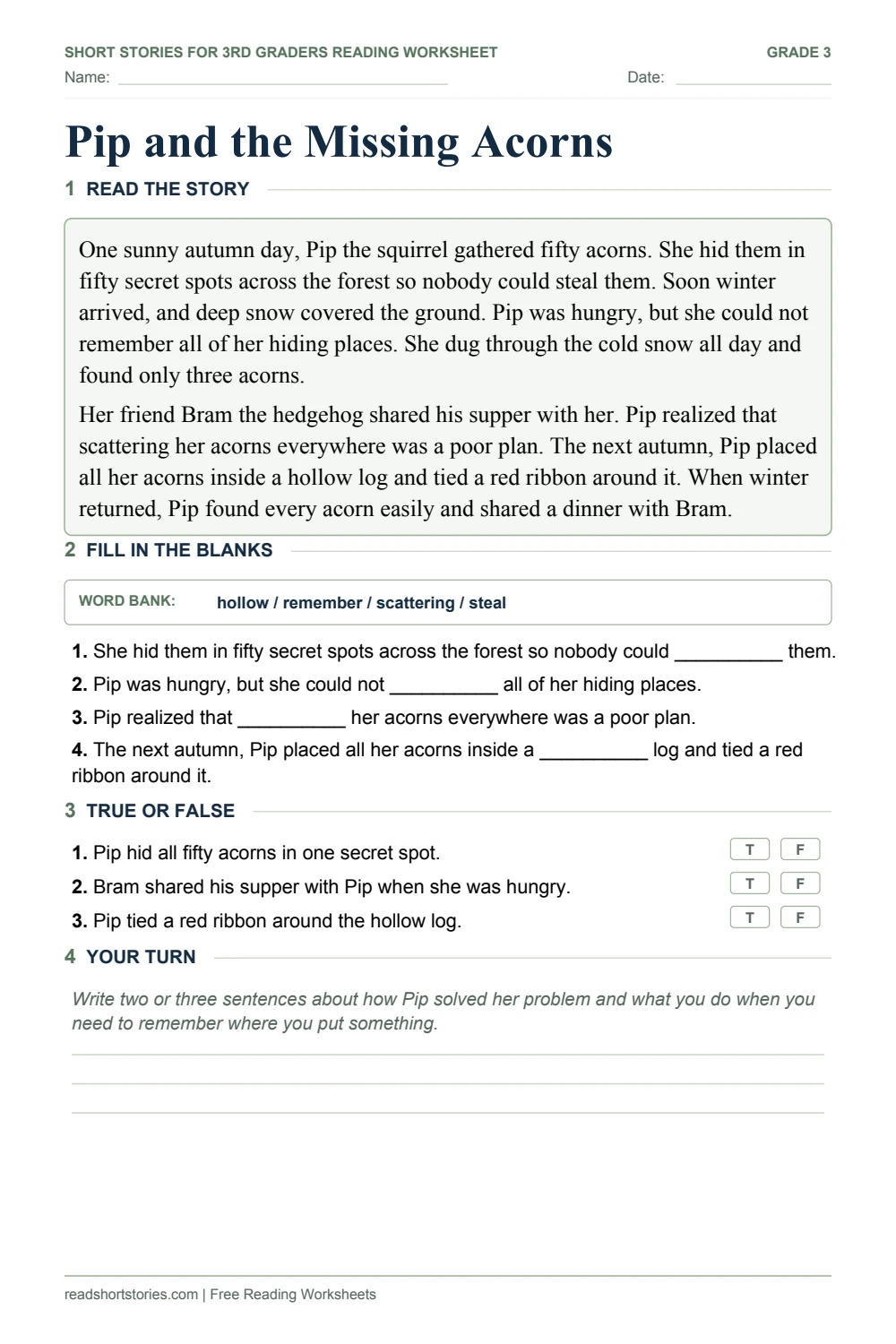
Open the full-size Pip and the Missing Acorns worksheet
Read the short worksheet text and exercises
One sunny autumn day, Pip the squirrel gathered fifty acorns. She hid them in fifty secret spots across the forest so nobody could steal them. Soon winter arrived, and deep snow covered the ground. Pip was hungry, but she could not remember all of her hiding places. She dug through the cold snow all day and found only three acorns.
Her friend Bram the hedgehog shared his supper with her. Pip realized that scattering her acorns everywhere was a poor plan. The next autumn, Pip placed all her acorns inside a hollow log and tied a red ribbon around it. When winter returned, Pip found every acorn easily and shared a dinner with Bram.
Worksheet Word Bank
hollow / remember / scattering / steal
Fill in the Blanks
- She hid them in fifty secret spots across the forest so nobody could __________ them.
- Pip was hungry, but she could not __________ all of her hiding places.
- Pip realized that __________ her acorns everywhere was a poor plan.
- The next autumn, Pip placed all her acorns inside a __________ log and tied a red ribbon around it.
True or False
- Pip hid all fifty acorns in one secret spot.
- Bram shared his supper with Pip when she was hungry.
- Pip tied a red ribbon around the hollow log.
Worksheet Writing Task
Write two or three sentences about how Pip solved her problem and what you do when you need to remember where you put something.
Download Short Stories for Grade 3 with Questions and Answers (Free Printable PDF)
Get all 6 stories, including 3 PDF bonus stories. Each has vocabulary, six comprehension questions and explained answers. The workbook is image-free and includes a separate answer key.
- Download short stories for 3rd graders PDF (US Letter)
- Download short stories for 3rd graders PDF (A4)
- Download printer-friendly Grade 3 short stories PDF (US Letter)
- Download printer-friendly Grade 3 short stories PDF (A4)
Three Extra Stories in the PDF
- The Blue Streak: Third-grader Jordan wants to paint the central sunbeam on Room 3’s hallway mural before the afternoon open house.
- Two Green Mittens: Clara and Sam both reach for identical green mittens in the lunchroom lost-and-found bin.
- A Rhythm for Everyone: Marcus turns a jump rope for his classmates on the playground, but Elena hesitates to jump because the fast tempo makes her nervous.
Reading Comprehension Answer Key for Teachers and Parents
These are sample answers. Accept another interpretation when the reader supports it with accurate text details.
The Classroom Compost Mystery: Questions and Answers
Reading Answers
- The compost bin was behind Room 4. Text evidence: Mateo knelt beside the wooden compost bin behind Room 4.
- He thought the leaves would soak up the water and dry the pile faster. Text evidence: He thought covering the mess would dry it faster.
- He wanted to show how food scraps could help plants grow during Science Week. Caring for the bin helped him prepare his project. Text evidence: Mateo wanted to show how food scraps could help plants grow.
- He learned to watch carefully and ask questions before trying to fix something. Text evidence: Watching the pile and asking questions had helped him understand what it needed.
- “Balance” means to use the right amount of each thing. Priya wants some leaves and some scraps mixed together, not only leaves. Text evidence: We need loose leaves mixed with chopped scraps, not a solid wall.
- Mateo probably felt embarrassed or sorry because his plan had made things worse. Text evidence: His cheeks felt warm.
Language Practice Answers
- Mr. Chen
- soggy
- Compost needs air.
- Lettuce stems
- False — The leaves blocked the air holes, and the worms were trying to get away.
Short Worksheet Answers
Use these answers with the short worksheet text and questions under the matching story.
Blanks: 1. floated; 2. mistake; 3. garden; 4. soil
- False. Mateo raked up dry brown leaves and dumped them on top. Evidence: Mateo raked up dry brown leaves from the playground and dumped them on top.
- True Evidence: Priya explained that compost needs air to help worms breathe.
- True Evidence: By Wednesday, the sour smell was gone.
The Cardboard Bridge Challenge: Questions and Answers
Reading Answers
- The bridge had to reach across twelve inches (one foot). Text evidence: It must reach across twelve inches and hold this toy bus.
- The flat cardboard bent under the bus. Without folds, it did not stay strong enough to hold the bus. Text evidence: The cardboard bent in the middle, and the bus slid into the chalk river with a dusty thump.
- Leo wanted to finish first and thought folding would take too long. Text evidence: Folding takes too long.
- Leo learned that taking time to do a job the right way is better than rushing. Text evidence: Taking time to do it the right way was better than rushing.
- Pleats look like tight folds that go back and forth, like a paper fan. The sentence says Maya “folded it back and forth to make tight, zigzag pleats.” Text evidence: Maya folded it back and forth to make tight, zigzag pleats.
- They worked well as a team. Leo listened to Maya’s idea and helped tape the folds, and they celebrated together. Text evidence: Leo nodded and handed her a new strip.
Language Practice Answers
- bent
- river
- Folds make paper strong.
- pleats
- False — The bus slid into the chalk river with a dusty thump.
Short Worksheet Answers
Use these answers with the short worksheet text and questions under the matching story.
Blanks: 1. bus; 2. folds; 3. taped; 4. stiff
- False. The flat cardboard bent, and the toy bus slid into the river. Evidence: When he placed the bus in the middle, the flat cardboard bent, and the bus slid into the river.
- True Evidence: Maya folded a new strip back and forth to make tight pleats.
- False. Leo learned that taking time to build it right was better than rushing. Evidence: Leo cheered because taking time to build it right was better than rushing.
Pip and the Missing Acorns: Questions and Answers
Reading Answers
- She put them inside a hollow log with a red ribbon on it. Text evidence: Pip put all her acorns inside a hollow log.
- She wanted to keep the acorns safe so nobody could steal them. Text evidence: If I hide them in lots of secret places, nobody can steal them
- She was hungry and could not find most of her stored acorns. The detail that she found only three explains why she felt upset. Text evidence: She found only three acorns.
- A simple plan that you can remember can work better than a complicated one. Pip changes from many secret spots to one marked log and finds her acorns. Text evidence: She tied a red ribbon around it so she could spot it easily.
- “Drooped” means hung down. Pip was sad, hungry, and tired, so her tail hung low. Text evidence: Her tail drooped, and her tummy growled.
- Bram is kind and caring. He shares food with hungry Pip and asks a helpful question. Accept another trait when the reader supports it with a detail. Text evidence: Bram gave her half of his supper.
Language Practice Answers
- A hedgehog
- drooped
- Pip loved acorns.
- A red ribbon
- False — She found only three acorns.
Short Worksheet Answers
Use these answers with the short worksheet text and questions under the matching story.
Blanks: 1. steal; 2. remember; 3. scattering; 4. hollow
- False. Pip hid them in fifty secret spots across the forest. Evidence: She hid them in fifty secret spots across the forest so nobody could steal them.
- True Evidence: Her friend Bram the hedgehog shared his supper with her.
- True Evidence: The next autumn, Pip placed all her acorns inside a hollow log and tied a red ribbon around it.
Frequently Asked Questions about Grade 3 Reading Worksheets
How long are these short stories for 3rd graders?
The 3 web stories in this collection have 303–374 words each. Story length is one factor when choosing a passage; also consider vocabulary, sentence structure and the reader’s confidence.
How do I use the reading comprehension questions?
Read the story first. Answer each question in a full sentence and point to a detail that supports the answer. Discuss other interpretations when the text supports them.
Are the questions and answers included in the PDF?
Yes. The printable workbook contains all 6 stories, vocabulary, reading questions, language practice and a separate answer key. The final 3 stories are PDF bonuses.
Can I print the stories for classroom or home use?
Yes. Download the free A4 or US Letter workbook. Print the student pages separately from the answer key when you want learners to answer independently.
Do these stories have a measured Lexile or Fountas & Pinnell level?
No measured Lexile score or Fountas & Pinnell level is assigned. Choose a passage by reading a sample with the child and checking vocabulary, understanding and the amount of support needed.
More Short Stories and Reading Activities
- 10 Lines Short Stories with Moral + Vocabulary (Free PDF)
- Action Words Stories for Grades 1 to 4 Learners – PDF
- 10 Popular Panchatantra Stories in English – PDF
- Benny and His Bunny Friends: A Rabbit Story for Kids
Resource by Read Short Stories. Adults can preview each passage and adjust support for the reader.