Listen and read along: Audio versions are available for 4 stories on this page. Use the players below.
You can download the free short stories for 6th graders PDF below.
Short Stories for 6th Graders
The Queue for Nothing
Pippa bounded into the sunlit clearing of Oakridge Wood, her wicker basket swinging from one paw. She had planned to cross to the clover meadow before noon, but near the center she stopped. Stretching from the great sycamore to the stone well was an impeccably straight, silent line of woodland animals. No one jostled. Every ear cocked forward, and every eye fixed on the tail ahead.
Such a gathering was unheard of on an ordinary Tuesday. Surely this patience signaled something extraordinary—perhaps candied beechnuts or an official announcement from the bird council. Not wanting to miss out, Pippa slipped behind Quillan the hedgehog and stood on her hind legs to survey the crowd.
Ten minutes passed under the steady sun without the line advancing an inch. Ahead, a grouse shifted from foot to foot. Behind Pippa, a field mouse arrived with an armful of seeds and fell into position.
Curiosity overcame Pippa’s patience. Leaning forward, she whispered, “Excuse me, Quillan. Is it ripe berries, or are they handing out orchard permits?”
Quillan turned his snout back. “I couldn’t say for certain,” he whispered. “I only saw Rowan the squirrel standing so purposefully that I knew there had to be something worth waiting for. When a squirrel skips morning foraging, sensible folk don’t ask questions; they take a place.”
Pippa frowned. She leaned out of rank to address Rowan, who stood ahead of Quillan. “Rowan, what are we waiting for?”
Rowan blinked in mild offense. “Ask Corvus the crow ahead of me. He arrived with his wings tucked and chest puffed like a town crier. When a crow takes a position with that sort of gravity, you don’t wander off.”
A ripple of doubt prickled Pippa’s paws. Ahead stood two raccoons, a pine marten, and a pair of tortoises, all staring silently at the back of the animal in front. None carried a basket, a ticket, or an explanation.
“This makes no sense,” Pippa muttered. Stepping out of the queue, she marched along the cobblestones. Heads turned in quiet disapproval as she broke line etiquette, passing the motionless tortoises and the solemn grouse.
At the very front, seated on a mossy sycamore root, sat Bramble. The elderly badger was calmly peeling a hickory nut with his claws, humming a lazy tune.
“Mr. Bramble,” Pippa asked, catching her breath. “What is being handed out? The whole village is lined up behind you!”
Bramble paused, a sliver of shell between his paws. He looked past Pippa at the long column of attentive creatures, then blinked in surprise.
“Handed out?” Bramble chuckled, his grizzled whiskers twitching. “Nothing is being handed out, child. I’m simply holding this cool shade until my brother Alden gets back. He went to find his spectacles, but he has terrible eyesight and wanders when he gets distracted.”
Pippa looked back down the clearing. There, at the very end of the line, squinting earnestly at the back of the field mouse, stood Alden with his wire-rimmed spectacles hanging from his neck.
“Alden!” Bramble shouted across the square. “What are you doing back there?”
The old badger peered forward through the sunlight. “Waiting, Bramble! The queue looked so important that I didn’t want to lose my turn!”
A wave of embarrassed laughter swept down the square. The great line instantly dissolved. Corvus flapped into the branches, Rowan darted into the brush, and the tortoises turned toward the creek. Only Quillan remained, settling happily into the cool moss beside the sycamore.
“Aren’t you leaving?” Pippa asked.
Quillan tucked his paws under his belly. “I didn’t need whatever they were giving away, but the shade here is excellent. A good spot is a good spot, line or no line.”
Pippa smiled, adjusted her basket, and set off toward the clover meadow, leaving the square quiet once again.
Questions
- What central theme is developed through the animals’ unquestioning participation in the line?
- How does Pippa demonstrate an independent point of view compared to the rest of the animals?
- Based on the animals’ reaction when Pippa leaves her spot, what does the word etiquette mean in the story?
- How does the sudden change in the line’s behavior help resolve the plot?
- What does Quillan’s choice to stay behind at the sycamore reveal about his perspective?
- What makes Alden’s search for his spectacles ironic?
Click to see the answers
Answers
- Following a crowd without checking its purpose can lead people to act on a shared mistake. Evidence: I only saw Rowan the squirrel standing so purposefully that I knew there had to be something worth waiting for. When a squirrel skips morning foraging, sensible folk don’t ask questions; they take a place.
- She leaves her place in the line to investigate instead of continuing to wait on assumptions. Evidence: Stepping out of the queue, she marched along the cobblestones.
- It refers to the unwritten rules of acceptable and polite behavior within a group. Evidence: Heads turned in quiet disapproval as she broke line etiquette, passing the motionless tortoises and the solemn grouse.
- The laughter and quick breakup contrast with the earlier solemn waiting, showing that the shared misunderstanding has ended. Evidence: A wave of embarrassed laughter swept down the square. The great line instantly dissolved.
- He recognizes that the shade is pleasant enough to stay for, even without any prize or event. Evidence: I didn’t need whatever they were giving away, but the shade here is excellent. A good spot is a good spot, line or no line.
- He has been looking for spectacles that are already hanging from his neck. Evidence: There, at the very end of the line, squinting earnestly at the back of the field mouse, stood Alden with his wire-rimmed spectacles hanging from his neck.
Twelve Seconds Above the Sand
On the morning of December 17, 1903, a freezing wind blew across the Outer Banks at Kill Devil Hills, North Carolina. Ice coated puddles around the wooden camp shed where Orville and Wilbur Wright housed their experimental aircraft. The wind was measured at twenty-seven miles per hour, blowing steadily from the north. Despite the biting cold, the brothers hung a white signal sheet against the side of their shed. This signal alerted the crew at the nearby Kill Devil Hills Life-Saving Station that a trial was planned. Soon, several station surfmen and local residents walked across the beach to watch and assist.
The Wright brothers had traveled from Dayton, Ohio, to this coastal stretch for four seasons. Since 1900, they had tested gliders, built a wind tunnel to calculate lift tables, and refined a system of three-axis aerodynamic control. Their 1903 Flyer featured a twelve-horsepower engine that turned two counter-rotating wooden propellers using bicycle chains. Three days earlier, on December 14, Wilbur had won a coin toss to make the first attempt. However, an over-correction on the elevator caused the machine to stall after three seconds, cracking a landing skid. With repairs completed, it was now Orville’s turn to take the controls.
To launch into the strong headwind, the men laid sixty feet of wooden track across level sand. Facing the rail directly into the wind helped the aircraft generate lift without needing high ground speed. At 10:35 a.m., Orville lay prone on the lower wing, resting inside the hip cradle that shifted the wingtips for lateral balance. Once the engine was running, Orville released the restraining wire, and the Flyer moved forward along the rail. Wilbur ran beside the right wingtip to steady the craft until it gathered speed.
After traveling forty feet along the rail, the machine lifted into the air. John T. Daniels, a surfman from the life-saving station, squeezed the bulb of a tripod-mounted camera, capturing the airborne craft just as it rose two feet above the sand with Wilbur watching nearby. In flight, the Flyer proved difficult to manage. The front elevator was extremely sensitive, and turbulent wind caused the craft to dart up and down. After twelve seconds and 120 feet of travel, a sudden dip brought the skids into the damp sand.
The twelve-second flight was brief, but it marked the first time an airplane had lifted itself by its own power and flown forward under human control. The men hauled the Flyer back to the rail to make further trials. At 11:20 a.m., Wilbur took his turn at the controls. Flying into the steady wind, he traveled 175 feet in roughly twelve seconds. Twenty minutes later, Orville piloted the third run, covering 200 feet in fifteen seconds as he worked to master the responsive pitch control.
Just after noon, Wilbur climbed aboard for the fourth flight. The Flyer rose smoothly and traveled past the marks of the earlier runs. Wilbur held the machine steady against the cold gusts, maintaining an altitude of about ten feet. The flight lasted fifty-nine seconds and covered 852 feet before an unexpected pitch change brought the craft down onto the sand. A short time later, while the men stood discussing the successful trial, a violent gust caught the parked aircraft. The wind rolled the Flyer repeatedly across the sand, breaking its frame and ending flights for the season.
Though the machine was damaged, the four flights had accomplished their goal. Orville walked to the weather station in Kitty Hawk to send a telegram to their father, Milton Wright. He reported four successful flights against the strong wind and announced they would be home for Christmas. As documented by the National Park Service, the morning at Kill Devil Hills established the foundation of aviation through verified measurements of time, distance, and control.
Questions
- What action did Orville take to start the Flyer moving forward along the launch track?
- How does the author connect the earlier attempt on December 14 to the events of December 17?
- How does the final paragraph present the trials despite the later damage to the Flyer?
- Based on the story, what does the word turbulent mean when describing the wind during the first flight?
- What can be inferred about the Wright brothers’ method of developing powered flight before their 1903 trials?
- What central theme does the story convey about historic breakthroughs?
Click to see the answers
Answers
- He released the restraining wire once the engine was running, allowing the Flyer to move along the rail. Evidence: Once the engine was running, Orville released the restraining wire, and the Flyer moved forward along the rail.
- Wilbur’s earlier trial ended in a stall that cracked a skid, so once repairs were finished, it became Orville’s turn to fly. Evidence: However, an over-correction on the elevator caused the machine to stall after three seconds, cracking a landing skid. With repairs completed, it was now Orville’s turn to take the controls.
- It presents the trials as successful because the four flights met their goal before the machine was damaged. Evidence: Though the machine was damaged, the four flights had accomplished their goal.
- It means rough, unsteady, or agitated, as shown by the wind causing the aircraft to bounce up and down. Evidence: The front elevator was extremely sensitive, and turbulent wind caused the craft to dart up and down.
- They relied on systematic testing and calculated aerodynamic data rather than guesswork. Evidence: Since 1900, they had tested gliders, built a wind tunnel to calculate lift tables, and refined a system of three-axis aerodynamic control.
- A short, limited success can be a major breakthrough when it demonstrates something that had not been achieved before. Evidence: The twelve-second flight was brief, but it marked the first time an airplane had lifted itself by its own power and flown forward under human control.
Listen to this story (audio)
The Last Frame
The red digital clock in Editing Booth B read 4:12 PM. Zora rested her hand on the scrub wheel, watching waveforms flicker across the monitor. She had spent three weeks following Rafi through the neighborhood arts center, gathering footage for her student documentary. The festival submission deadline was five o’clock sharp.
Mr. Torres tapped the doorframe with his clipboard. “Forty-eight minutes, Zora,” he warned. “The projection booth needs the file by five for format checks. If your drive isn’t on my desk, your slot goes to the backup reel.”
“Almost ready,” Zora promised. “Just balancing the final audio.”
As footsteps faded, Zora scrubbed to the four-minute mark. This was the emotional center of her film: footage from Tuesday’s rehearsal in the third-floor studio. During an intricate passage, Rafi’s bow had slipped with a harsh screech. On screen, Rafi lowered his violin, buried his face in his hands, and slumped in defeat. The camera captured his private distress before he tried again. It was dramatic, gripping, and deeply personal.
The booth door clicked open. Rafi stepped inside with his violin case. “Is the export ready?” he asked, pulling up a rolling stool.
“Watch this transition,” Zora said, turning the preview monitor toward him. “It’s the lead-up to your recital.”
She hit play. Rafi watched intently, but as the harsh bow scrape filled the room and his recorded self slumped in defeat, his shoulders went rigid. His fingers tightened on his case straps as the color drained from his face.
“Zora, pause it,” Rafi said softly. Zora clicked the mouse. Rafi stared at his frozen expression of frustration. “You can’t show that.”
“Why?” Zora asked. “Rafi, it’s the strongest scene in the film. It proves how difficult the piece really is. Without that struggle, the performance looks effortless, like you never had to sweat.”
“It feels like an ambush,” Rafi said, meeting her eyes. “I agreed to be filmed so people could understand the work, not to have neighbors watch me break down on a giant screen. That happened when I thought your camera was off.”
“Judges look for raw emotion,” Zora countered, checking the clock. It read 4:26 PM. “If I remove it, the film gets flatter.”
“Then let it be flat,” Rafi said evenly. “I trusted you. If making an exciting movie means showing my private panic without permission, take my name off the whole project.”
His words hung in the narrow booth. Zora looked at the screen. Three weeks ago, she had promised an honest partnership. Winning praise from festival judges felt hollow if it meant betraying the classmate who had trusted her with his workspace.
“You’re right,” Zora said, exhaling slowly. “Give me fifteen minutes.”
She highlighted the breakdown clip and hit delete. Opening her extra bin, she selected an alternate cut: Rafi seated beside a metronome, his pencil scribbling fingerings above the staff, patiently repeating a four-measure phrase at half-speed. It showed quiet concentration and real effort without turning frustration into spectacle.
Zora adjusted the audio dissolve and exported the project. The progress bar finished at 4:52 PM. She dragged the video file to her flash drive, ejected it, and hurried down the hall. She reached the office with four minutes to spare, handing the drive to Mr. Torres.
At six o’clock, the arts center auditorium filled with families and musicians. When Zora’s film screened, the audience watched attentively. During the practice sequence, as the camera focused on Rafi’s pencil marks and deliberate repetitions, several orchestra members nodded in quiet recognition.
When the lights rose, warm applause filled the hall. A cellist stopped in the aisle to ask Rafi about his shifting technique. Across the room, Rafi caught Zora’s eye and gave her a steady, grateful nod. Zora smiled, knowing the honest cut had protected something far more lasting than dramatic flair.
Questions
- How much time did Zora have remaining when she delivered her flash drive to Mr. Torres?
- Why does Zora decide to remove the clip of Rafi’s frustration from her project?
- In the story, what does the word spectacle mean when describing the alternate cut of Rafi practicing?
- How does the replacement practice sequence support the theme of respecting Rafi?
- What can be inferred from the silent gesture Rafi gives Zora after the film screening?
- What central theme is conveyed through Zora’s final decision about her documentary?
Click to see the answers
Answers
- Zora arrived at the office with four minutes left before the deadline. Evidence: She reached the office with four minutes to spare, handing the drive to Mr. Torres.
- She decides that making a more dramatic film is not worth breaking Rafi’s trust. Evidence: I trusted you. If making an exciting movie means showing my private panic without permission, take my name off the whole project.
- It means a dramatic public display intended to attract attention. Evidence: It showed quiet concentration and real effort without turning frustration into spectacle.
- It shows genuine effort through quiet practice without making his frustration a public display. Evidence: It showed quiet concentration and real effort without turning frustration into spectacle.
- Rafi’s nod indicates that he appreciates Zora honoring his boundaries and feels respected by the final version of the documentary. Evidence: Across the room, Rafi caught Zora’s eye and gave her a steady, grateful nod.
- Trust and respect matter more than making creative work dramatic or winning praise. Evidence: Winning praise from festival judges felt hollow if it meant betraying the classmate who had trusted her with his workspace.
Listen to this story (audio)
A Table for Two Maps
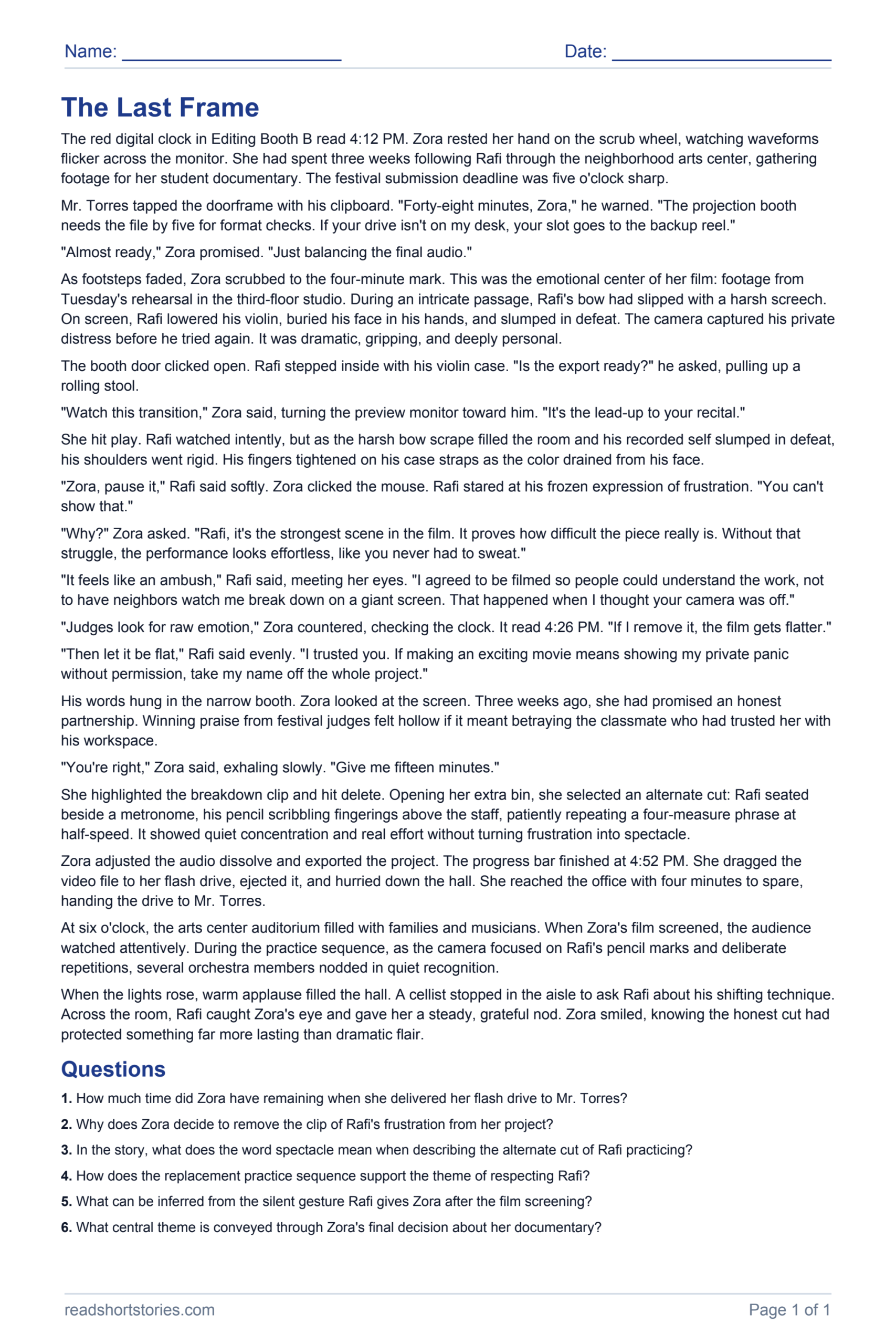
Keiko anchored the corners of her neighborhood walking map with a ceramic sugar jar and her pencil case. Through the wide glass wall of the station cafe, silver commuter trains glided along elevated tracks, humming over the afternoon streets. Across the small round table, her visiting cousin Ivo unfolded a glossy transit guide that crackled like stiff paper sails. Ivo had arrived from São Paulo only two days earlier, his eyes still wide at the sheer size of Tokyo’s railway network. They had four free hours before meeting their families for dinner at five o’clock.
“If we take the subway two stops north, we can reach the old temple district,” Keiko said, tapping a light circle around a quiet grid of narrow streets. “There is a weathered wooden gate tucked behind cedar trees and a hidden courtyard where green moss cushions the stone lanterns. It feels like stepping right into another era, completely away from the station crowds.”
Ivo shook his head, rotating his transit foldout so the bold lines faced Keiko. “We only have today to explore on our own,” he argued, his finger tracing the bright turquoise line that looped toward the river. “Look at this junction. Two levels of train tracks cross above the canal, and just two blocks away is a huge multistory arcade packed with robot kits and digital sound boards. That is the Tokyo I have been reading about for months.”
Keiko looked between the two sheets on the table. Her walking map used soft sepia tones and ink sketches of curved tile roofs, while Ivo’s transit foldout glowed with electric colors and numbered line symbols. “If we ride your elevated line out toward the bay, we will spend half our time stuck underground in transfer tunnels,” she objected. “And if we spend all afternoon wandering through temple gardens, you will be studying roof tiles while I stare at fences,” Ivo countered, leaning back in his chair with a grin. “Neither of us wants to follow someone else’s plan for four straight hours.”
A cafe server stepped up, set down two glasses of iced tea on paper coasters, and quietly returned to the counter. Keiko took a sip of her roasted barley tea, watching the condensed droplets run down the glass. She looked at Ivo’s bright subway map, then back at her own walking guide. “How far is your electronics arcade from the water?” she asked, leaning forward.
Ivo picked up Keiko’s red pencil, pointing to the grid along the canal. “It is directly beneath the brick railway arches on the south bank, only a five-minute walk from the exit.” Keiko leaned closer, tilting her head. “Wait. The stone stairway to my quiet temple lane begins on the north bank of that exact same canal. They are separated by only one footbridge.” Ivo checked the map distance with his thumb. “They are practically on opposite sides of the same water.”
“Then let’s split the afternoon,” Keiko proposed, drawing a neat red ring around the footbridge between their two destinations. “Two stops each, connected into one big loop. First we take the subway two stops north, and from the station exit, you lead the way to the elevated platform so you can watch three commuter trains cross over the canal at the same time. After that, I guide us down the stone steps into the quiet temple garden.” Ivo clicked his blue pen, his eyes lighting up as he traced along the red circle. “Deal. And from the temple gate, I navigate through the covered market alley to the robotics shop. What is your second stop?” Keiko smiled, tapping a tiny square near the canal path. “A neighborhood shop where sweet soy sauce crackers are grilled fresh over hot charcoal.”
Ivo connected their pencil marks where the paper maps overlapped, turning two separate plans into a single continuous trail. Keiko finished her iced tea, folded both maps together, and slid them into her canvas bag. They stepped out through the glass doors into the cool afternoon air, where the chime of train signals mixed with the rustle of neighborhood trees. Heading toward the subway entrance for their two-stop ride north, Ivo checked his compass while Keiko watched the station signs, ready to take turns leading their loop from the canal exit.
Questions
- How much time do Keiko and Ivo have to explore Tokyo before meeting their families for dinner?
- How do the visual styles of the two maps reflect Keiko and Ivo’s differing priorities?
- How does the physical action of connecting their pencil marks represent the resolution of the plot?
- What does the word anchored mean as used to describe what Keiko did to her map?
- What does Ivo’s reaction to Tokyo’s railway network suggest about his perspective as a visitor?
- What central theme about compromise is developed through Keiko and Ivo’s experience?
Click to see the answers
Answers
- They have four hours before their family dinner at five o’clock. Evidence: They had four free hours before meeting their families for dinner at five o’clock.
- Keiko’s map highlights traditional cultural landmarks using muted tones and sketches of historic roofs, whereas Ivo’s transit guide emphasizes modern technology and urban transportation with vivid electric colors. Evidence: Her walking map used soft sepia tones and ink sketches of curved tile roofs, while Ivo’s transit foldout glowed with electric colors and numbered line symbols.
- It demonstrates that the cousins have resolved their conflict by combining their two competing plans into a single shared route. Evidence: Ivo connected their pencil marks where the paper maps overlapped, turning two separate plans into a single continuous trail.
- It means held firmly in place; the jar and pencil case hold down the map’s corners. Evidence: Keiko anchored the corners of her neighborhood walking map with a ceramic sugar jar and her pencil case.
- His wide-eyed reaction suggests that the size of the railway network fascinates and impresses him. Evidence: Ivo had arrived from São Paulo only two days earlier, his eyes still wide at the sheer size of Tokyo’s railway network.
- Respecting different interests can help people make a shared plan and take turns contributing. Evidence: Heading toward the subway entrance for their two-stop ride north, Ivo checked his compass while Keiko watched the station signs, ready to take turns leading their loop from the canal exit.
Listen to this story (audio)
Download the Free PDF
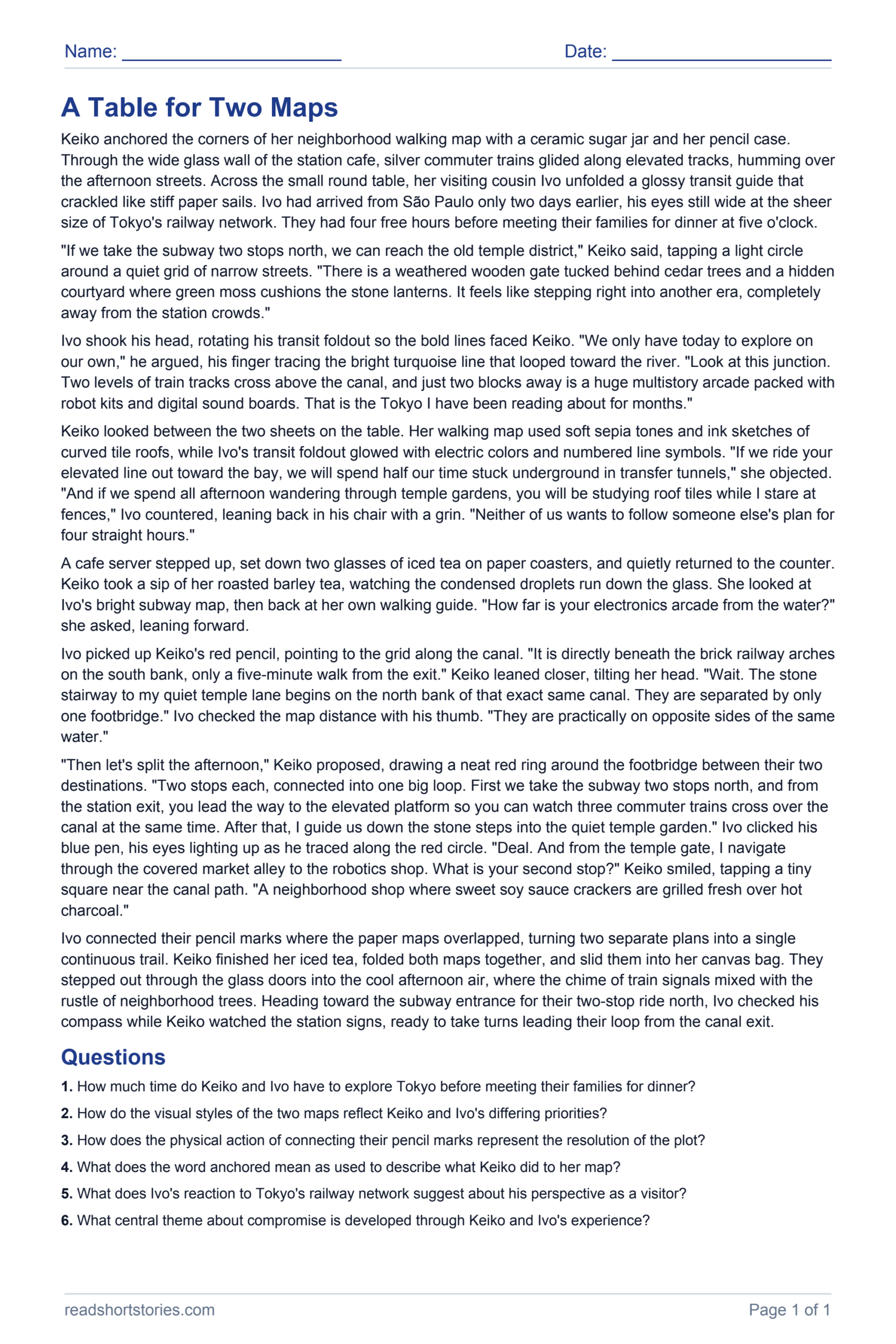
The workbook includes 10 stories: the 4 stories above and 6 bonus stories, with questions and a separate answer key.
Frequently Asked Questions
How long are the stories?
The web stories have 635–718 words each. Read together when a child needs support.
Does the PDF include answers?
Yes. All 10 stories have questions, and the answer key is on separate pages.
How can we use these stories?
Read or listen, answer the questions, and look back at the story for clues. Print the US Letter or A4 pages for home or classroom reading.