- Action Words Stories for Grades 1 to 4 Learners – PDF
- Grade 1 Story: Tommy’s Super Busy Day
- Words to Know
- Comprehension Questions
- Try It: Find and Act
- Grade 2 Story: The Big Day at the Park
- Words to Know
- Comprehension Questions
- Try It: Present and Past
- Grade 3 Story: The Big Bake Sale
- Words to Know
- Comprehension Questions
- Try It: Retell the Problem
- Grade 4 Story: The Community Clean-Up Day
- Words to Know
- Comprehension Questions
- Try It: Write About a Helpful Action
- Answer Key
- Tommy’s Super Busy Day — Answers
- The Big Day at the Park — Answers
- The Big Bake Sale — Answers
- The Community Clean-Up Day — Answers
- Download 8 More Action Words Stories
- Action Words Stories PDF - Download
- What to Read Next
What happens when a ball rolls under a bench or a bake sale sign blows away? Action words help us tell the story. Read these four short stories for grades 1–4, notice the verbs in bold, and answer the questions after each one.
Action words are verbs that tell us what someone or something does, such as jumps, carries, and helps. Some verbs describe states rather than actions, but these stories focus on actions you can picture.
The grade labels are flexible teaching suggestions, not formal reading-level assessments. Choose a story based on the reader’s confidence and vocabulary. Younger readers and children learning English may enjoy reading with an adult.
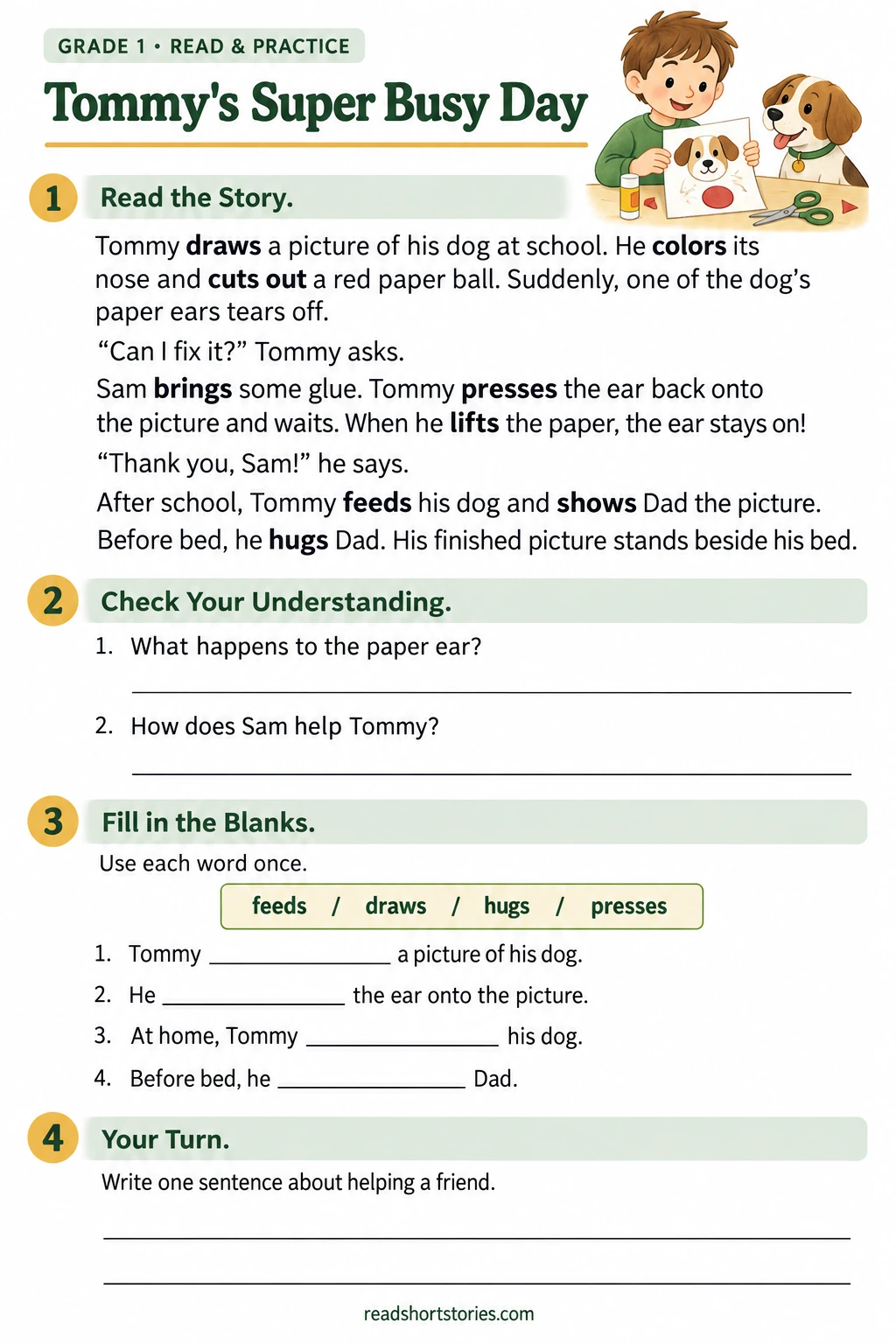
Grade 1 Story: Tommy’s Super Busy Day
Tommy jumps out of bed. Today, his class will make animal pictures.
He brushes his teeth and gets dressed. In the kitchen, Mom cooks eggs. Tommy eats breakfast and carries his plate to the sink.
Then he picks up his backpack and walks to the bus with Mom. His friend Sam is on the bus.
“I will draw my dog,” Tommy says.
“I will draw a cat,” says Sam.
At school, their teacher puts paper and crayons on a table. Tommy draws a big dog with long ears. He colors its nose black.
Next, he cuts out a red paper ball for his picture.
Rip! One of the dog’s paper ears tears off.
Tommy looks at the ear in his hand.
“Oh, no! Can I fix it?” he asks.
Sam brings the glue.
“Let’s put it back,” he says.
Tommy spreads a little glue on the paper. He presses the ear down and waits. Then he gently lifts his picture. The ear stays on!
“Thank you, Sam!”
Tommy adds the red ball beside his dog. Then he shows his picture to the teacher.
After school, Dad walks home with Tommy. Tommy tells him about the torn ear.
At home, Tommy feeds his dog and fills its water bowl. Then he shows Dad the picture.
“You fixed it!” Dad says.
“Sam helped,” says Tommy.
Before bed, Dad reads him a story. Tommy hugs Dad and closes his eyes. His dog picture stands beside the bed, with both ears in place.
Words to Know
- backpack: a bag you carry on your back. Example: My lunch is in my backpack.
- tear: to pull or break something into pieces by accident or on purpose. Example: Be careful not to tear the thin paper.
- glue: something sticky that joins things together. Example: We use glue to stick stars onto a card.
- fix: to make something work or look right again. Example: Can we fix this toy car?
Comprehension Questions
- What animal does Tommy draw?
- What happens to one of the paper ears?
- How does Sam help Tommy?
- Why does Tommy wait before lifting his picture?
Try It: Find and Act
Find three bold action words you can act out while standing beside your chair. Say each word and show the action.
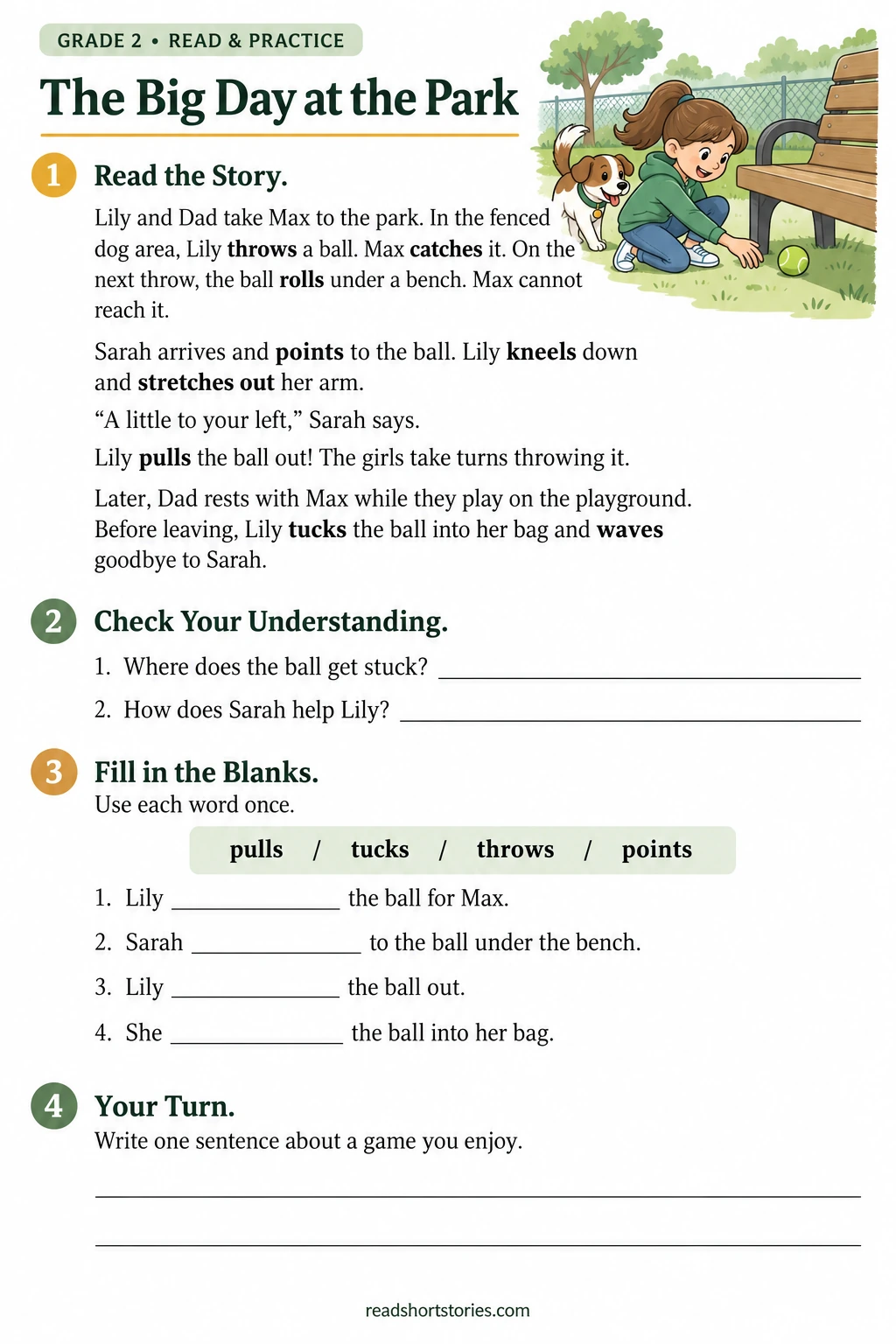
Grade 2 Story: The Big Day at the Park
One sunny morning, Lily picked up her favorite ball. Max, her dog, waited beside the door.
“Ready for the park?” she asked.
Max wagged his tail. Lily’s dad clipped on Max’s leash, and they walked down the street together.
At the park, they entered the fenced dog area. Dad took off the leash, and Lily threw the ball. Max raced across the grass and caught it.
“Good boy!” Lily called.
On her next turn, Lily threw the ball too low. It bounced twice and rolled under a bench.
Max pushed his nose underneath, but he could not reach it. He walked around the bench and tried from the other side.
The ball stayed where it was.
Just then, Lily’s friend Sarah arrived with her mom.
“What are you looking for?” Sarah asked.
“Our ball. Max’s nose is too short!”
Sarah bent down and pointed beneath the bench.
“I can see it near the back.”
Lily knelt on the path and stretched out her arm. Her fingers almost touched the ball.
“A little to your left,” Sarah said.
Lily tried again. This time, she pulled the ball out.
Max jumped happily, but Lily held it up.
“Let’s throw it away from the bench this time!”
The girls took turns throwing the ball. Then Dad put Max’s leash back on, and everyone left the dog area.
While Dad rested with Max, Lily and Sarah climbed the playground ladder and slid down the slide. Later, they played tag and hide-and-seek on the grass nearby.
Before going home, they sat on a bench for a drink. Dad poured water into Max’s bowl.
“We nearly lost this,” Lily said, holding the ball.
She tucked it safely into her bag. Then she waved goodbye to Sarah and walked home with Dad and a very tired Max.
Words to Know
- leash: a strap or cord used to keep a dog close. Example: We put a leash on our dog before crossing the street.
- fenced: surrounded by a fence. Example: The children play in a fenced garden.
- bench: a long seat for more than one person. Example: Two friends sit together on the bench.
- reach: to get close enough to touch something. Example: I cannot reach the book on the top shelf.
- tucked: put something carefully into a place. Example: She tucked a note into her pocket.
Comprehension Questions
- Who walks to the park with Lily and Max?
- Where does the ball get stuck?
- How does Sarah help Lily get the ball?
- What does Dad do while the girls play on the playground?
- Why does Lily put the ball in her bag before going home?
Try It: Present and Past
Find the past-tense forms of these action words in the story: throw, catch, and take. Write one pair, then use the past-tense form in your own sentence.
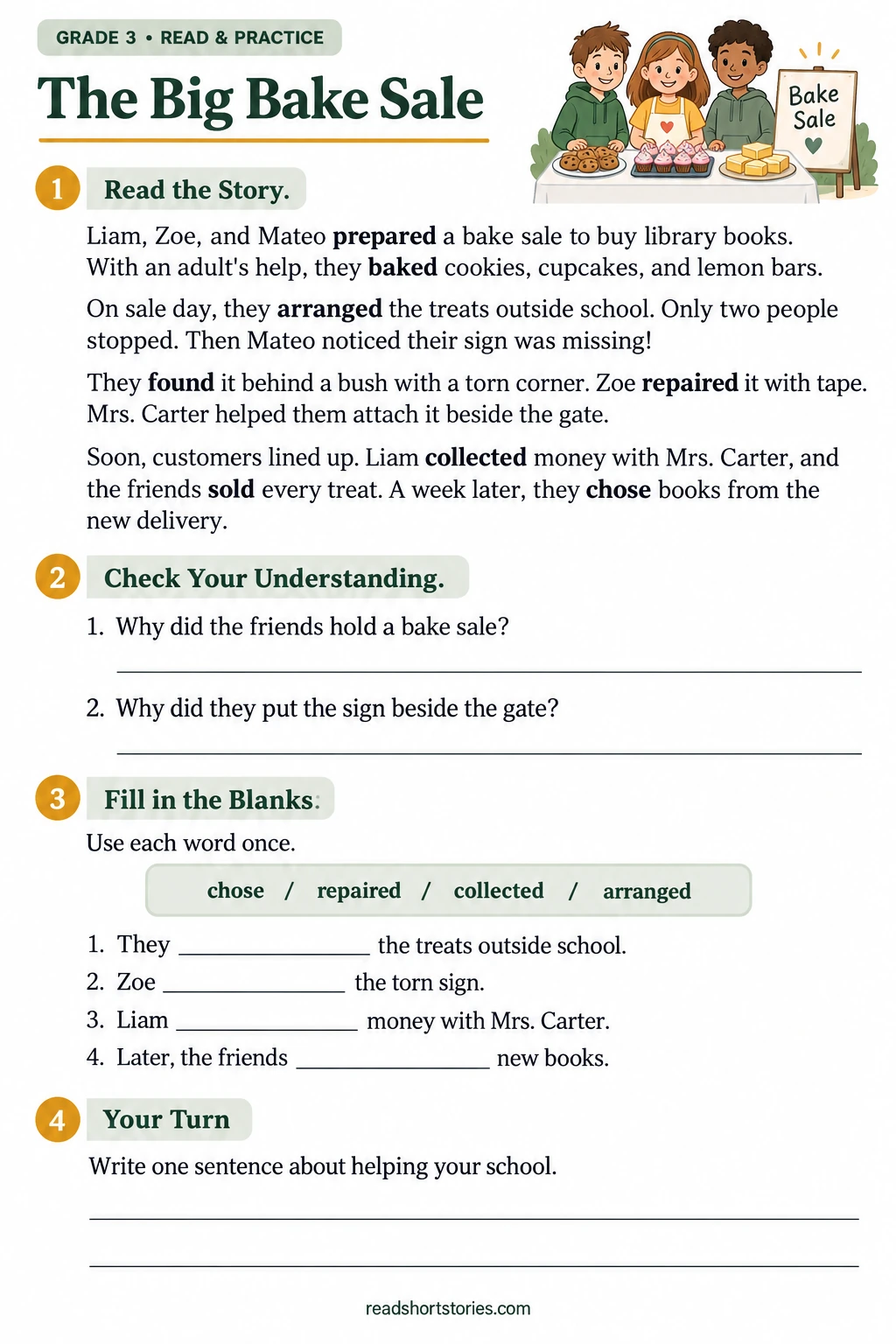
Grade 3 Story: The Big Bake Sale
Mrs. Carter’s third-grade class needed new library books. When she suggested a bake sale, Liam, Zoe, and Mateo raised their hands.
“I can bake chocolate chip cookies,” Zoe said.
“I’ll make cupcakes,” said Liam.
“And I can bring lemon bars,” Mateo added.
The next afternoon, they met in Zoe’s kitchen. Zoe’s dad helped them read the recipes and handled the hot oven trays.
The children washed their hands and put on aprons. Liam measured flour and sugar. Zoe cracked eggs and stirred the cookie mixture. Mateo squeezed lemons for his lemon bars.
When the cupcakes cooled, the friends decorated them. Liam accidentally dropped one on the floor.
“That one isn’t going to the sale,” he said with a small laugh.
He threw it away, cleaned the spot, and washed his hands again.
On Saturday, they arranged the treats on tables outside the school. Mrs. Carter placed ingredient cards beside each tray. Mateo hung up a large sign that read “Books and Bakes.”
Everything was ready. But after ten minutes, only two people had stopped.
“Where is everyone?” Liam asked.
Zoe looked toward the school gate. Parents were walking past without turning.
Then a gust of wind lifted the tablecloth. Mateo looked up.
“Our sign is gone!”
They found it lying behind a nearby bush. One corner had torn, and the writing was facing the ground.
Mrs. Carter brought tape. Zoe repaired the corner while Liam and Mateo held the sign flat. With their teacher’s help, they attached it firmly to the fence beside the gate.
Soon, a parent stopped to read it.
“New library books? I’ll take four cookies, please.”
More people joined the line. Zoe handed out treats, Liam collected money with Mrs. Carter, and Mateo kept the table clean.
By the end of the sale, every treat was gone. Mrs. Carter counted the money. They had enough for the books on the class list.
The friends packed the empty trays and folded the tablecloth.
A week later, Mrs. Carter opened a box of new books. Liam, Zoe, and Mateo each chose one. Before they started reading, Mateo pointed to the repaired sale sign above the bookshelf.
“I’m glad we found that,” he said.
Words to Know
- recipe: instructions for making a particular food. Example: This soup recipe uses carrots and potatoes.
- measured: checked how much of something was needed. Example: Dad measured one cup of rice.
- tray: a flat object used to hold or carry food. Example: She carried the sandwiches on a tray.
- ingredient: one of the foods used to make a dish. Example: Flour is an ingredient in many cakes.
- gust: a sudden, strong movement of wind. Example: A gust blew my hat across the yard.
- repaired: fixed something that was damaged. Example: We repaired the torn page with tape.
Comprehension Questions
- Why does the class hold a bake sale?
- What does each of the three friends make?
- Why do the friends move the sign to the fence beside the gate?
- What happens to the money from the sale?
- Why might Mrs. Carter keep the repaired sign above the bookshelf?
Try It: Retell the Problem
Explain what happened to the sign in three sentences. Start your sentences with First, Next, and Finally. Use at least three action verbs.
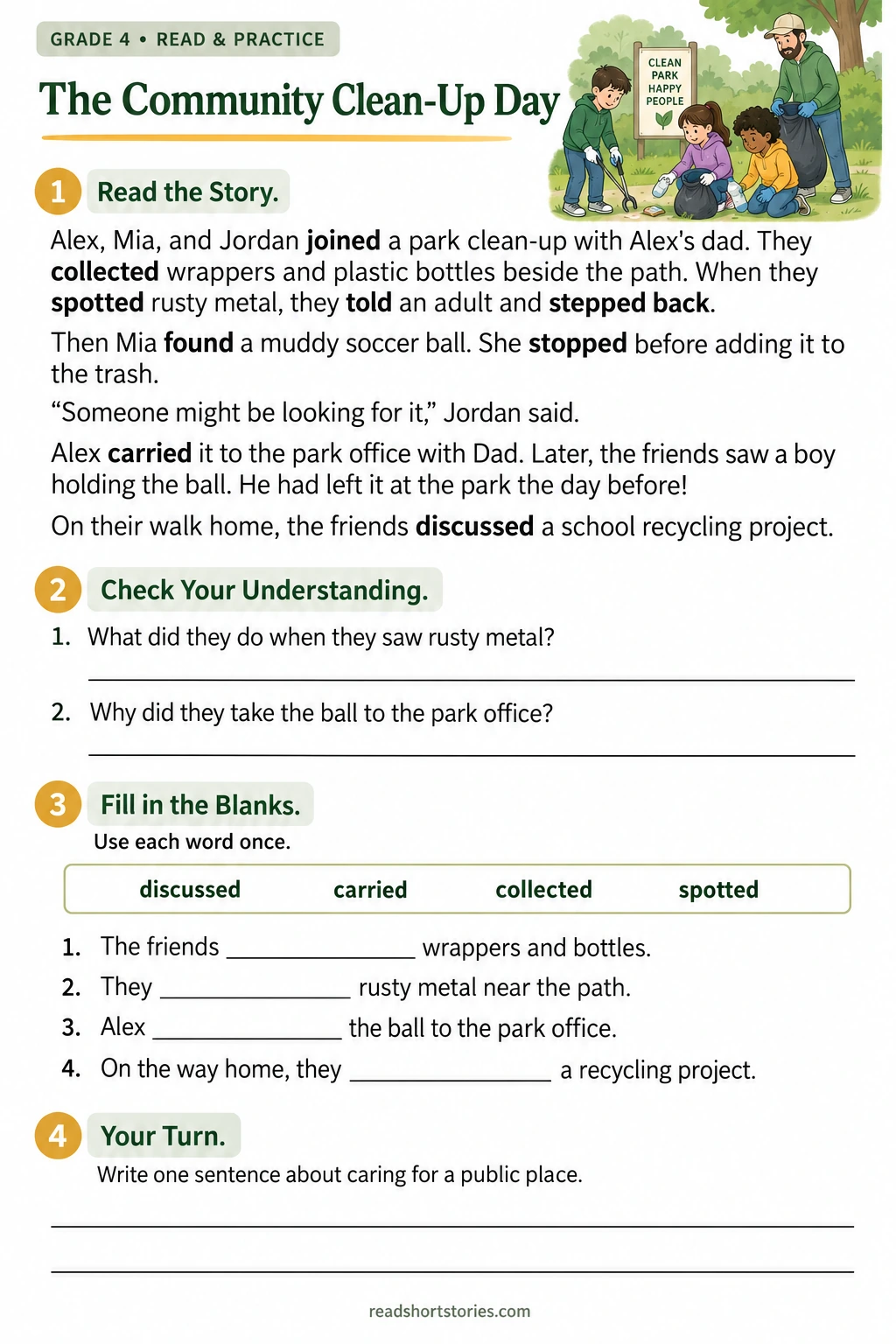
Grade 4 Story: The Community Clean-Up Day
On Saturday morning, Alex’s family joined the town’s Community Clean-Up Day. At the park entrance, volunteers collected gloves, bags, and litter grabbers.
Alex found his friends Mia and Jordan beside the supply table. They decided to work together.
The team leader showed everyone a map.
“Your group will clean the path near the river,” she said. “Stay with your adults and keep away from the water’s edge. If you find anything sharp or heavy, leave it and tell us.”
Alex’s dad walked with the friends. They searched the grass beside the path and used their grabbers to pick up candy wrappers and empty plastic bottles.
For a while, the work was easy. Then Jordan spotted an old bicycle tire beneath a bush. A piece of rusty metal lay beside it.
“We need help with this,” he said.
Alex’s dad called the team leader. The children stepped back while two adults removed the objects.
A little farther along, Mia found an abandoned soccer ball. It was muddy, but it still held air.
She lifted her foot to kick it toward their collection point, then stopped.
“Wait. Does this belong in the trash?”
Jordan looked at the ball. “Someone might be looking for it.”
They asked the team leader, who suggested taking it to the park office. Alex carried it there with his dad. The person at the desk wiped away the mud and put it in the lost-and-found box.
When Alex returned, Mia and Jordan had nearly filled another bag. Ducks floated past on the river as the friends checked the last stretch of path.
After two hours, everyone met at the park center. The mayor thanked the volunteers and handed out certificates.
“Look!” Mia said as they passed the park office afterward.
A younger boy was holding the soccer ball. His grandmother thanked the person at the desk.
“We left it here yesterday,” the boy explained.
Mia smiled at her friends. “Good thing we asked.”
On the walk home, they discussed starting a recycling project at school. Alex held his certificate carefully, but he kept thinking about the boy carrying his ball home.
Words to Know
- volunteer: someone who chooses to help without being paid. Example: A volunteer helped visitors find the meeting room.
- litter: trash left on the ground in a public place. Example: Please put your wrapper in the bin instead of leaving litter.
- rusty: covered with a reddish-brown layer that can form on metal. Example: The old metal gate was rusty.
- abandoned: left behind and apparently no longer cared for. Example: An abandoned cart stood beside the empty building.
- lost-and-found: a place where found objects are kept for their owners. Example: I checked the lost-and-found for my jacket.
- certificate: a document that recognizes an achievement or participation. Example: Each reader received a certificate after completing the reading challenge.
Comprehension Questions
- Where is Alex’s group asked to work?
- What do the children do when they find the tire and rusty metal?
- Why does Mia stop before kicking the soccer ball toward the collection point?
- How do the friends learn that the ball has an owner?
- Why might Alex keep thinking about the boy with the ball?
Try It: Write About a Helpful Action
Write four or five sentences about helping at school, at home, or in your neighborhood. Explain the problem, what you did, and what happened afterward. Underline three action verbs in your writing.
Answer Key
Tommy’s Super Busy Day — Answers
- Tommy draws his dog.
- One of the paper ears tears off.
- Sam brings glue so Tommy can put the ear back.
- Suggested answer: He waits to give the glue time to hold the ear in place.
Find and Act: Answers will vary. Possible choices include jumps, brushhes, and hugs. Students can mime the actions without using objects.
The Big Day at the Park — Answers
- Lily’s dad walks with them.
- The ball gets stuck under a bench.
- Sarah points out the ball and tells Lily to move her hand a little to the left.
- Dad rests with Max while the girls play.
- Suggested answer: She wants to keep it safe so it does not roll away or get left behind.
Present and Past: throw → threw; catch → caught; take → took.
Suggested sentence: I threw the ball to my sister.
The Big Bake Sale — Answers
- The class wants to raise money for new library books.
- Zoe makes chocolate chip cookies, Liam makes cupcakes, and Mateo makes lemon bars.
- The sign has fallen behind a bush. They move it beside the gate so people entering the school can see it.
- The money pays for the books on the class list.
- Suggested answer: The sign reminds the class how the friends helped buy the new books and solved a problem together.
Retell the Problem — Suggested answer: First, the sign fell behind a bush. Next, Zoe repaired it with tape while her friends held it flat. Finally, they attached it to the fence with Mrs. Carter’s help.
The Community Clean-Up Day — Answers
- They are asked to clean the path near the river.
- They tell Alex’s dad and step back while adults remove the objects.
- She realizes that the ball may not be trash and that someone might want it back.
- They see a boy with the ball at the park office. He explains that he left it there the day before.
- Suggested answer: Alex feels pleased that their decision helped someone recover a lost possession.
Writing activity: Answers will vary. Check that the paragraph explains a problem, an action, and a result, and that three action verbs are underlined.
Download 8 More Action Words Stories
Keep practicing with eight new stories—two for each grade from 1 to 4. This printable PDF includes highlighted action verbs, vocabulary, comprehension questions, verb gap-fill exercises, writing activities, and separate answer keys. These stories are different from the four stories above.
Action Words Stories PDF – Download
What to Read Next
To practice everyday action verbs in the present tense, try our simple present tense stories. To explore actions happening now, continue with our present continuous tense stories.
For more reading with vocabulary support, choose a story from our A1 English stories with vocabulary. After reading, pick five action verbs and use them to retell the story in your own words.