- Reported Speech Stories with Exercises and Answers (PDF)
- Story 1: The Community Garden Mix-Up
- Vocabulary
- Reading Questions
- Language Practice
- Reading Answers
- Practice Answers
- Your Turn
- Story 2: On the Air at Oak Street
- Vocabulary
- Reading Questions
- Language Practice
- Reading Answers
- Practice Answers
- Your Turn
- Story 3: Passing the Tools at the Repair Cafe
- Vocabulary
- Reading Questions
- Language Practice
- Reading Answers
- Practice Answers
- Your Turn
- Language to Notice
- Statements: said or told
- Tense, pronoun, and time changes
- Reported questions
- Requests and instructions
- Download the Complete Workbook
- Continue Reading
Level: B1 (editorial estimate) · adults · US English
Identify and form reported statements, questions, and polite requests accurately in past-tense narratives, applying appropriate pronoun, tense, and word-order changes.
Story 1: The Community Garden Mix-Up

Elena arrived at the Maple Street Community Garden at eight o’clock on Saturday morning. The autumn air was cool, and her plan was simple. She wanted to weed the demonstration plots and arrange the gardening tools before thirty neighborhood volunteers arrived for the annual planting day.
When she opened the main gate, however, two separate groups were already standing near the green shed. Marcus, the coordinator for the local youth club, looked frustrated. Beside him, Mrs. Delgado, who managed the senior herbalist society, held a brass key and a printed checklist.
“Elena, we have a serious issue here,” Marcus said, pointing toward the locked shed door. “The garden president told us that our group had exclusive access to the equipment until noon. He said that we should take all the wheelbarrows and start hauling soil to the back fence immediately.”
Mrs. Delgado shook her head firmly and stepped forward. She told Elena that the groundskeeper had called her on Friday evening. She explained that he had promised her club the main hoses and the raised beds for their herbal workshop. Furthermore, she said that he had specifically asked her to open the shed early because the young plants needed water right away.
Elena took a deep breath. She knew that miscommunications happened frequently whenever multiple organizers planned events on the same weekend. Instead of arguing about who had arrived first, she decided to verify what each board member had actually intended.
Elena asked Marcus whether President Baker had mentioned the herbal society during their conversation. Marcus admitted that the president had only discussed the compost project. Then Elena asked Mrs. Delgado if the groundskeeper had signed an official equipment permit. Mrs. Delgado confessed that he had not given her any formal paperwork.
To resolve the conflict, Elena quickly called President Baker on speakerphone. She told him that two groups were waiting at the gate, and she asked him to clarify the schedule. The president apologized immediately. He explained that he had completely forgotten about the herbal workshop when he spoke with Marcus on Thursday. He told everyone that the youth volunteers could spread the mulch while the herbal group used the planting tables.
After hanging up, Elena organized the volunteers into cooperative pairs. She asked Marcus to take three wheelbarrows to the compost pile, and she told his team that they could collect shovels from the side rack. Then she instructed Mrs. Delgado’s members to set up their seedling trays near the southern tap so that both teams could share the water supply without getting in each other’s way.
By ten o’clock, both projects were running smoothly under the morning sun. Marcus thanked Elena for listening carefully, and Mrs. Delgado remarked that clear communication always solved problems faster than anger. Elena clipped the updated schedule to her board and smiled. Next time, each organizer would have the same written plan.
Vocabulary
- demonstration: Showing or explaining how something works or is done The teacher gave a short demonstration before we began the project.
- frustrated: Feeling upset or annoyed because you cannot achieve what you want He felt frustrated when his computer crashed during the test.
- exclusive: Limited to only one person or group and not shared with others Club members have exclusive use of the tennis courts on weekends.
- miscommunication: A failure to communicate clearly or understand correctly A simple miscommunication caused us to meet at different cafes.
- verify: To check or prove that something is true and accurate Please verify your flight details before leaving for the airport.
- confessed: Admitted that something is true, often reluctantly She confessed that she had forgotten to send the email.
- cooperative: Willing to work together smoothly to achieve a common goal The students were very cooperative during the group assignment.
Reading Questions
- At what time did Elena arrive at the Maple Street Community Garden?
- What did Mrs. Delgado hold when standing near the shed?
- Why did President Baker apologize to Elena on the speakerphone?
- Why was Elena successful in resolving the disagreement between the two groups?
Language Practice
- Complete with the simple past form of have: The president told us that our group __________ exclusive access to the equipment.
- Choose the correct verb: Elena asked Marcus if President Baker __________ the herbal society.
- had mentioned
- mentions
- has mentioned
- mentioning
- Put all 6 words in order. Start with Elena. Use each word once and add a period.
- two
- said
- waiting
- were
- groups
- Elena
- Choose the reporting verb: Mrs. Delgado __________ that he had not given her any formal paperwork.
- confessed
- apologized
- refused
- warned
- Choose the correct word order for a reported question.
- Elena asked whether President Baker had mentioned the workshop.
- Elena asked whether had President Baker mentioned the workshop.
- Elena asked whether did President Baker mention the workshop.
Check Your Answers: The Community Garden Mix-Up
Reading Answers
- At eight o’clock on Saturday morning
- A brass key and a printed checklist
- He had completely forgotten about the herbal workshop when he spoke with Marcus.
- She stayed calm, asked for clarification, and helped the groups agree on how to share the equipment.
Practice Answers
- had
- had mentioned
- Elena said two groups were waiting.
- confessed
- Elena asked whether President Baker had mentioned the workshop.
Your Turn
Write 3–4 sentences reporting what someone told or asked you recently, using reported speech verbs like ‘said that’, ‘told me that’, or ‘asked if’.
Story 2: On the Air at Oak Street

Mateo arrived at the Oak Street Community Radio station at seven in the morning. The broadcast booth smelled of black coffee and warm electronics. As a volunteer producer, he prepared the community arts segment every Thursday. Today, his goal was straightforward: he planned to interview Mr. Vance, an elderly resident who collected old photographs of the city’s early streetcar network.
Mateo reviewed his notes at the audio console while testing the studio microphones. Ten minutes before airtime, the red desk phone rang loudly. It was Mr. Vance’s daughter. She apologized and explained that her father had caught a sudden cold that morning. She told Mateo that her father could not speak clearly and asked if they could reschedule the interview for the following week. Mateo said that he understood completely and wished Mr. Vance a quick recovery.
Mateo hung up the receiver and exhaled slowly. He had an empty thirty-minute slot on live radio. Just then, station director Carla stepped into the control room holding a clipboard. She looked energetic despite the early hour. She told Mateo that a local artist named Sofia was waiting in the lobby. Carla explained that Sofia was painting a large public mural on Fourth Avenue that week. Carla asked whether Mateo could interview Sofia instead.
“Is she ready to go live in five minutes?” Mateo asked.
Carla replied that Sofia had agreed immediately. Carla added that Sofia wanted to talk about how neighborhood youth were helping design the wall panels. However, Carla warned Mateo that Sofia had never spoken on the radio before. She asked Mateo to explain the studio hand signals clearly so Sofia would not feel nervous.
Mateo hurried to the front lobby to welcome the guest. Sofia wore a navy jacket marked with traces of yellow paint. Mateo introduced himself and told her that they were thrilled to have her on the show. Sofia admitted that her hands were shaking slightly. She asked Mateo what kind of questions he would ask during the first segment. Mateo told her that she did not need to memorize any formal answers. He explained that he would ask where the project began and why community art mattered to local residents.
Mateo brought Sofia into the booth and adjusted her headset. Through the glass partition, he signaled to Jamal, the audio engineer. Mateo told Jamal that they were switching the morning topic from local history to the Fourth Avenue mural project. Jamal gave a thumbs-up and said that he had already updated the digital program title on the website stream.
The red on-air light flashed across the studio wall. Mateo leaned toward his microphone with a steady smile. He announced to the listeners that they had an exciting guest in the studio. He told everyone that Sofia was transforming Fourth Avenue with vibrant colors and neighborhood stories. Sofia relaxed, leaned into her microphone, and began describing the community project with genuine enthusiasm. The live broadcast was lively, engaging, and completely on time.
Vocabulary
- broadcast: A radio or television program transmitted to the public The evening broadcast shared important news about the storm.
- straightforward: Simple, direct, and easy to understand The teacher gave straightforward instructions for the homework.
- reschedule: To change the date or time of an event We had to reschedule our meeting because the manager was sick.
- mural: A large painting done directly on a wall The artists painted a colorful mural on the community center.
- thrilled: Extremely happy and excited She was thrilled to win the first prize in the competition.
- partition: A wall, screen, or glass divider separating two areas A glass partition separated the office desks from the hallway.
- enthusiasm: A feeling of great excitement, interest, or energy The children showed great enthusiasm for the science experiment.
Reading Questions
- Why did Mr. Vance cancel his interview that morning?
- What project was Sofia working on that week?
- What change did Jamal make before the broadcast started?
- How did Sofia feel before going on the air?
Language Practice
- Carla explained that Sofia __________ a large public mural on Fourth Avenue that week.
- is painting
- was painting
- paints
- will paint
- Complete with said or told: She __________ Mateo that her father could not speak clearly.
- Carla asked whether Mateo __________ Sofia instead.
- could interview
- can interview
- interviews
- interviewing
- Put all 6 words in order. Start with She. Use each word once and add a period.
- She
- admitted
- was
- nervous
- that
- she
- Complete with said or told: Mateo __________ that he understood completely.
Check Your Answers: On the Air at Oak Street
Reading Answers
- He had caught a sudden cold and could not speak clearly.
- She was painting a large public mural on Fourth Avenue.
- He updated the digital program title on the website stream.
- She felt nervous because she had never been on the radio before.
Practice Answers
- was painting
- told
- could interview
- She admitted that she was nervous.
- said
Your Turn
Imagine someone gave you a message earlier today. Write 3–4 sentences reporting what that person told, explained, or asked you using reported speech.
Story 3: Passing the Tools at the Repair Cafe
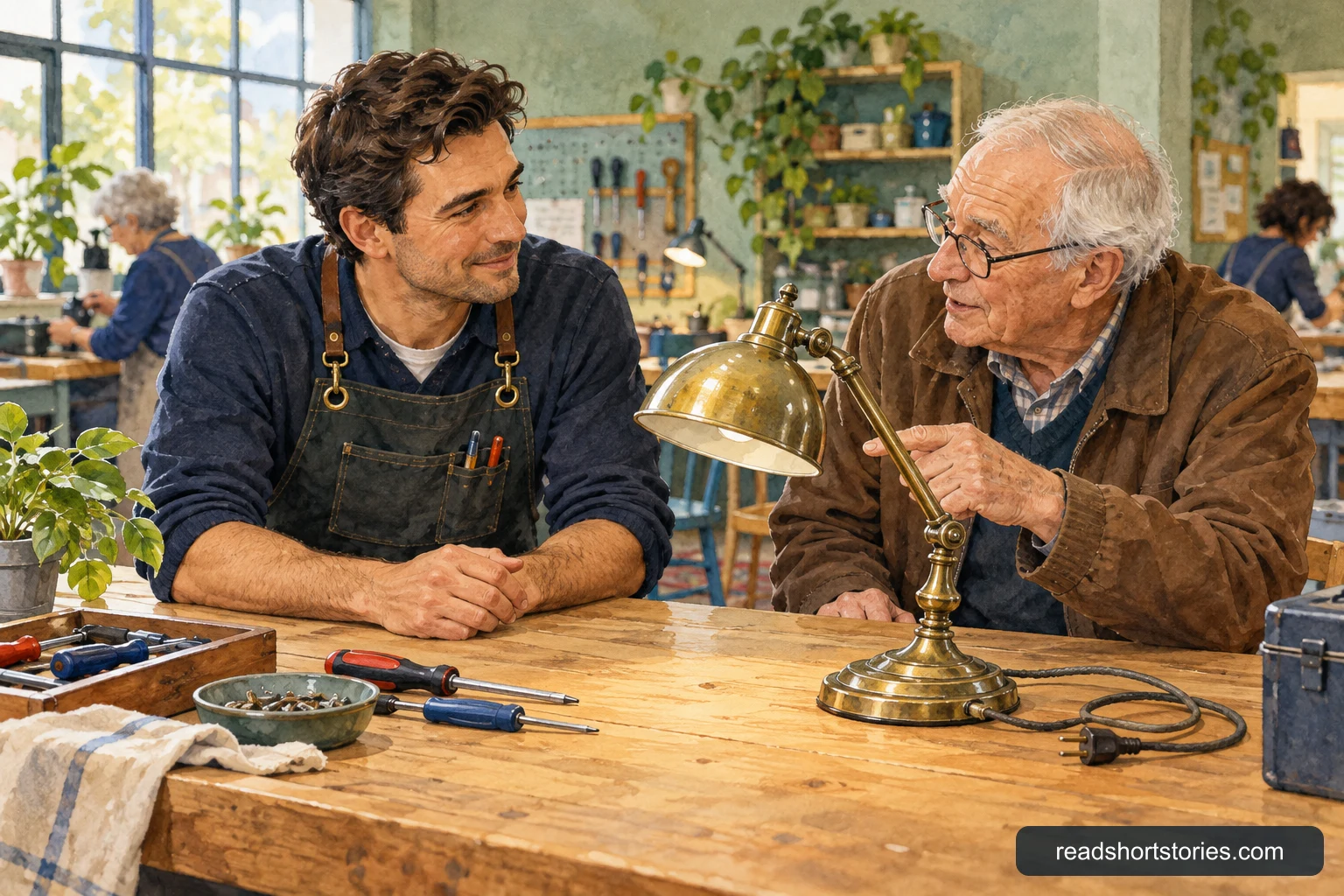
Daniel tied his dark canvas apron around his waist and stepped into the bustling workshop room at the community center. Once a month, local residents brought broken household gadgets to the volunteer Repair Cafe instead of throwing them into the landfill. Daniel enjoyed fixing electronics, and he looked forward to taking over the main workbench for the three o’clock shift. However, when he reached Table 4, the morning technician, Clara, was already throwing her coat on. She gestured at three opened devices and apologized that she had to catch an urgent ride across town.
Before Daniel could ask any detailed questions, Clara mentioned that she had left some quick notes on yellow sticky pads. She told him that the silver bread maker only needed a thermal fuse replacement, but she warned him not to plug in the blue espresso machine yet. She also stated that the owner of a vintage desk lamp would return at four o’clock. Then she hurried through the double doors, leaving Daniel with a confusing puzzle of screwdrivers, wires, and unlabeled components.
Daniel examined the workbench carefully. Two yellow sticky notes had fallen onto the dusty floor, and another note was torn in half. He knew he could not guess with electrical circuits, so he walked over to the welcome desk to consult Nora, the event organizer. Daniel asked Nora if Clara had explained anything specific about the espresso machine before running out. Nora checked her check-in register and replied that Clara had discovered a frayed grounding wire near the heating coil. Nora added that Clara had asked her to hold the customer’s phone number in case they needed a special replacement cord.
Just as Daniel returned to the bench to fix the grounding wire, an elderly man in a brown winter jacket approached Table 4. The man introduced himself as Mr. Henderson and asked whether his antique lamp was ready to take home. Daniel explained politely that he had just arrived for the afternoon shift. He asked Mr. Henderson what Clara had told him earlier that morning. Mr. Henderson said that Clara had promised to replace the brass rotary switch. Furthermore, Mr. Henderson explained that Clara had asked him to inspect the original lampshade at four o’clock so they could test the dimmer together.
Daniel felt relieved because the pieces of the puzzle were finally coming together. He thanked Mr. Henderson and said that he would gladly finish the switch within twenty minutes. Daniel then focused on the tasks systematically. First, he secured the espresso machine’s power connection, telling Nora that the appliance was now completely safe for a power test. Next, he opened the vintage lamp’s base, replaced the broken switch mechanism, and rewired the socket carefully.
When Mr. Henderson returned at four o’clock, Daniel showed him that the warm bulb illuminated smoothly with each turn of the knob. Mr. Henderson smiled warmly and said that the family heirloom had not worked so well in fifteen years. Seeing how much trouble the rushed handover had caused, Daniel grabbed an extra clipboard from the cabinet and created a neat table with columns for diagnostic steps, parts used, and owner requests. He told Nora that all evening volunteers would now record their updates in writing, ensuring that every volunteer knew exactly what the previous technician had accomplished.
Vocabulary
- gadgets: Small tools or mechanical electronic devices designed for a specific purpose. Our kitchen drawer is filled with useful cooking gadgets.
- technician: A person skilled in the technical details of a craft, machine, or mechanical equipment. The technician checked the air conditioner to find out why it stopped blowing cold air.
- circuits: Complete paths through which electrical current can flow. He learned how to wire electrical circuits safely in his science class.
- consult: To ask someone for information, advice, or assistance. You should consult the office manager if you have questions about the schedule.
- dimmer: A switch or device used to adjust the brightness of an electric light. We turned down the dimmer on the dining room lamp to create a cozy atmosphere.
- heirloom: A valuable or sentimental object that has belonged to a family for several generations. She inherited an antique silver teapot as a cherished family heirloom.
- clipboard: A small board with a metal clip at the top for holding papers flat while writing. The nurse wrote down the patient’s details on a wooden clipboard.
Reading Questions
- Why did Clara leave Table 4 in a hurry?
- What problem did Clara discover on the espresso machine before running out?
- What did Daniel do to prevent future shifts from experiencing confusion?
- Why was Daniel reluctant to work on the electrical appliances without consulting others?
Language Practice
- Choose the verb form: Clara mentioned that she __________ some quick notes on yellow sticky pads.
- had left
- has leave
- leaving
- will leaves
- Nora told Daniel that Clara __________ a frayed wire near the heating coil.
- discovers
- had discovered
- has discovered
- will discover
- Put all 6 words in order. Start with Clara. Use each word once; the period is supplied.
- Clara
- said
- she
- had
- left
- notes.
- Daniel said that he __________ finish the switch within twenty minutes.
- would gladly
- will gladly
- gladly will
- can gladly
- Choose the correct form: Daniel asked Nora if Clara had __________ anything about the espresso machine.
- explained
- explains
- explain
- explaining
Check Your Answers: Passing the Tools at the Repair Cafe
Reading Answers
- She had an urgent ride across town that she needed to catch.
- She found a frayed grounding wire near the heating coil.
- He created a tracking table on a clipboard for volunteers to write diagnostic steps, parts used, and owner requests.
- He knew working with electricity based on guesses was dangerous, and the notes were torn or missing.
Practice Answers
- had left
- had discovered
- Clara said she had left notes.
- would gladly
- explained
Your Turn
Write 3–4 sentences reporting what someone at your school, home, or work told or asked you earlier today, using reported speech (for example: ‘My manager said that…’).
Language to Notice
Statements: said or told
Use said + (that) + a statement. Use told + a person + (that) + a statement. Direct: Elena said, “Two groups are waiting.” Reported: Elena said that two groups were waiting. Elena told Marcus that two groups were waiting.
Tense, pronoun, and time changes
When reporting an earlier conversation, we often move the tense back: am/is → was; are → were; have/has → had; will → would; can → could. Change pronouns and time words to fit the speaker and reporting time: “I will call you tomorrow,” she said on Monday. On Tuesday, he reported: She said that she would call him that day. Backshift is not always needed when information is still true.
Reported questions
Use statement word order: subject + verb. Direct: “Where are the tools?” Reported: She asked where the tools were. For yes/no questions, use if or whether: “Have you tested the recorder?” → She asked whether he had tested the recorder. Do not keep question-form do, does, or did.
Requests and instructions
Use asked or told + a person + to + verb. Direct: “Please label the seeds.” Reported: She asked us to label the seeds. For a negative instruction, use not to: “Do not plug it in.” → She told him not to plug it in.
Download the Complete Workbook
Get all 6 stories, including 3 bonus stories, vocabulary, exercises and answers.