- 100 English Short Stories to Improve Your Vocabulary – PDF
- English Short Stories to Improve Your Vocabulary
- 1. Introducing Yourself
- Words to Know — Introducing Yourself
- Comprehension Questions — Introducing Yourself
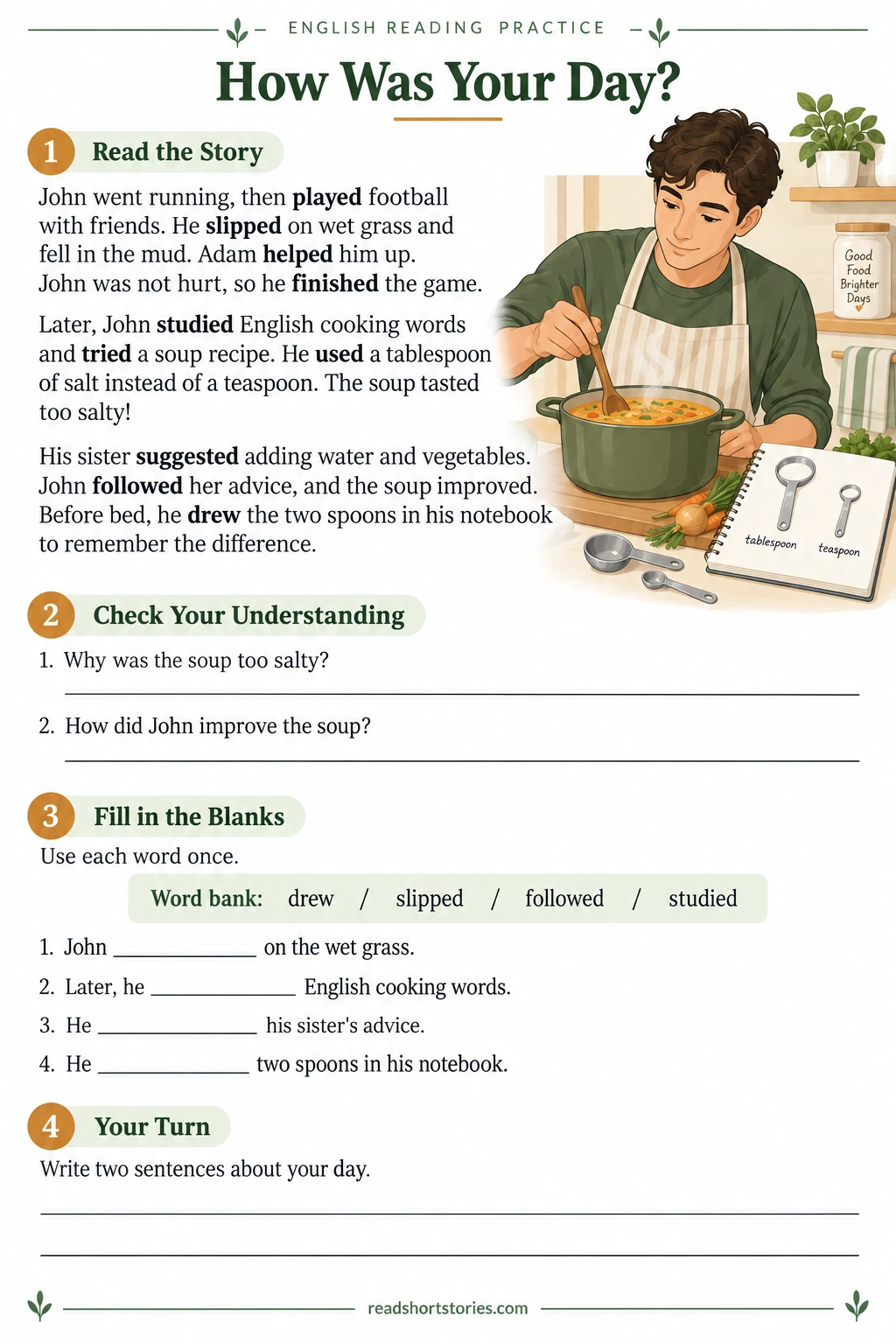
- 2. How Was Your Day?
- Words to Know — How Was Your Day?
- Comprehension Questions — How Was Your Day?
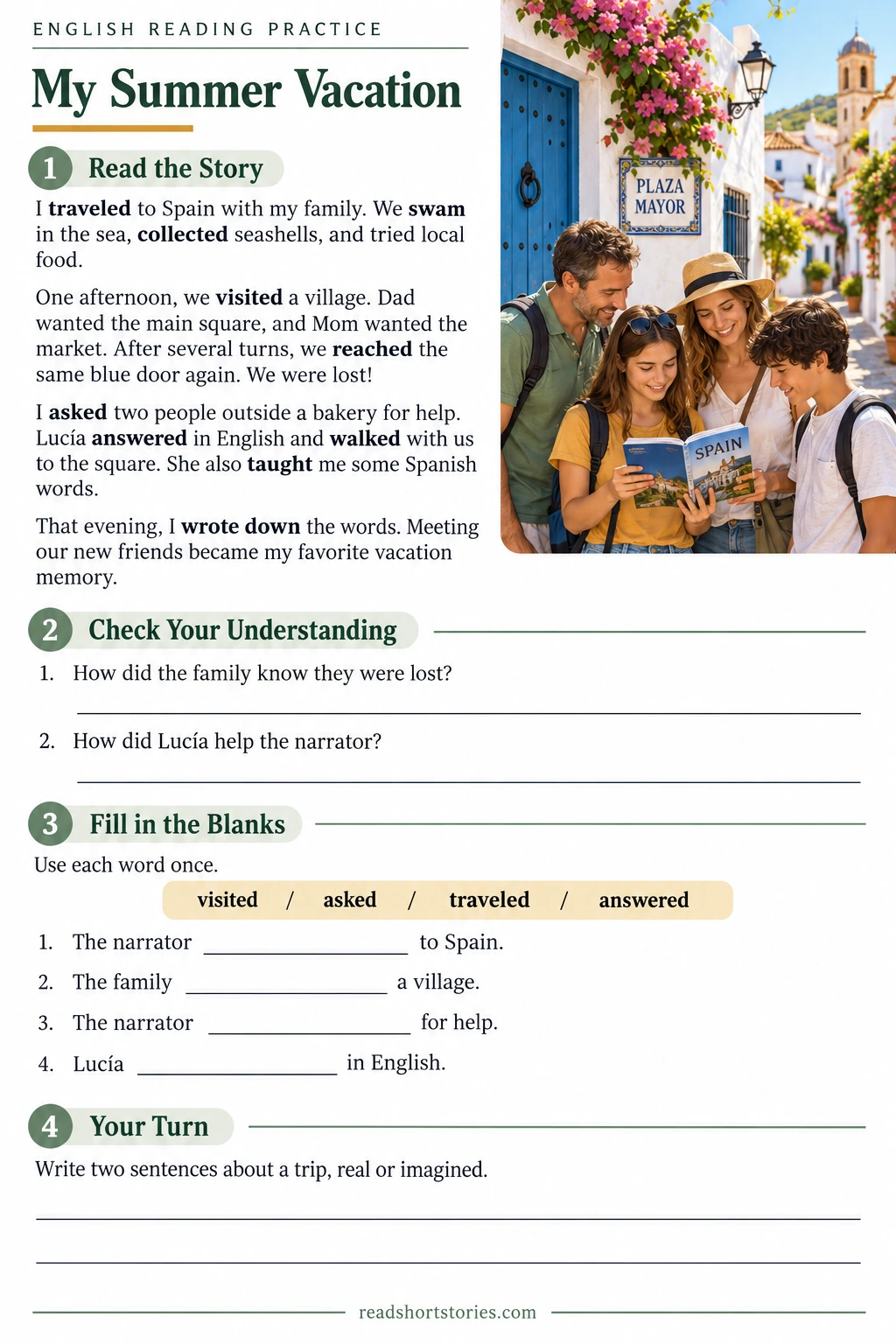
- 3. My Summer Vacation
- Words to Know — My Summer Vacation
- Comprehension Questions — My Summer Vacation
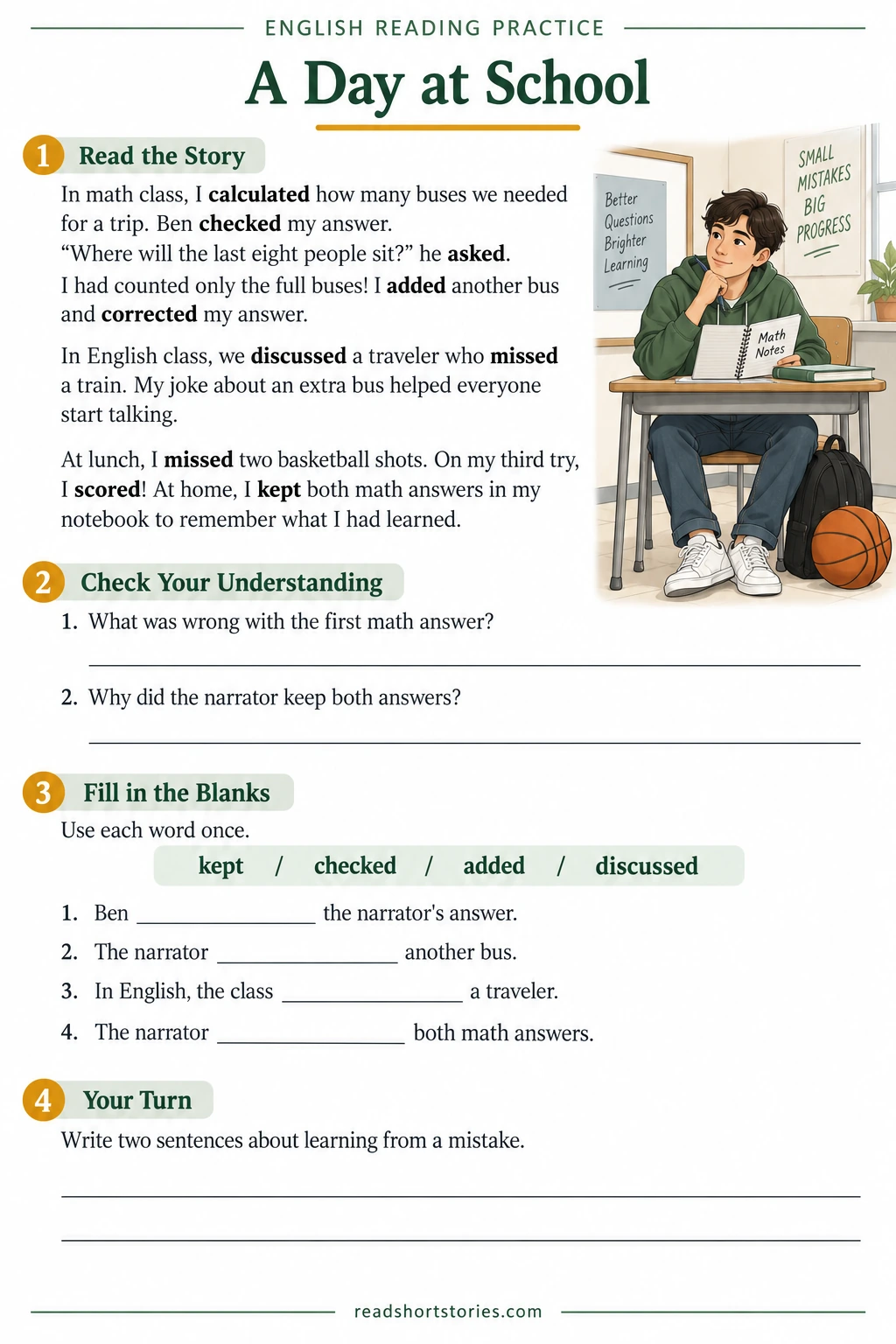
- 4. A Day at School
- Words to Know — A Day at School
- Comprehension Questions — A Day at School
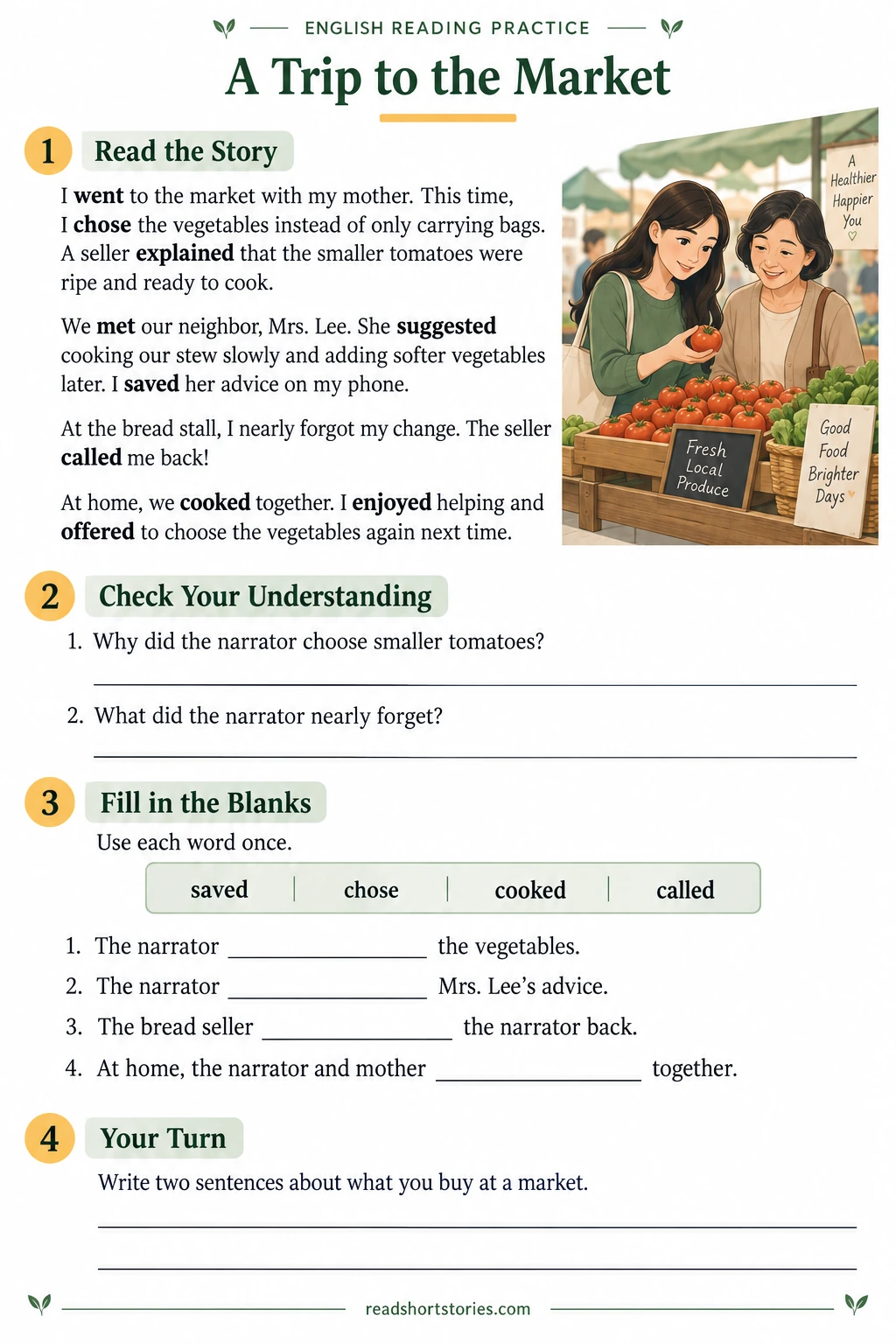
- 5. A Trip to the Market
- Words to Know — A Trip to the Market
- Comprehension Questions — A Trip to the Market
- Answer Key
- 1. Introducing Yourself — Answers
- 2. How Was Your Day? — Answers
- 3. My Summer Vacation — Answers
- 4. A Day at School — Answers
- 5. A Trip to the Market — Answers
- Download 100 English Short Stories to Improve Your Vocabulary
- Download the 100 English Short Stories PDF
- Keep Building Your Vocabulary
You may know the word change as a verb: “I want to change my plans.” But at a market, change can also mean the money a seller gives back to you. A story helps you see which meaning fits.
These five English short stories introduce useful vocabulary through everyday situations: meeting someone, talking about your day, traveling, studying, and shopping. Read each story, explore the words, and check your understanding with the questions. You will find the answer keys and a downloadable story collection at the end.
The stories are written mainly for A2 learners, with some vocabulary to stretch your reading. This is an editorial estimate, not a formal level assessment. For a gentler starting point, try our short stories in English for beginners.
English Short Stories to Improve Your Vocabulary
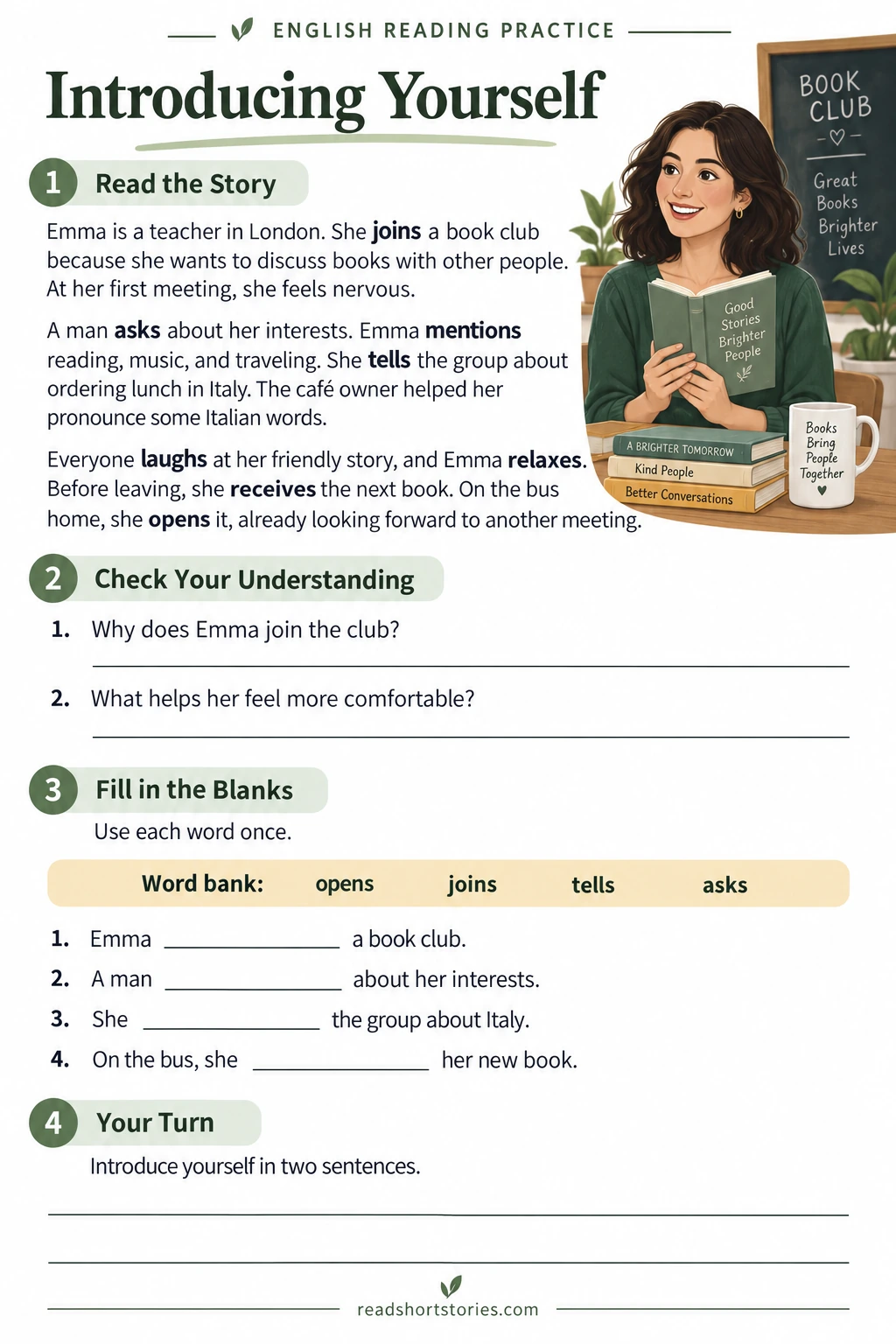
1. Introducing Yourself
My name is Emma. I am 25, and I work as a teacher in London. Most mornings, I introduce new ideas to my students. Introducing myself to a room full of strangers feels much harder.
Last Thursday, I joined a local book club. I love adventure books, but I usually read them alone. This time, I wanted someone to talk to about the ending.
When I arrived, six people were sitting around a table. A woman near the window waved me over.
“You must be Emma. Tell us a little about yourself.”
Suddenly, all the simple facts in my head seemed to disappear.
“Hello. I’m Emma. I’m 25, and I’m a teacher,” I said.
Then I stopped. Was that enough?
A man across the table smiled. “What do you enjoy doing when you’re not teaching?”
“I like reading, listening to music, and traveling,” I replied. “Last summer, I visited Italy.”
“So did I! Which places did you visit?”
I told him about a small café where I had tried to order lunch in Italian. I knew only a few words, so I pointed at the menu and hoped for the best.
“Did you get what you wanted?” someone asked.
“Eventually! The owner helped me pronounce the words. I went back the next day to try again.”
Everyone laughed, and my shoulders relaxed. Soon, we were comparing places we wanted to visit and books we wanted to read.
At the end of the evening, the woman by the window handed me the next book on the club’s list.
“Will we see you next month?”
“Yes,” I said. “I’ve already got a question about this one.”
On the bus home, I opened the book. I was still the newest person in the club, but the next meeting no longer felt like a room full of strangers.
Words to Know — Introducing Yourself
- stranger: someone you do not know. Example: A friendly stranger showed us the way to the station.
- join: to become part of a group or activity. Example: I want to join the school photography club.
- reply: to answer someone. Example: “I’m coming,” she replied.
- eventually: after some time or difficulty. Example: We eventually found a quiet place to sit.
- pronounce: to say the sounds of a word. Example: Can you show me how to pronounce your name?
Comprehension Questions — Introducing Yourself
- Where does Emma live, and what is her job?
- Why does she join the book club?
- Which three interests does Emma mention?
- How does the café owner in Italy help her?
- Why does Emma feel more comfortable by the end of the meeting?
Speaking practice: Introduce yourself in four sentences. Include your name, where you live, an interest, and something you did recently.
2. How Was Your Day?
When John came home, his sister looked up from the sofa.
“How was your day?” she asked.
John put down his bag and looked at his muddy shoes.
“Good, I think. But my shoes might disagree.”
That morning, he had gone for a run in the park. The sun was shining, and the air felt cool. After his run, he met some friends for a game of football.
Near the end of the game, John ran toward the ball. His foot slipped on the wet grass, and he landed in a muddy patch.
His friend Adam stopped immediately.
“Are you all right?”
John moved his arms and legs. Nothing hurt.
“Only my pride,” he said, looking at his brown knees.
Adam helped him up. John finished the game, then walked home to change his clothes.
In the afternoon, he studied English. His lesson included words for cooking, such as “slice,” “stir,” and “pour.” Instead of only writing them in his notebook, he decided to try a new soup recipe.
He sliced carrots, stirred them in a pot, and poured in some water. Everything seemed fine until he tasted the soup.
It was much too salty.
John read the recipe again. It said one teaspoon of salt. He had used a tablespoon.
He almost threw the soup away. Then he called his sister, who suggested adding more water and vegetables. John followed her advice and let the soup cook a little longer.
“So, did dinner survive?” she asked that evening.
“Yes. There’s enough for tomorrow, too.”
John made two cups of tea and sat beside her. He felt tired, but he was pleased that he had kept trying.
Before bed, he added two words to his English notebook: “teaspoon” and “tablespoon.” This time, he drew a small picture beside each one.
Words to Know — How Was Your Day?
- muddy: covered with wet earth. Example: We left our muddy boots outside the door.
- slip: to slide accidentally and lose your balance. Example: Be careful not to slip on the wet floor.
- recipe: instructions for preparing food. Example: This recipe makes enough rice for four people.
- stir: to mix food or liquid with a spoon. Example: Stir the milk into the sauce slowly.
- teaspoon: a small spoon or a small cooking measure. Example: Add one teaspoon of sugar to the mixture.
- tablespoon: a larger spoon or cooking measure; a standard tablespoon holds three teaspoons. Example: The recipe needs one tablespoon of oil.
Comprehension Questions — How Was Your Day?
- What does John do before meeting his friends?
- Why does he fall during the football game?
- What encourages him to try cooking soup?
- What mistake does he make, and how does he improve the soup?
- Why does John draw pictures beside the two new words?
Writing practice: Describe your day in four sentences. Use “First,” “Then,” “Later,” and “Finally” to organize the events.
3. My Summer Vacation
This summer, I traveled to Spain with my family. We stayed near the sea, where most mornings began with a walk along the beach.
We swam, collected a few seashells, and watched the waves wash over our footprints. In the evenings, we tried local food. My favorite meal was paella, although the warm churros were a close second.
One afternoon, we visited a small village with narrow streets and colorful houses. My father wanted to see the main square, and my mother hoped to find a local market.
We followed a sign into a quiet street. Then we turned left, right, and left again.
After ten minutes, we were standing in front of the same blue door.
“I think we’ve walked in a circle,” I said.
My father took out his phone, but the battery was nearly empty. We needed to ask someone for directions.
Two young people were sitting outside a bakery. I wanted to speak to them, but I knew very little Spanish.
“You can try,” my mother said.
I walked over and said hello. Then I pointed to the name of the square in our guidebook.
One of them, Lucía, answered in English.
“You’re close. We’re going that way. Come with us.”
As we walked, Lucía and her friend taught me a few Spanish words. I repeated them, and they helped when I made a mistake.
At the square, we found the market my mother wanted. We bought some fruit and sat with our new friends near the fountain.
Later, my family returned to the beach to watch the sunset. I wrote down the Spanish words before I forgot them.
We had taken plenty of beautiful photographs that week. Still, when someone asks about the vacation, I usually tell them about the blue door, the wrong turns, and the people who helped us find our way.
Words to Know — My Summer Vacation
- footprint: a mark left by a foot or shoe. Example: The dog left small footprints in the snow.
- square: an open area in a town, often surrounded by buildings. Example: We met outside the café in the town square.
- directions: instructions explaining how to reach a place. Example: The receptionist gave us directions to the museum.
- bakery: a shop that makes or sells bread and similar foods. Example: I bought a fresh loaf from the bakery.
- fountain: a structure that sends water into the air or a pool. Example: Water splashed into the fountain beside the library.
Comprehension Questions — My Summer Vacation
- Where does the narrator go on vacation, and with whom?
- Which two places do the narrator’s parents want to find in the village?
- How does the family realize they have walked in a circle?
- How do Lucía and her friend help?
- Why might the narrator remember this afternoon more clearly than other parts of the vacation?
Speaking practice: Imagine you need directions. Practice saying, “Excuse me. Could you help me find the market?” Then give simple directions using “left,” “right,” and “straight ahead.”
4. A Day at School
Today, our first lesson was math. Usually, I enjoy working with numbers, but the problem on the board looked more like a short story than a calculation.
Our teacher asked us to work out how many buses a school would need for a trip. Each bus had a limited number of seats, and both students and teachers needed places.
I read the question twice. Then I divided the number of people by the number of seats and wrote down my answer.
My classmate Ben looked at my notebook.
“Where will the last eight people sit?” he asked.
I checked my work. I had counted only the full buses.
“They’ll need another bus,” I said.
I changed my answer and explained why. When the teacher asked someone to share a solution, I raised my hand.
In English class, we read a story about a traveler who missed a train. We had to discuss whether the traveler was unlucky or careless.
At first, nobody in our group spoke. Then I said, “Maybe he needed one of our extra buses.”
Ben laughed, and the others joined the conversation. Soon, we were pointing to details in the story to support our opinions.
During lunch, we played basketball. I missed my first two shots. When I got the ball again, I almost passed it straight back.
“You’ve got space!” Ben called.
I took a breath, aimed, and shot. The ball went through the basket.
My friends cheered, and I ran back to help defend.
Before going home, I packed my math notebook into my bag. The wrong answer was still there, with one neat line through it and the corrected answer underneath.
I decided to leave both answers on the page. If I faced a similar problem again, I wanted to remember the eight people who almost had no seats.
Words to Know — A Day at School
- calculation: a process of using numbers to find an answer. Example: Check your calculation before writing the total.
- divide: to calculate how many times one number fits into another. Example: Divide twelve by three to get four.
- solution: an answer to a problem. Example: Our group found a simple solution to the puzzle.
- careless: not giving enough attention to what you are doing. Example: A careless spelling mistake changed the meaning of the sentence.
- defend: to try to stop the other team from scoring. Example: Two players stayed near the basket to defend.
Comprehension Questions — A Day at School
- What does the class need to calculate in math?
- What mistake does the narrator make?
- What question does the group discuss in English class?
- What happens on the narrator’s third basketball shot?
- Why does the narrator keep the incorrect answer in the notebook?
Writing practice: Write three or four sentences about a mistake that helped you learn something. It can be a real or imaginary experience.
5. A Trip to the Market
Yesterday, I went to the market with my mother. Before we left home, she handed me the shopping list.
“Would you like to choose the vegetables today?” she asked.
I usually carried the bags while she did the shopping. This time, I would need to ask questions and make a few decisions myself.
The market was already busy. People were carrying baskets, sellers were calling out prices, and the smell of fresh bread came from a stall near the entrance.
Our list included tomatoes, carrots, potatoes, oranges, and bread. We planned to make vegetable stew for dinner.
At the first stall, I reached for the largest tomatoes.
“Those look good,” Mom said. “But check these smaller ones, too.”
The seller explained that the smaller tomatoes were ripe and ready to cook. I chose four and placed them carefully in our bag.
While we were looking at carrots, someone called my mother’s name. It was our neighbor, Mrs. Lee.
“Making soup?” she asked.
“Stew,” I replied. “I’m helping.”
Mrs. Lee suggested cooking the vegetables slowly and adding the softer ones later. I saved her advice as a short note on my phone.
After buying the vegetables, we picked up oranges and a loaf of bread. I paid for the bread and started to walk away.
“Your change!” the seller called.
I turned back. There were still a few coins on the counter.
“Thank you. I nearly forgot.”
Mom smiled. “There’s more to shopping than carrying the bags.”
At home, I washed the vegetables while she prepared the pot. We followed Mrs. Lee’s advice and checked the stew as it cooked.
When we sat down to eat, Mom asked which part of the shopping I would do next time.
“The vegetables again,” I said. “And I’ll remember my change.”
Then I tore a piece from the fresh loaf and passed the bread to her.
Words to Know — A Trip to the Market
- stall: a table or small open shop where goods are sold. Example: The flower stall is beside the market entrance.
- ripe: ready to eat or use after growing fully. Example: These peaches are ripe and smell sweet.
- stew: a dish of vegetables, meat, or both cooked slowly in liquid. Example: We made a bean stew for lunch.
- loaf: bread baked in one piece that can be sliced. Example: Please buy a loaf of whole-wheat bread.
- change: money returned when you pay more than the price. Example: The ticket cost four dollars, so I received one dollar in change.
Comprehension Questions — A Trip to the Market
- What new responsibility does the narrator have at the market?
- Why does the narrator choose the smaller tomatoes?
- What cooking advice does Mrs. Lee give?
- What does the narrator nearly leave behind at the bread stall?
- What suggests that the narrator wants to help with shopping again?
Speaking practice: Practice a short conversation between a customer and a seller. Include “How much is it?”, “I’d like…”, and “Thank you.”
Answer Key
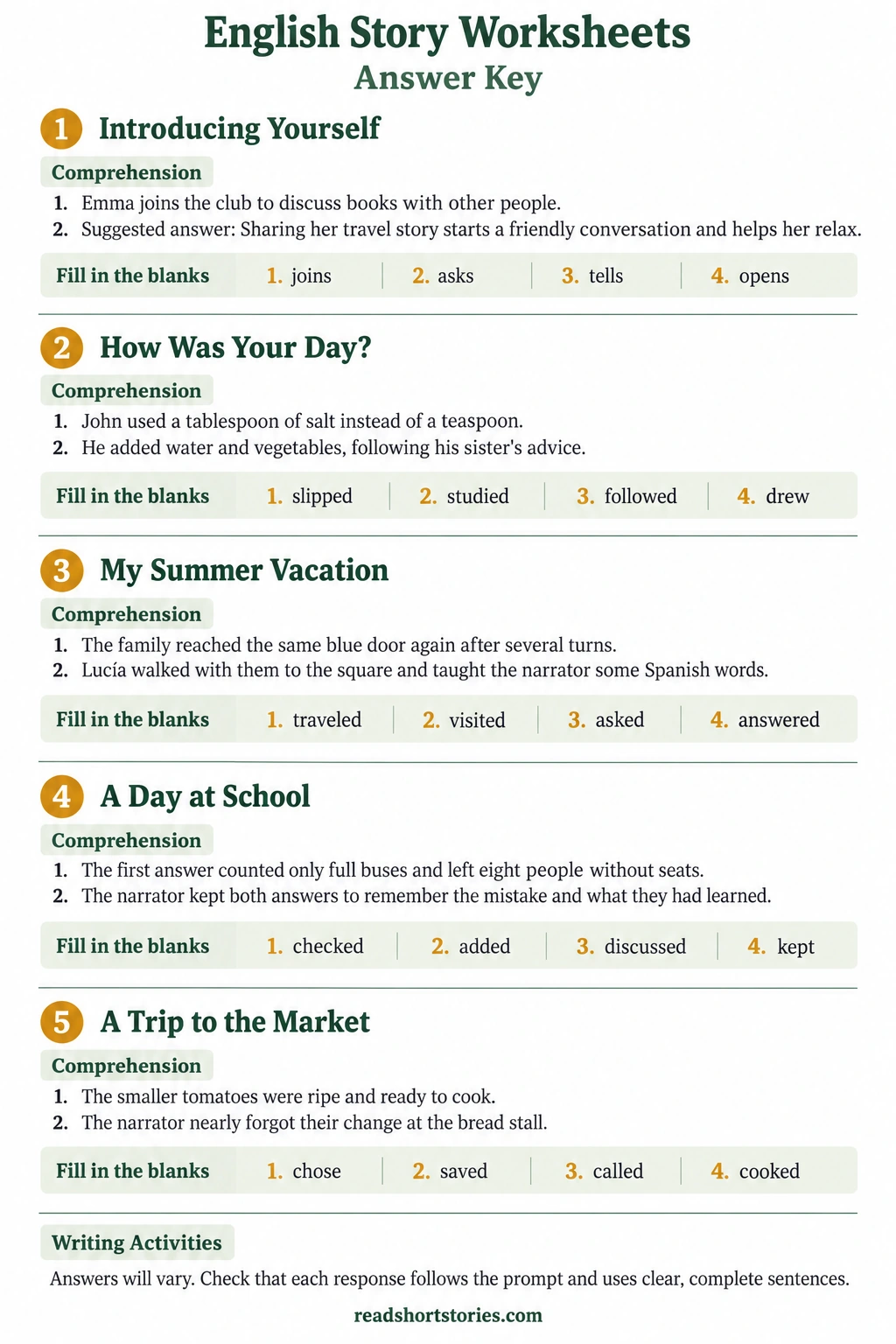
1. Introducing Yourself — Answers
- Emma lives in London and works as a teacher.
- She wants to discuss books with other people rather than always reading alone.
- She mentions reading, listening to music, and traveling.
- The owner helps her pronounce Italian words when she orders lunch.
- Suggested answer: Sharing her travel experience starts a friendly conversation and helps her connect with the group.
2. How Was Your Day? — Answers
- John goes for a run in the park.
- His foot slips on the wet grass.
- His English lesson includes cooking words, and he wants to practice them by following a recipe.
- He uses a tablespoon of salt instead of a teaspoon. Following his sister’s advice, he adds more water and vegetables.
- Suggested answer: The pictures help him remember the difference and avoid making the same mistake again.
3. My Summer Vacation — Answers
- The narrator goes to Spain with their family.
- The father wants to find the main square, and the mother wants to find a local market.
- They arrive back at the same blue door.
- They walk with the family to the square and teach the narrator a few Spanish words.
- Suggested answer: Getting lost leads to a friendly meeting and a chance to communicate and learn.
4. A Day at School — Answers
- The class needs to calculate how many buses are needed for a school trip.
- The narrator counts only the full buses and forgets that the remaining eight people need another bus.
- The group discusses whether a traveler who missed a train was unlucky or careless.
- The ball goes through the basket, and the narrator’s friends cheer.
- The narrator wants to remember the mistake when solving a similar problem.
5. A Trip to the Market — Answers
- The narrator chooses the vegetables instead of only carrying the bags.
- The seller explains that they are ripe and ready to cook.
- She suggests cooking the vegetables slowly and adding the softer ones later.
- The narrator nearly leaves their change on the counter.
- The narrator says they want to choose the vegetables again next time.
Speaking and writing activities: Answers will vary. Check that your response follows the instructions and communicates a clear idea.
Download 100 English Short Stories to Improve Your Vocabulary
Looking for more reading practice? Download the 100 English Short Stories to Improve Your Vocabulary collection below. Choose one story, write down a few useful words, and use them in sentences about your own life.
This is a separate reading collection. The five expanded stories and exercises on this page may differ from the versions in the PDF.
Download the 100 English Short Stories PDF
Keep Building Your Vocabulary
Choose three words from today’s reading. Write a new sentence with each word, then return tomorrow and see how many you remember without checking.
For more supported reading, explore our A1 English stories with vocabulary. For another collection with everyday situations, continue with our short stories for ESL students.