- Short Stories for 5th Graders – Free PDF
- Short Stories for 5th Graders
- The Raccoon Report
- Questions
- Answers
- The Fossil in the Creek Bed
- Questions
- Answers
- The Same Hypothesis
- Questions
- Answers
- The Signal Tower
- Questions
- Answers
- Download the Free PDF
- Frequently Asked Questions
- How long are the stories?
- Does the PDF include answers?
- How can we use these stories?
- More Short Stories and Reading Activities
You can download the free short stories for 5th graders PDF below.
Short Stories for 5th Graders
The Raccoon Report
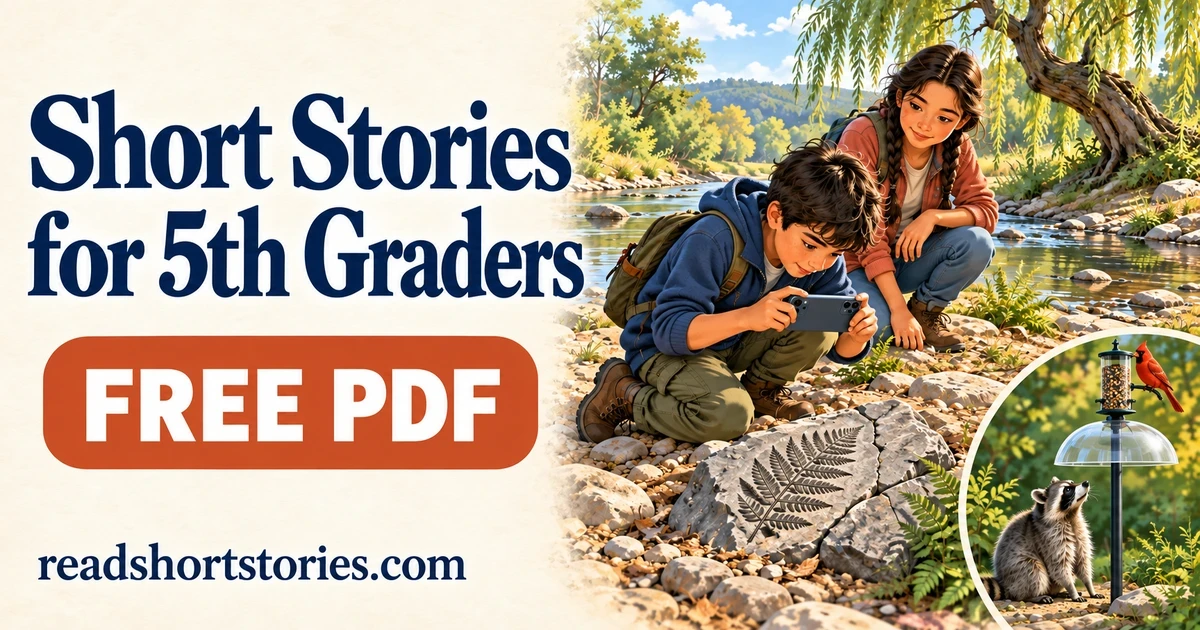
Nadia watched two cardinals land on the new bird feeder. Mom had mounted it on a metal pole near the oak tree, and she had filled it with seeds. For her class observation project, she planned to record the birds that visited. Her notebook had a neat heading: BACKYARD BIRDS.
The following morning, the feeder was empty. Tiny hand-shaped prints crossed the wet grass. That evening, a raccoon climbed the pole while Nadia watched from the kitchen. He opened the feeder lid with both front paws. She added another heading: UNINVITED GUEST.
“I’m calling him Bandit,” she said. Mom looked at the empty feeder. “He certainly has the right qualifications.”
Mom fitted a smooth plastic dome beneath the feeder to block the climb. That night, Bandit climbed the oak instead. He stretched from an overhanging branch and shook the feeder until seeds scattered below. Then he climbed down to collect them.
Nadia wrote: FIRST PLAN—EXCELLENT LADDER STILL AVAILABLE.
With Mom, she moved the pole into the open yard, well away from branches. On the next evening, Bandit climbed until he reached the dome. His paws slipped from its smooth edge. He tried from the other side, then sat below it as though waiting for someone to apologize.
“That did it,” Mom whispered.
Bandit began searching the grass. He picked up seeds spilled during the move, one after another. Nadia had nearly closed her notebook, but now she drew a little circle around the pole on her diagram.
“The lid is safe,” she said. “The ground is still a dinner plate.”
They decided to bring the feeder inside before dusk and sweep up spilled seeds. Nadia could watch the birds after school, then help take it down. She hated losing a few hours of birdwatching, but she wanted the raccoon to find his meals away from their yard.
For three evenings, Bandit checked the clean patch of grass. He stretched his nose toward the empty pole, found nothing, and moved on. By Friday, Nadia watched him disappear behind the far hedge without stopping.
At school, Nadia changed her project title to The Raccoon Report. She showed two diagrams: a pole beside an oak and a pole in the open. Under them, she wrote what had happened after each change.
“Did you win?” a classmate asked.
“The birds get seeds in the daytime,” Nadia said. “Bandit gets his dinner somewhere else. He didn’t tell me where.”
That afternoon, a cardinal landed on the feeder. Nadia opened her notebook. At last, she could use her first heading again.
Questions
- How does Bandit reach the feeder after Mom adds the plastic dome?
- How does moving the pole away from the oak change Bandit’s access to the feeder?
- Why do Nadia and Mom clean the ground even after moving the feeder into the open?
- What does Nadia’s decision to keep watching after Mom says “That did it” suggest about her?
- What does scattered mean when seeds fall below the feeder?
- What theme is supported by Nadia’s diagrams and the changes she makes?
Answers
Answers
- He climbs the oak and stretches from an overhanging branch to shake seeds from the feeder. Evidence: That night, Bandit climbed the oak instead. He stretched from an overhanging branch and shook the feeder until seeds scattered below.
- After the move, the dome stops Bandit from reaching the feeder. Evidence: On the next evening, Bandit climbed until he reached the dome. His paws slipped from its smooth edge.
- Spilled seeds still attract Bandit even though he cannot reach the feeder. Evidence: “The lid is safe,” she said. “The ground is still a dinner plate.”
- She checks what actually happens instead of accepting that the problem is completely solved. Evidence: Nadia had nearly closed her notebook, but now she drew a little circle around the pole on her diagram.
- It means the seeds spread over the ground. Evidence: He stretched from an overhanging branch and shook the feeder until seeds scattered below. Then he climbed down to collect them.
- Careful observation helps people improve a plan. Nadia records the results of changes to the feeder. Evidence: She showed two diagrams: a pole beside an oak and a pole in the open. Under them, she wrote what had happened after each change.
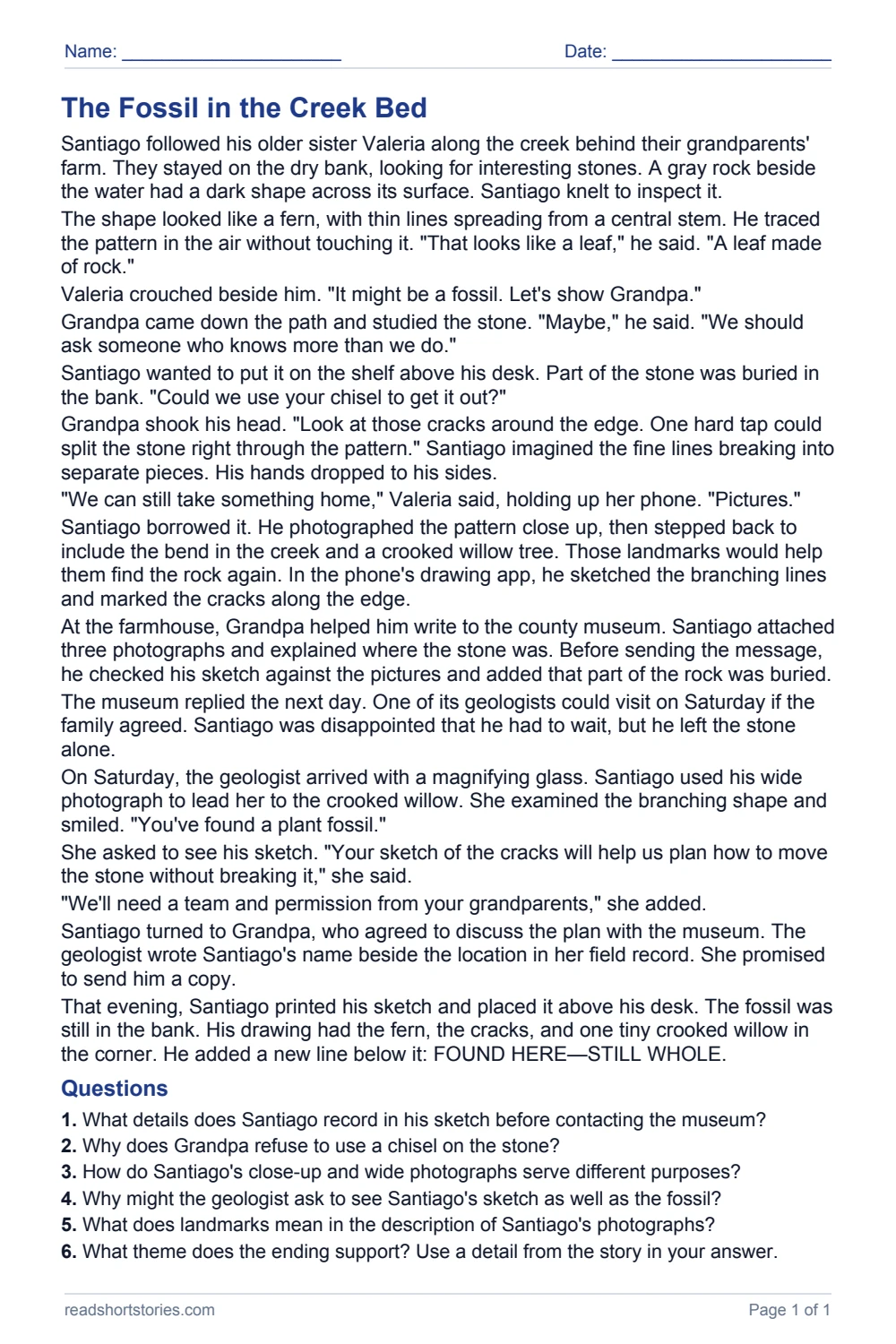
The Fossil in the Creek Bed
Santiago followed his older sister Valeria along the creek behind their grandparents’ farm. They stayed on the dry bank, looking for interesting stones. A gray rock beside the water had a dark shape across its surface. Santiago knelt to inspect it.
The shape looked like a fern, with thin lines spreading from a central stem. He traced the pattern in the air without touching it. “That looks like a leaf,” he said. “A leaf made of rock.”
Valeria crouched beside him. “It might be a fossil. Let’s show Grandpa.”
Grandpa came down the path and studied the stone. “Maybe,” he said. “We should ask someone who knows more than we do.”
Santiago wanted to put it on the shelf above his desk. Part of the stone was buried in the bank. “Could we use your chisel to get it out?”
Grandpa shook his head. “Look at those cracks around the edge. One hard tap could split the stone right through the pattern.” Santiago imagined the fine lines breaking into separate pieces. His hands dropped to his sides.
“We can still take something home,” Valeria said, holding up her phone. “Pictures.”
Santiago borrowed it. He photographed the pattern close up, then stepped back to include the bend in the creek and a crooked willow tree. Those landmarks would help them find the rock again. In the phone’s drawing app, he sketched the branching lines and marked the cracks along the edge.
At the farmhouse, Grandpa helped him write to the county museum. Santiago attached three photographs and explained where the stone was. Before sending the message, he checked his sketch against the pictures and added that part of the rock was buried.
The museum replied the next day. One of its geologists could visit on Saturday if the family agreed. Santiago was disappointed that he had to wait, but he left the stone alone.
On Saturday, the geologist arrived with a magnifying glass. Santiago used his wide photograph to lead her to the crooked willow. She examined the branching shape and smiled. “You’ve found a plant fossil.”
She asked to see his sketch. “Your sketch of the cracks will help us plan how to move the stone without breaking it,” she said.
“We’ll need a team and permission from your grandparents,” she added.
Santiago turned to Grandpa, who agreed to discuss the plan with the museum. The geologist wrote Santiago’s name beside the location in her field record. She promised to send him a copy.
That evening, Santiago printed his sketch and placed it above his desk. The fossil was still in the bank. His drawing had the fern, the cracks, and one tiny crooked willow in the corner. He added a new line below it: FOUND HERE—STILL WHOLE.
Questions
- What details does Santiago record in his sketch before contacting the museum?
- Why does Grandpa refuse to use a chisel on the stone?
- How do Santiago’s close-up and wide photographs serve different purposes?
- Why might the geologist ask to see Santiago’s sketch as well as the fossil?
- What does landmarks mean in the description of Santiago’s photographs?
- What theme does the ending support? Use a detail from the story in your answer.
Answers
Answers
- He draws the branching lines and marks the cracks along the stone’s edge. Evidence: In the phone’s drawing app, he sketched the branching lines and marked the cracks along the edge.
- Cracks around its edge could cause a hard tap to split the pattern. Evidence: “Look at those cracks around the edge. One hard tap could split the stone right through the pattern.”
- The close-up records the pattern; the wider view includes landmarks to help locate the stone again. Evidence: He photographed the pattern close up, then stepped back to include the bend in the creek and a crooked willow tree. Those landmarks would help them find the rock again.
- His sketch of the cracks helps her plan how to move the stone without breaking it. Evidence: She asked to see his sketch. “Your sketch of the cracks will help us plan how to move the stone without breaking it,” she said.
- They are recognizable features, such as the creek bend and willow, that help people find the place again. Evidence: He photographed the pattern close up, then stepped back to include the bend in the creek and a crooked willow tree. Those landmarks would help them find the rock again.
- Taking care of a discovery can matter more than owning it. Santiago displays his sketch while leaving the fossil in place. Evidence: That evening, Santiago printed his sketch and placed it above his desk. The fossil was still in the bank.
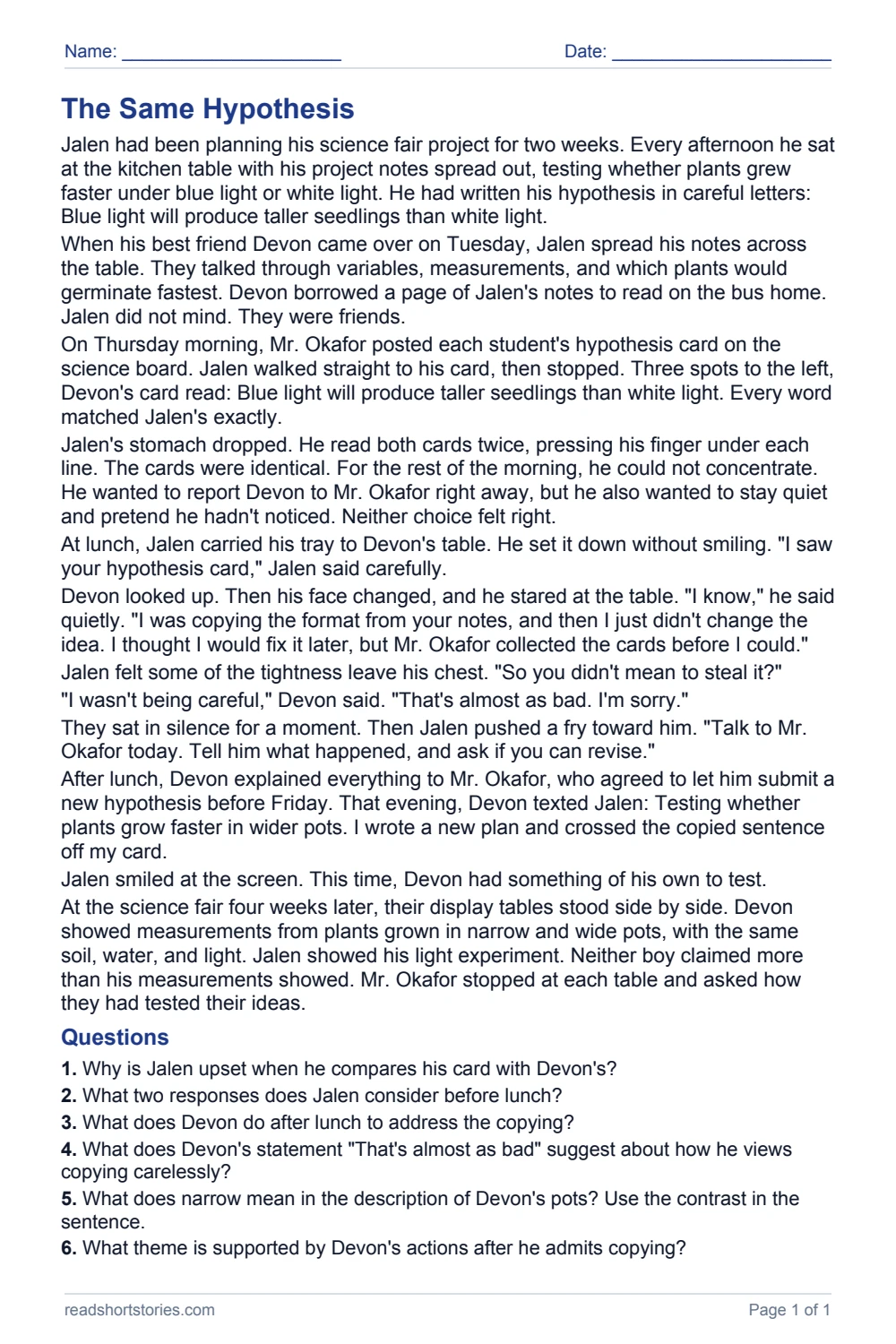
The Same Hypothesis
Jalen had been planning his science fair project for two weeks. Every afternoon he sat at the kitchen table with his project notes spread out, testing whether plants grew faster under blue light or white light. He had written his hypothesis in careful letters: Blue light will produce taller seedlings than white light.
When his best friend Devon came over on Tuesday, Jalen spread his notes across the table. They talked through variables, measurements, and which plants would germinate fastest. Devon borrowed a page of Jalen’s notes to read on the bus home. Jalen did not mind. They were friends.
On Thursday morning, Mr. Okafor posted each student’s hypothesis card on the science board. Jalen walked straight to his card, then stopped. Three spots to the left, Devon’s card read: Blue light will produce taller seedlings than white light. Every word matched Jalen’s exactly.
Jalen’s stomach dropped. He read both cards twice, pressing his finger under each line. The cards were identical. For the rest of the morning, he could not concentrate. He wanted to report Devon to Mr. Okafor right away, but he also wanted to stay quiet and pretend he hadn’t noticed. Neither choice felt right.
At lunch, Jalen carried his tray to Devon’s table. He set it down without smiling. “I saw your hypothesis card,” Jalen said carefully.
Devon looked up. Then his face changed, and he stared at the table. “I know,” he said quietly. “I was copying the format from your notes, and then I just didn’t change the idea. I thought I would fix it later, but Mr. Okafor collected the cards before I could.”
Jalen felt some of the tightness leave his chest. “So you didn’t mean to steal it?”
“I wasn’t being careful,” Devon said. “That’s almost as bad. I’m sorry.”
They sat in silence for a moment. Then Jalen pushed a fry toward him. “Talk to Mr. Okafor today. Tell him what happened, and ask if you can revise.”
After lunch, Devon explained everything to Mr. Okafor, who agreed to let him submit a new hypothesis before Friday. That evening, Devon texted Jalen: Testing whether plants grow faster in wider pots. I wrote a new plan and crossed the copied sentence off my card.
Jalen smiled at the screen. This time, Devon had something of his own to test.
At the science fair four weeks later, their display tables stood side by side. Devon showed measurements from plants grown in narrow and wide pots, with the same soil, water, and light. Jalen showed his light experiment. Neither boy claimed more than his measurements showed. Mr. Okafor stopped at each table and asked how they had tested their ideas.
Questions
- Why is Jalen upset when he compares his card with Devon’s?
- What two responses does Jalen consider before lunch?
- What does Devon do after lunch to address the copying?
- What does Devon’s statement “That’s almost as bad” suggest about how he views copying carelessly?
- What does narrow mean in the description of Devon’s pots? Use the contrast in the sentence.
- What theme is supported by Devon’s actions after he admits copying?
Answers
Answers
- Devon has submitted the same hypothesis that Jalen had shared in his notes. Evidence: Three spots to the left, Devon’s card read: Blue light will produce taller seedlings than white light. Every word matched Jalen’s exactly.
- He considers reporting Devon immediately or staying quiet and pretending not to notice. Evidence: He wanted to report Devon to Mr. Okafor right away, but he also wanted to stay quiet and pretend he hadn’t noticed. Neither choice felt right.
- He explains what happened to Mr. Okafor and gets permission to submit a new hypothesis. Evidence: After lunch, Devon explained everything to Mr. Okafor, who agreed to let him submit a new hypothesis before Friday.
- He thinks being careless does not excuse copying. Evidence: “I wasn’t being careful,” Devon said. “That’s almost as bad. I’m sorry.”
- It means small in width, the opposite of wide. Evidence: Devon showed measurements from plants grown in narrow and wide pots, with the same soil, water, and light.
- Taking responsibility includes correcting the problem. Devon replaces the copied sentence with his own plan. Evidence: I wrote a new plan and crossed the copied sentence off my card.
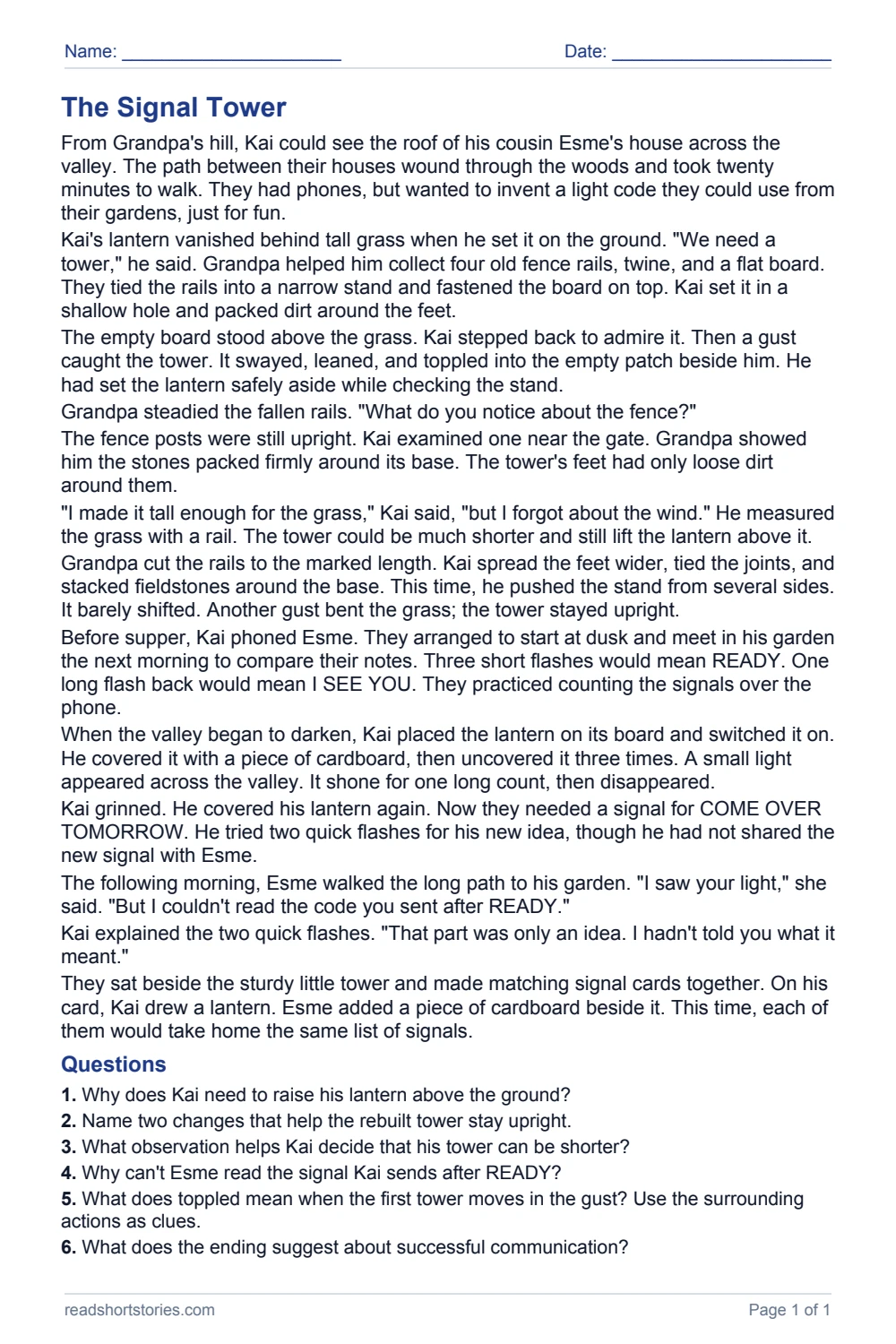
The Signal Tower
From Grandpa’s hill, Kai could see the roof of his cousin Esme’s house across the valley. The path between their houses wound through the woods and took twenty minutes to walk. They had phones, but wanted to invent a light code they could use from their gardens, just for fun.
Kai’s lantern vanished behind tall grass when he set it on the ground. “We need a tower,” he said. Grandpa helped him collect four old fence rails, twine, and a flat board. They tied the rails into a narrow stand and fastened the board on top. Kai set it in a shallow hole and packed dirt around the feet.
The empty board stood above the grass. Kai stepped back to admire it. Then a gust caught the tower. It swayed, leaned, and toppled into the empty patch beside him. He had set the lantern safely aside while checking the stand.
Grandpa steadied the fallen rails. “What do you notice about the fence?”
The fence posts were still upright. Kai examined one near the gate. Grandpa showed him the stones packed firmly around its base. The tower’s feet had only loose dirt around them.
“I made it tall enough for the grass,” Kai said, “but I forgot about the wind.” He measured the grass with a rail. The tower could be much shorter and still lift the lantern above it.
Grandpa cut the rails to the marked length. Kai spread the feet wider, tied the joints, and stacked fieldstones around the base. This time, he pushed the stand from several sides. It barely shifted. Another gust bent the grass; the tower stayed upright.
Before supper, Kai phoned Esme. They arranged to start at dusk and meet in his garden the next morning to compare their notes. Three short flashes would mean READY. One long flash back would mean I SEE YOU. They practiced counting the signals over the phone.
When the valley began to darken, Kai placed the lantern on its board and switched it on. He covered it with a piece of cardboard, then uncovered it three times. A small light appeared across the valley. It shone for one long count, then disappeared.
Kai grinned. He covered his lantern again. Now they needed a signal for COME OVER TOMORROW. He tried two quick flashes for his new idea, though he had not shared the new signal with Esme.
The following morning, Esme walked the long path to his garden. “I saw your light,” she said. “But I couldn’t read the code you sent after READY.”
Kai explained the two quick flashes. “That part was only an idea. I hadn’t told you what it meant.”
They sat beside the sturdy little tower and made matching signal cards together. On his card, Kai drew a lantern. Esme added a piece of cardboard beside it. This time, each of them would take home the same list of signals.
Questions
- Why does Kai need to raise his lantern above the ground?
- Name two changes that help the rebuilt tower stay upright.
- What observation helps Kai decide that his tower can be shorter?
- Why can’t Esme read the signal Kai sends after READY?
- What does toppled mean when the first tower moves in the gust? Use the surrounding actions as clues.
- What does the ending suggest about successful communication?
Answers
Answers
- Tall grass hides its light when it is on the ground. Evidence: Kai’s lantern vanished behind tall grass when he set it on the ground.
- Any two: shorter rails, wider feet, or fieldstones around the base. Evidence: Grandpa cut the rails to the marked length. Kai spread the feet wider, tied the joints, and stacked fieldstones around the base.
- Measuring the grass shows that a shorter tower can still raise the lantern above it. Evidence: He measured the grass with a rail. The tower could be much shorter and still lift the lantern above it.
- Kai has invented a new signal but has not told Esme what it means. Evidence: He tried two quick flashes for his new idea, though he had not shared the new signal with Esme.
- It means fell over; the tower sways and leans before landing beside Kai. Evidence: Then a gust caught the tower. It swayed, leaned, and toppled into the empty patch beside him.
- Both people need to share the same code. The cousins make matching signal cards to take home. Evidence: This time, each of them would take home the same list of signals.
Download the Free PDF
The workbook includes 10 stories: the 4 stories above and 6 bonus stories, with questions and a separate answer key.
Frequently Asked Questions
How long are the stories?
The web stories have 427–485 words each. Read together when a child needs support.
Does the PDF include answers?
Yes. All 10 stories have questions, and the answer key is on separate pages.
How can we use these stories?
Read or listen, answer the questions, and look back at the story for clues. Print the US Letter or A4 pages for home or classroom reading.