- Learn English Through 10 Stories – Free PDF
- Story 1: Vincent Finds His Colors
- Words to Know: Art and Creativity
- Story 2: Before the World Knew the Beatles
- Words to Know: Music and Performance
- Story 3: The Message That Needed a Network
- Words to Know: Computers and Communication
- Seven More Stories in the PDF
- Download Ten Stories, Ten Worlds — Free PDF
- Download 10 Stories + Vocabulary (PDF)
- A Simple Way to Read the Collection
- More English Reading Practice
A painter finds his colors. A young band finds its sound. Researchers find a way to connect computers across great distances. These English stories with vocabulary introduce interesting topics while giving you something worthwhile to read.
Ten Stories, Ten Worlds is a 22-page reading collection with ten different vocabulary themes. Read the first three stories below, then download the complete PDF for all ten stories and 60 useful words with simple example sentences.
Who is it for? Adult and teen English learners who can already follow short paragraphs. The language is approximately A2–B1, as an editorial estimate. Some science and history words need extra support, which you will find in each “Words to Know” section.
Selected action verbs appear in bold. The collection includes historical narratives and clearly labeled fiction. It is a reading book with vocabulary support, rather than a grammar workbook.
Go to the PDF download section
Story 1: Vincent Finds His Colors
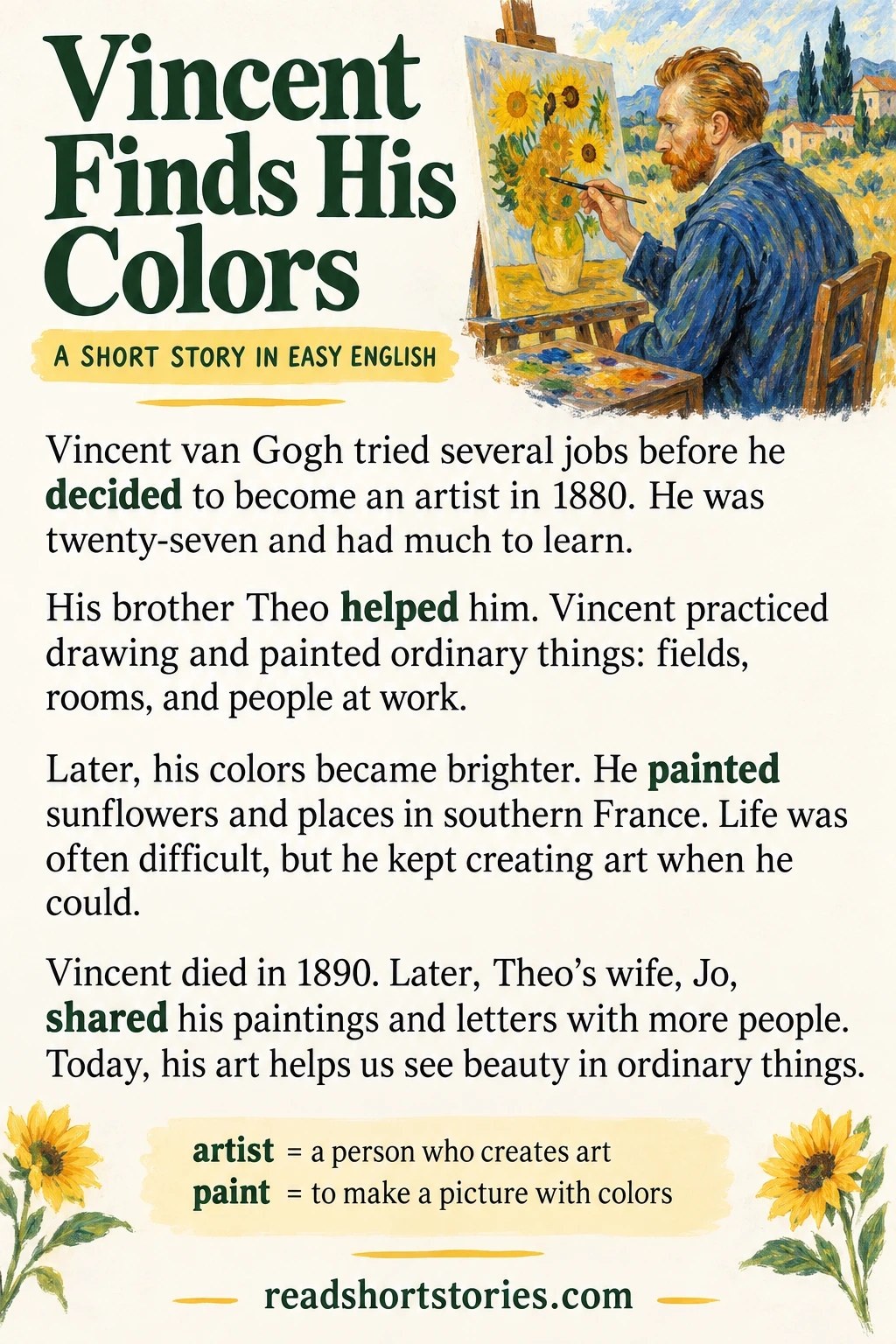
Vocabulary theme: art and creativity. Historical narrative.
Vincent van Gogh did not begin adult life as a famous painter. Before he chose art, he worked in other jobs and tried to find a place in the world. For a time, he wanted to help people through religious work. That path did not become his life’s work.
In 1880, he decided to become an artist. He was twenty-seven. He had much to learn, and learning took practice.
His brother Theo supported him. The brothers wrote letters, and Vincent sent drawings as well as words. A page could carry news about money, a difficult day, or an idea for a picture.
Vincent drew ordinary people and places. Workers, fields, rooms, and simple objects each became a subject for his art. He did not need a palace to find something worth looking at.
His early paintings often used dark colors. Later, in Paris, he met other artists and saw different ways to paint. His colors became brighter. He began to explore what a brush could do beyond making an exact copy of a scene.
In southern France, he painted flowers, fields, and the places around him. In pictures of sunflowers, yellow could appear warm, bright, or almost brown. One familiar flower could fill a whole canvas with life.
His life also included serious illness and periods of distress. Painting did not remove every difficulty. Theo’s support remained important, and Vincent continued to work when he could.
Vincent died in 1890, before the great public success his paintings later received. Theo died soon afterward. Theo’s wife, Jo van Gogh-Bonger, then worked to share Vincent’s art and letters with a wider audience.
The story did not end in a closed studio. Paintings traveled into exhibitions, and letters found readers. People who never met Vincent could still see how closely he had looked at a field or a vase of flowers.
He had spent years trying to find his work. Today, his colors help other people look again at the ordinary world.
Words to Know: Art and Creativity
- Artist: a person who creates art. The artist draws a tree.
- Brush: a tool used to put paint on a surface. I wash my brush.
- Canvas: strong cloth used as a painting surface. She paints on a small canvas.
- Subject: the person or thing shown in an artwork. A flower is the subject of my picture.
- Exhibition: a public display of art or other objects. We visit an art exhibition.
- Support: help given to someone. My family gives me support.
Story 2: Before the World Knew the Beatles
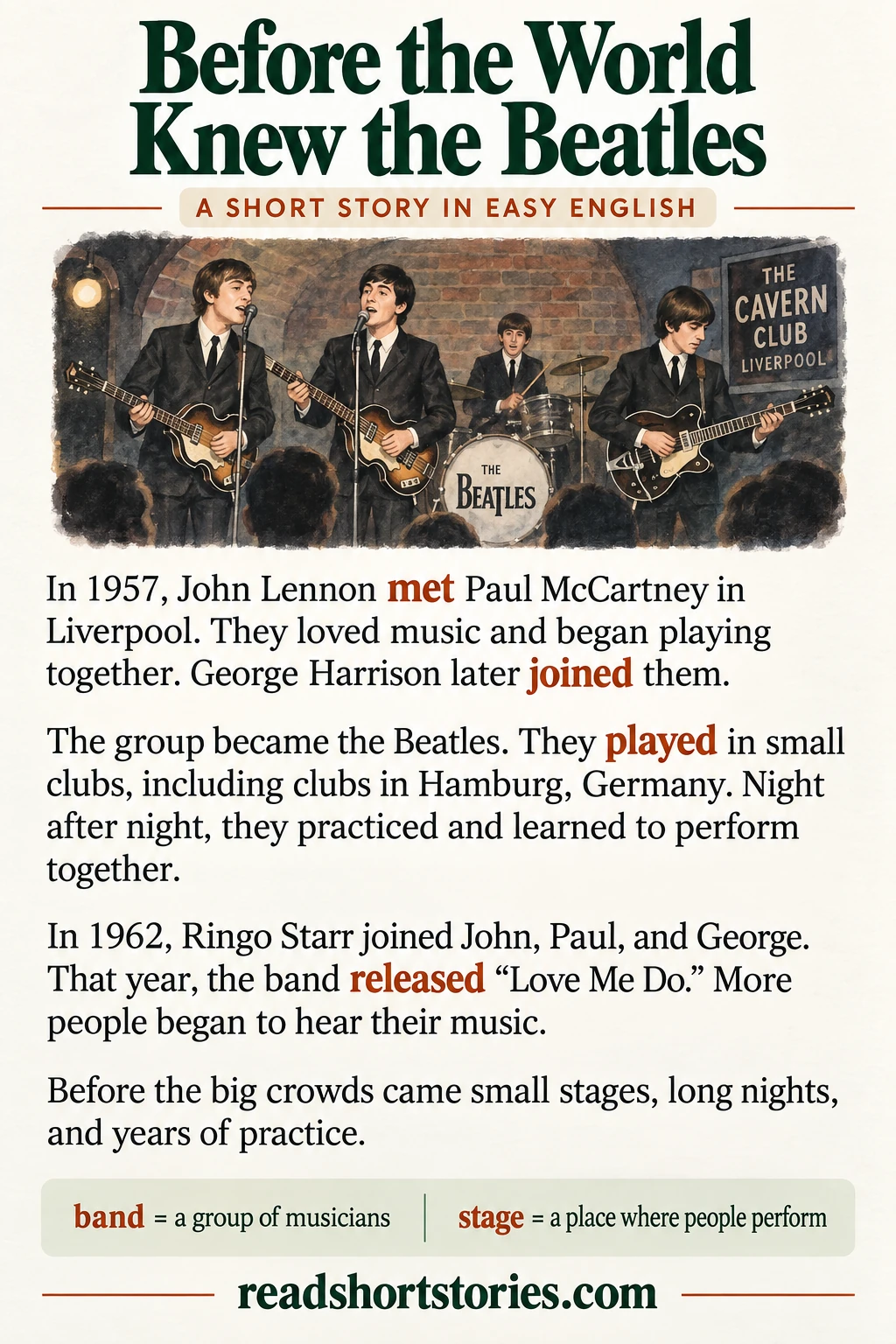
Vocabulary theme: music and performance. Historical narrative.
Before there were screaming crowds, there were young musicians learning songs in Liverpool. They needed instruments, places to play, and people who wanted to listen.
In 1957, John Lennon met Paul McCartney. John already played in a group called the Quarrymen. Paul knew songs and could play guitar. Music gave them a reason to spend time together.
George Harrison later joined them. He was younger, but he could play. The group changed as different people came and went. Becoming the Beatles was a process, not one single meeting of four famous men.
By 1960, they were using the name the Beatles. They traveled to Hamburg in Germany, where they played in clubs. Pete Best was their drummer during this early period, and Stuart Sutcliffe played bass for a time.
Club work was demanding. Long performances gave the musicians many hours together on stage. They learned how to keep a song moving and how to keep an audience interested.
Back in Liverpool, they also performed at the Cavern Club. Their local audience grew. Manager Brian Epstein later helped them find wider opportunities.
In 1962, Ringo Starr joined the band, replacing Pete Best. John, Paul, George, and Ringo became the four members most people know today.
That year, they released “Love Me Do.” A song that people could hear on a record could travel much farther than a performance in one small club. More records and concerts followed, and their audience grew beyond Liverpool and Britain.
It is easy to begin their story with fame. But the earlier part matters: learning songs, changing members, traveling for work, and playing again the next night.
Four names eventually appeared together on records around the world. Behind those names were years of practice and a sound they had built together.
Words to Know: Music and Performance
- Band: a group of musicians who play together. My friends have a band.
- Guitar: a musical instrument with strings. He plays the guitar.
- Drummer: a person who plays drums. The drummer starts the song.
- Stage: the place where performers stand. The singer walks onto the stage.
- Audience: people who watch or listen to a performance. The audience claps.
- Record: a recording of music, often on a disc. We listen to an old record.
Story 3: The Message That Needed a Network
Vocabulary theme: computers and communication. Historical narrative.
A computer can be useful on its own. But what happens when the information you need is on another computer, far away?
Researchers worked on that question long before most homes had computers. They wanted machines in different places to share information. There was no single inventor who built the entire internet in one day.
One important idea was to divide information into small pieces called packets. A network could carry those pieces and put the information back together at the other end. Different researchers helped develop this approach.
In 1969, the ARPANET project connected computers at research locations in the United States. By the end of that year, four host computers were connected. It was a small beginning compared with the network people use today.
As more networks appeared, another problem became important. How could networks built in different ways communicate with one another?
Vint Cerf, Bob Kahn, and many colleagues developed and tested rules for connecting networks. Rules called TCP/IP became a central part of the internet. ARPANET adopted them in 1983.
The growing internet could carry messages and support different services. But the internet and the World Wide Web are not the same thing.
In 1989, Tim Berners-Lee, working at CERN, proposed the Web. It offered a way to connect information through linked pages. The Web used the internet that already existed.
A link made it possible to move from one page to another. People no longer needed to think only about which distant machine held a document; they could follow connected information.
No one laboratory completed the whole story. Researchers, engineers, and users continued to improve different parts.
Now a message can cross countries in moments. Behind that simple action is a long history of people solving smaller problems together: how to send information, how to agree on rules, and how to connect what was once separate.
Words to Know: Computers and Communication
- Network: a group of connected computers or other things. The school computers use one network.
- Packet: a small unit of data sent across a network. The network sends data in packets.
- Connect: to join things together. We connect the two computers.
- Message: information sent to another person. I send a short message.
- Link: something you select to open another page or resource. Click the link to read more.
- Researcher: a person who studies a subject carefully. The researcher tests a new idea.
Seven More Stories in the PDF
The complete collection includes the three stories above and seven additional readings. Each introduces a different group of useful words.
- A Ticket to Tomorrow: a broken clock leads to a conversation about time travel—and a decision about tomorrow. Learn words about time and space.
- Twelve Seconds Above the Sand: follow the Wright brothers from their bicycle workshop to a short flight that changed aviation. Learn words about flight and engineering.
- Six Dots and an Open Book: discover how Louis Braille developed a different way to read and write. Learn words about reading and accessibility.
- The Seeds in the Paper Envelope: a few saved beans give Amira and her grandfather something to grow together. Learn words about plants and gardening.
- The Quiet Tide Pool: Ben thinks a small pool is empty until he takes time to look. Learn words about the coast and observation.
- The Bread That Would Not Rise: Mateo promises to bring bread to lunch, but he misses an important part of the recipe. Learn words about cooking and baking.
- The Birth of Islam: read a short historical account of Prophet Muhammad and the early Muslim community, with Islamic beliefs clearly identified. Learn words about faith and community.
Download Ten Stories, Ten Worlds — Free PDF
Keep the complete collection for reading at home, on your phone, or in a printed copy. The PDF includes:
- 10 complete readings across 10 vocabulary themes.
- 60 useful words with clear meanings and simple examples.
- Selected action verbs in bold.
- 22 A4 pages, including a contents page and background sources.
Download 10 Stories + Vocabulary (PDF)
A Simple Way to Read the Collection
Start with the topic that interests you most. Read once to follow the main idea; you do not need to stop at every unfamiliar word.
Then check the “Words to Know” section and read again. Choose two words you could use in your own life and write one sentence with each.
Finally, explain the story in three sentences: how it begins, what changes, and how it ends. You can do this aloud or in a notebook.
More English Reading Practice
If you would like shorter sentences and familiar everyday situations, try our short stories in English for beginners.
For stories with vocabulary explanations and reading questions, continue with our A1–A2 English stories with vocabulary.