- Past Perfect Continuous Stories with Exercises and Answers (Free PDF)
- Past Perfect Continuous: A Quick Reminder
- Form and Questions
- Duration and Past Results
- Continuous or Simple?
- About the True Story
- Past Perfect Continuous Stories
- The Quiet Table
- Questions
- Past Perfect Continuous Practice
- Reading Answers
- Practice Answers
- Fill in the Blanks
- True or False
- The Women Who Planted a Beginning
- Questions
- Past Perfect Continuous Practice
- Reading Answers
- Practice Answers
- Fill in the Blanks
- True or False
- A Coat with Room to Move
- Questions
- Past Perfect Continuous Practice
- Reading Answers
- Practice Answers
- Fill in the Blanks
- True or False
- Download the Free PDF
- Frequently Asked Questions
- What level are these stories for?
- What does the PDF include?
- When do we use the past perfect continuous?
- More Short Stories and Reading Activities
Listen and read along: Audio versions are available for 3 stories on this page. Use the players below.
You can download the free past perfect continuous stories PDF below.
Listen to the web stories and read along. The PDF also includes 3 bonus stories.

Past Perfect Continuous: A Quick Reminder
Form and Questions
Use had been + -ing for every subject: Zehra had been rehearsing for three evenings before the recording. For negatives, use had not been (hadn’t been) + -ing. For questions, put had before the subject: Had Inez been tapping her pencil?
Duration and Past Results
Use the past perfect continuous to focus on an activity continuing up to, or ending shortly before, a past moment: Elio was tired because he had been drawing for hours. The past simple often gives that reference point.
Continuous or Simple?
The continuous form emphasizes duration or an ongoing process. The past perfect simple often emphasizes completion: She had finished a coat before the market opened. State verbs such as know usually use the simple form: She had known the answer, not had been knowing.
About the True Story
The Women Who Planted a Beginning follows the Green Belt Movement’s history and the 2004 Nobel Prize records: Source and Source . The Wind inside the Workshop follows the US National Park Service’s detailed 1901 account, including the distinction between earlier doubts and largely correct Lilienthal wing data: Source .
Past Perfect Continuous Stories
The Quiet Table
Zehra and Inez had been rehearsing their two-person radio drama for three evenings before they felt ready for a full recording. They had been sharing a small community studio with thick blue curtains, two wooden chairs, and a long worktable. On the center of the table, a sensitive desk microphone stood on a round metal base between their seats. Inez had been practicing the gravelly voice of an elderly ship captain, while Zehra had been reading the captain’s daughter. For nearly two hours that evening, they had been working steadily through each page of their script.
When they reached the final line, Zehra pressed the stop button and put on her large black headphones for a complete playback. Almost immediately, her eyebrows pulled together in confusion.
“Listen to this section,” Zehra said, turning one ear cup toward Inez. “How long had that strange sound been happening?”
Behind their dialogue, a steady, rhythmic tapping filled every quiet pause. Tap, tap, tap. The clicks were soft, but the microphone had recorded every single one with sharp clarity.
“Earlier, we had been blaming the street outside,” Inez said, listening closely. “Delivery vans had been driving down the alley all evening, so I thought the vibrations were shaking the floor.”
“No, this rhythm is far too regular,” Zehra replied, shaking her head. “It only appears during the dramatic moments. Had someone been knocking gently on the studio door while we were performing?”
They replayed the third scene to check the timing. They had not been wearing headphones during the actual performance, so neither had heard the unwanted noise while speaking. Both women had been concentrating entirely on their pacing and emotional delivery. Then Zehra leaned forward and looked closely at Inez’s side of the table.
Inez was holding a yellow wooden pencil with a metal band near the eraser. Throughout their practice sessions, she had been using the pencil to follow her dialogue line by line. Whenever Zehra delivered a long speech, Inez had been resting her wrist on the wooden table and tapping the eraser. Because the microphone stand had been resting directly on the bare wood, it had been picking up every physical vibration.
Inez covered her face with both hands and laughed quietly. “I had been doing that without thinking, hadn’t I? It is a nervous habit from my university days.”
To solve the issue, they moved their paper scripts onto two separate metal music stands away from the table. Zehra hit record and tested thirty seconds of absolute silence while they sat perfectly still. On the small mixer, the green level bars remained completely calm and steady. Satisfied with the clean audio track, the two friends smiled, reset their papers, and began recording their play once more.
Questions
- What initial explanation did Inez suggest for the mysterious noise on the recording?
- Why had neither woman noticed the tapping sound during their performance?
- What caused the rhythmic tapping sound to be recorded with such clarity?
- What decision did Zehra and Inez make to prevent the noise from spoiling their next take?
Past Perfect Continuous Practice
- Which sentence correctly explains the past cause of the noise with an ongoing action before the playback?
- Inez had been tapping her pencil on the table.
- Inez tapped her pencil once on the wooden table.
- Inez has tapped her pencil on the wooden table.
- Complete the sentence with one word: Before Zehra stopped the playback, how long had the strange sound __________ happening?
- Which negative sentence explains why they did not hear the recorded noise during the performance?
- They had not been wearing headphones.
- They had not worn headphones since the next recording.
- They have not been wearing headphones tomorrow.
- Complete the sentence with one word: Delivery vans had been __________ (drive) down the alley for hours before the rehearsal ended.
- Put these six words in the correct order to form a past perfect continuous statement: working / had / hours. / been / They / for
- working
- had
- hours.
- been
- They
- for
Click to see the answers
Reading Answers
- Inez initially thought that delivery vans driving through the alley were causing floor vibrations. Evidence: Delivery vans had been driving down the alley all evening, so I thought the vibrations were shaking the floor.
- Neither woman heard the noise because they were not wearing headphones during the performance. Evidence: They had not been wearing headphones during the actual performance, so neither had heard the unwanted noise while speaking.
- The microphone stand rested directly on the bare wood, so it picked up every physical vibration. Evidence: Because the microphone stand had been resting directly on the bare wood, it had been picking up every physical vibration.
- They decided to move their paper scripts onto separate metal music stands away from the table. Evidence: To solve the issue, they moved their paper scripts onto two separate metal music stands away from the table.
Practice Answers
- Inez had been tapping her pencil on the table.
- been
- They had not been wearing headphones. Had not been + -ing describes the missing ongoing activity before they listened to the playback.
- driving
- They had been working for hours.
Your turn: Think of a time when an unexpected problem or noise interrupted your work or study. Write 3–4 sentences explaining what had been happening leading up to that moment. Use at least two examples of the past perfect continuous (had been + -ing) to describe duration or background causes.
Listen to this story (audio)
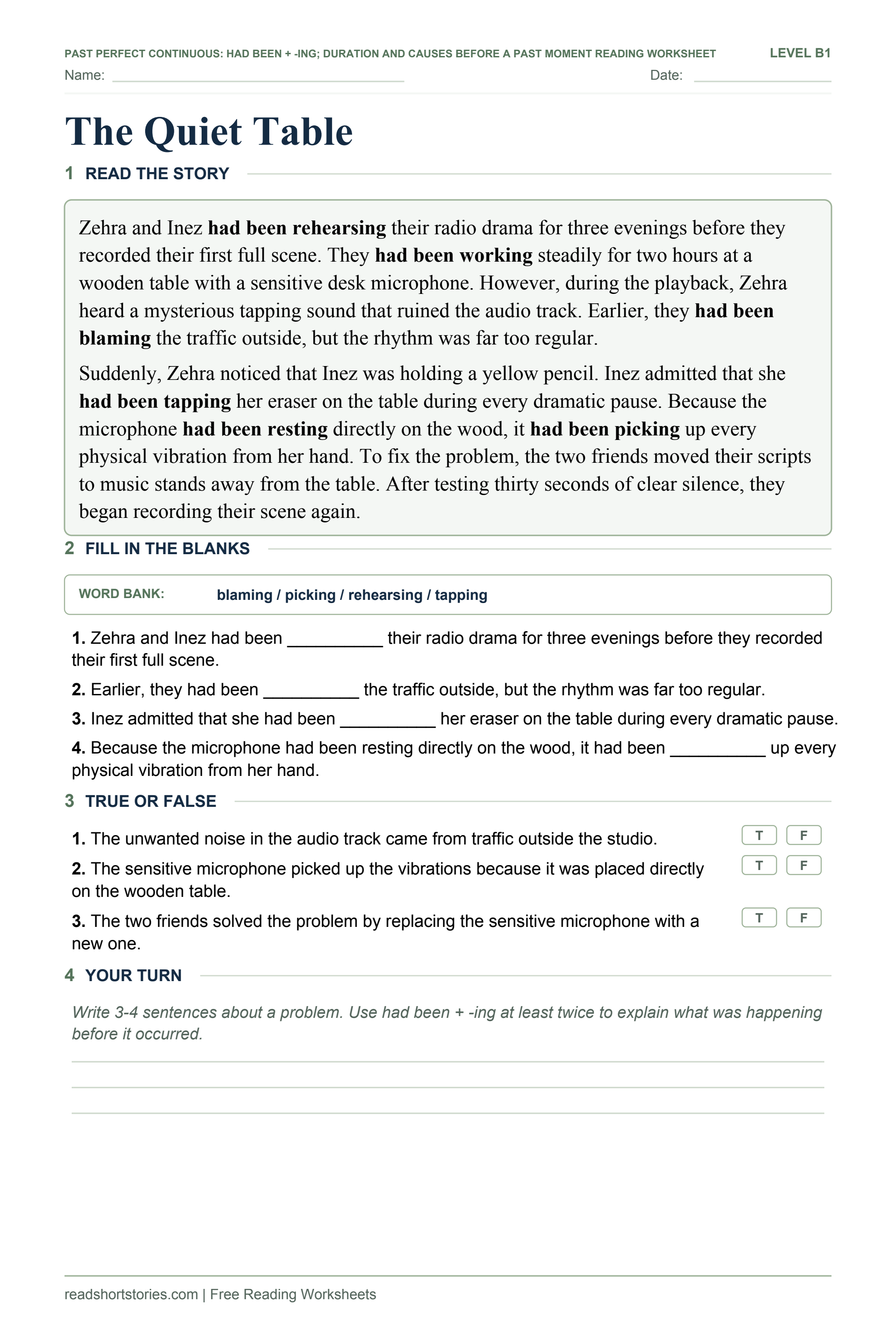
Click to see the short worksheet text and answers
Zehra and Inez had been rehearsing their radio drama for three evenings before they recorded their first full scene. They had been working steadily for two hours at a wooden table with a sensitive desk microphone. However, during the playback, Zehra heard a mysterious tapping sound that ruined the audio track. Earlier, they had been blaming the traffic outside, but the rhythm was far too regular.
Suddenly, Zehra noticed that Inez was holding a yellow pencil. Inez admitted that she had been tapping her eraser on the table during every dramatic pause. Because the microphone had been resting directly on the wood, it had been picking up every physical vibration from her hand. To fix the problem, the two friends moved their scripts to music stands away from the table. After testing thirty seconds of clear silence, they began recording their scene again.
Fill in the Blanks
Words: rehearsing, blaming, tapping, picking
- Zehra and Inez had been __________ their radio drama for three evenings before they recorded their first full scene. Answer: rehearsing
- Earlier, they had been __________ the traffic outside, but the rhythm was far too regular. Answer: blaming
- Inez admitted that she had been __________ her eraser on the table during every dramatic pause. Answer: tapping
- Because the microphone had been resting directly on the wood, it had been __________ up every physical vibration from her hand. Answer: picking
True or False
- The unwanted noise in the audio track came from traffic outside the studio. False. The tapping noise came from Inez tapping her pencil eraser on the wooden table, not from traffic outside. Evidence: Inez admitted that she had been tapping her eraser on the table during every dramatic pause.
- The sensitive microphone picked up the vibrations because it was placed directly on the wooden table. True. Evidence: Because the microphone had been resting directly on the wood, it had been picking up every physical vibration from her hand.
- The two friends solved the problem by replacing the sensitive microphone with a new one. False. They solved the problem by moving their scripts to music stands away from the table. Evidence: To fix the problem, the two friends moved their scripts to music stands away from the table.
Write 3–4 sentences about a problem. Use had been + -ing at least twice to explain what was happening before it occurred.
Sample answer: Yesterday, my phone turned off during a video call. I had been talking to a friend for an hour. I had not been checking the battery level. I charged the phone and called again.
The Women Who Planted a Beginning
In 2004, Wangari Maathai was awarded the Nobel Peace Prize. The award brought global attention to a Kenyan movement that had started nearly three decades earlier. Before the Green Belt Movement began in 1977, rural women had been reporting serious environmental problems. They shared their concerns with the National Council of Women of Kenya. Local streams had been drying up, and families had less clean water. Because nearby trees were disappearing, women had been walking farther distances to collect firewood. In addition, families had been reporting less secure food, which made daily life difficult.
Wangari Maathai listened to these rural families through her work with the council. She realized that tree planting could respond directly to their daily needs. In 1977, Wangari Maathai founded the Green Belt Movement under the auspices of the National Council of Women of Kenya. Women began planting trees together to protect their local environment. Before this work began, rural families had been struggling to find enough fuel and food. Tree planting responded directly to these shortages, aiming to provide firewood, protect streams, and conserve the land.
As the years passed, the movement expanded its mission. It did not stop at planting trees; it also began supporting environmental protection and community rights. For years, local groups had been organizing community meetings to discuss conservation and fair access to land. Women had also been protecting public forests and open spaces from damage. By 2004, Kenyan women had been planting trees and caring for the land for twenty-seven years. They had been working together through many challenges to build healthier communities.
The 2004 Nobel Peace Prize recognized this long effort. The Nobel committee emphasized that peace depends on the fair and sustainable protection of natural resources. For decades, Kenyan women had been demonstrating how environmental care strengthens communities. A simple plan that began with firewood and water grew into a lasting global example of community action.
Questions
- Why had rural Kenyan women been walking farther distances before 1977?
- Why did Wangari Maathai decide that planting trees was a suitable solution?
- How did the mission of the Green Belt Movement develop over time?
- What does the 2004 award help readers understand about the work that began in 1977?
Past Perfect Continuous Practice
- Before the movement began in 1977, rural women __________ farther distances to collect firewood.
- had been walking
- have walked
- will walk
- By 2004, local groups had __________ organizing community meetings for years. Complete with one word.
- Which sentence describes an ongoing activity that continued over time before a specific past moment?
- Kenyan women had been planting trees for twenty-seven years by 2004.
- Wangari Maathai founded the Green Belt Movement in 1977.
- Wangari Maathai was awarded the Nobel Peace Prize in 2004.
- Complete with the -ing form of ‘struggle’: Before 1977, rural families had been __________ to find enough fuel and food.
- Put the words in the correct order: planting / had / together. / trees / Women / been
- planting
- had
- together.
- trees
- Women
- been
Click to see the answers
Reading Answers
- Rural women had been walking farther distances to collect firewood because nearby trees were disappearing. Evidence: Because nearby trees were disappearing, women had been walking farther distances to collect firewood.
- She saw that planting trees could help meet rural families daily needs. Evidence: She realized that tree planting could respond directly to their daily needs.
- The movement broadened its focus beyond tree planting to support community rights and broader environmental protection. Evidence: It did not stop at planting trees; it also began supporting environmental protection and community rights.
- It shows that the movement received international attention after many years of work. Evidence: The award brought global attention to a Kenyan movement that had started nearly three decades earlier.
Practice Answers
- had been walking
- been
- Kenyan women had been planting trees for twenty-seven years by 2004.
- struggling
- Women had been planting trees together.
Your turn: Write 3–4 sentences about an environmental or community project in the past. Use the past perfect continuous (had been + -ing) to explain what people had been doing and what problems they had been facing before the project succeeded.
Listen to this story (audio)
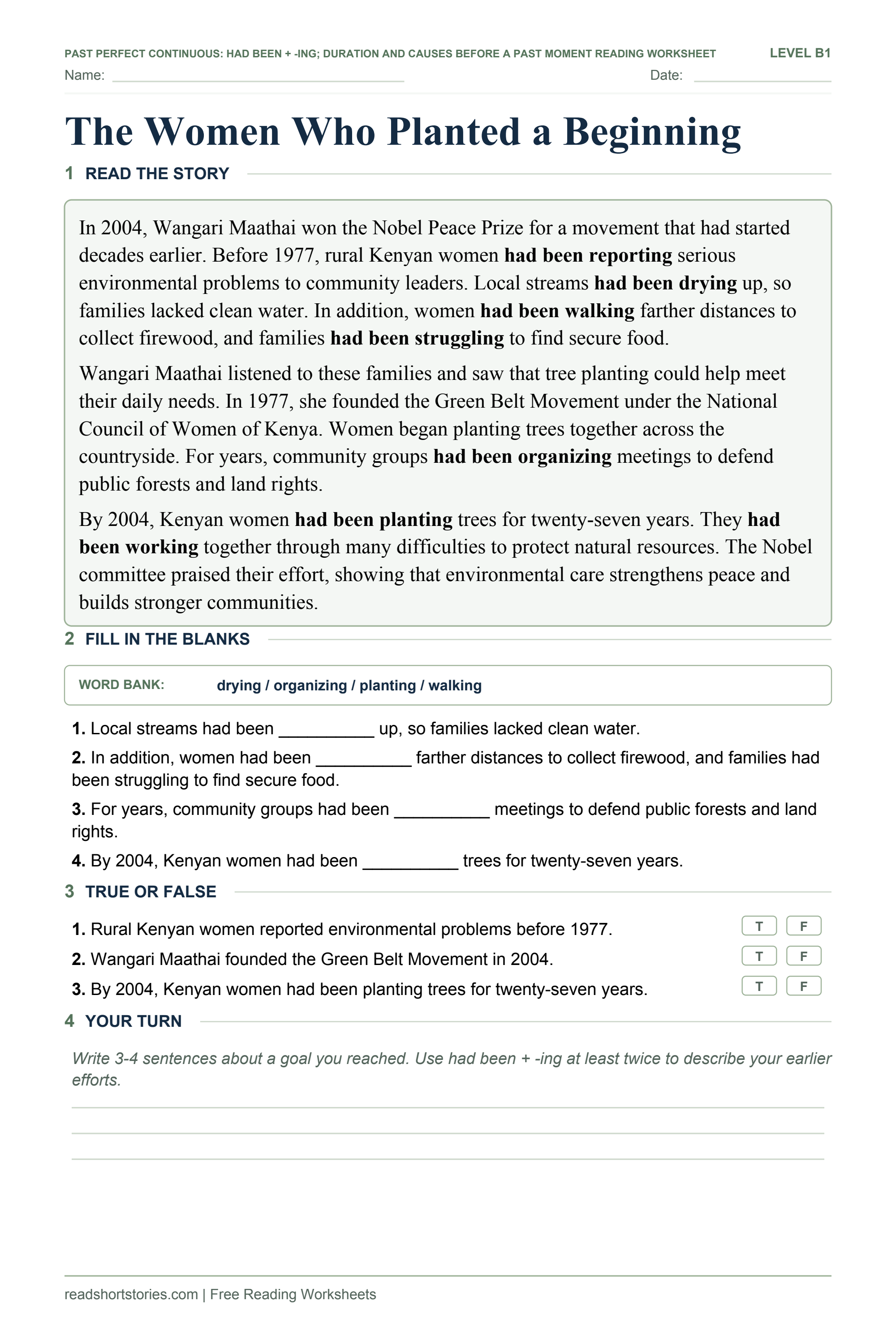
Click to see the short worksheet text and answers
In 2004, Wangari Maathai won the Nobel Peace Prize for a movement that had started decades earlier. Before 1977, rural Kenyan women had been reporting serious environmental problems to community leaders. Local streams had been drying up, so families lacked clean water. In addition, women had been walking farther distances to collect firewood, and families had been struggling to find secure food.
Wangari Maathai listened to these families and saw that tree planting could help meet their daily needs. In 1977, she founded the Green Belt Movement under the National Council of Women of Kenya. Women began planting trees together across the countryside. For years, community groups had been organizing meetings to defend public forests and land rights.
By 2004, Kenyan women had been planting trees for twenty-seven years. They had been working together through many difficulties to protect natural resources. The Nobel committee praised their effort, showing that environmental care strengthens peace and builds stronger communities.
Fill in the Blanks
Words: drying, walking, organizing, planting
- Local streams had been __________ up, so families lacked clean water. Answer: drying
- In addition, women had been __________ farther distances to collect firewood, and families had been struggling to find secure food. Answer: walking
- For years, community groups had been __________ meetings to defend public forests and land rights. Answer: organizing
- By 2004, Kenyan women had been __________ trees for twenty-seven years. Answer: planting
True or False
- Rural Kenyan women reported environmental problems before 1977. True. Evidence: Before 1977, rural Kenyan women had been reporting serious environmental problems to community leaders.
- Wangari Maathai founded the Green Belt Movement in 2004. False. Wangari Maathai founded the Green Belt Movement in 1977, not in 2004. Evidence: In 1977, she founded the Green Belt Movement under the National Council of Women of Kenya.
- By 2004, Kenyan women had been planting trees for twenty-seven years. True. Evidence: By 2004, Kenyan women had been planting trees for twenty-seven years.
Write 3–4 sentences about a goal you reached. Use had been + -ing at least twice to describe your earlier efforts.
Sample answer: Last year, I finally passed my advanced driving test. Before the exam date, I had been practicing parallel parking and highway driving every weekend for three months. I had also been studying the traffic laws carefully because I had been feeling nervous about the written section. Achieving this goal gave me the confidence to drive safely on my own.
A Coat with Room to Move
Luz had been sewing at her kitchen table for nearly a month before the neighborhood craft market opened. She had been preparing five wool garments for her very first sales stall, hoping to earn a modest extra income. Luz loved clean lines and sturdy fabrics, but she was still an amateur maker who worked slowly. To protect against measuring mistakes, she had left wide, one-inch seam allowances inside all the major panels.
On Tuesday evening, her neighbor Adela stopped by to test the dark green autumn coat. Luz had been pressing the hem when Adela knocked on the door. Luz hung the garment up proudly, offered Adela a cup of tea, and smiled.
“Slip this on,” Luz said. “Tell me how the shoulders feel.”
Adela put her arms through the smooth cotton sleeves and looked into the full-length mirror. The rich green wool draped neatly, and the front buttons lined up straight. But when Adela reached down for her canvas tote bag on the floor, she stopped abruptly. The heavy fabric tightened across her upper back, locking her elbows in front of her.
“I cannot reach forward,” Adela said. “It looks wonderful while I stand still, but my back feels completely trapped.”
Luz stepped behind her friend and examined the pulled fabric. Her fingers were stiff because she had been cutting heavy wool all afternoon, but she quickly saw the problem. For weeks, she had been testing the fit only on a motionless wooden dress form. She had also been checking the shape on her own body while standing completely still. In her excitement, she had not been leaving enough room across the shoulders for normal reaching and bending.
“Had you been feeling any tightness before you reached for your bag?” Luz asked.
“Not at all,” Adela replied. “It felt perfectly comfortable until I moved.”
“Do not worry,” Luz said with a smile. “I planned ahead for adjustments.”
With Adela’s permission, Luz turned the coat inside out on the wooden cutting table. The generous interior seams gave her plenty of extra fabric to work with. Using a small seam ripper, she carefully opened the upper back seams. She pinned the panels half an inch wider, resewed them securely on her machine, and pressed the wool flat with a warm steam iron.
“Try it again,” Luz said, handing the coat back.
Adela slipped the coat on once more. She crossed her arms, bent her elbows, and reached down to pick up her bag. The wool moved smoothly without pulling.
“Now I can move freely,” Adela laughed.
Luz felt quiet relief wash over her. Before packing the coat into a protective garment bag, she wrote a rule in her sewing notebook: always test clothes in motion. She had been evaluating garments only by their appearance on a stand, but real daily comfort would now guide every piece she made.
Questions
- Why were Luz’s fingers stiff when she inspected the coat?
- Why did Luz have enough extra fabric available to widen the coat?
- What happened when Adela reached down for her canvas tote bag?
- What practical rule did Luz decide to record in her sewing notebook?
Past Perfect Continuous Practice
- Complete the sentence with one word: Her fingers were stiff because she __________ been cutting heavy wool all afternoon.
- Choose the correct verb phrase: Luz __________ garments for weeks before the market opened, so she felt well prepared.
- had been preparing
- has been preparing
- is preparing
- Why does the writer use the past perfect continuous in ‘Luz had been pressing the hem when Adela knocked on the door’?
- To show an ongoing activity that was already in progress before a past interruption
- To describe a single, completed action that happened after Adela arrived
- To express a future goal that Luz hoped to achieve
- Put these words in the correct order:
- weeks.
- sewing
- had
- for
- been
- She
- Complete the negative sentence with one word: In her excitement, Luz had not __________ leaving enough room across the shoulders.
Click to see the answers
Reading Answers
- Luz’s fingers were stiff because she had been cutting heavy wool fabric all afternoon. Evidence: Her fingers were stiff because she had been cutting heavy wool all afternoon, but she quickly saw the problem.
- Luz had extra fabric because she had left wide, one-inch seam allowances inside the panels to guard against mistakes. Evidence: To protect against measuring mistakes, she had left wide, one-inch seam allowances inside all the major panels.
- The coat’s heavy fabric tightened across Adela’s upper back and locked her elbows in front of her. Evidence: The heavy fabric tightened across her upper back, locking her elbows in front of her.
- Luz decided to record a rule stating that clothes must always be tested in motion. Evidence: Before packing the coat into a protective garment bag, she wrote a rule in her sewing notebook: always test clothes in motion.
Practice Answers
- had
- had been preparing
- To show an ongoing activity that was already in progress before a past interruption
- She had been sewing for weeks.
- been
Your turn: Think of a time when you made, repaired, or practiced something. Write 3–4 sentences describing what you had been doing before a problem or success occurred. Use the past perfect continuous (had been + -ing) at least twice to explain the duration or cause.
Listen to this story (audio)
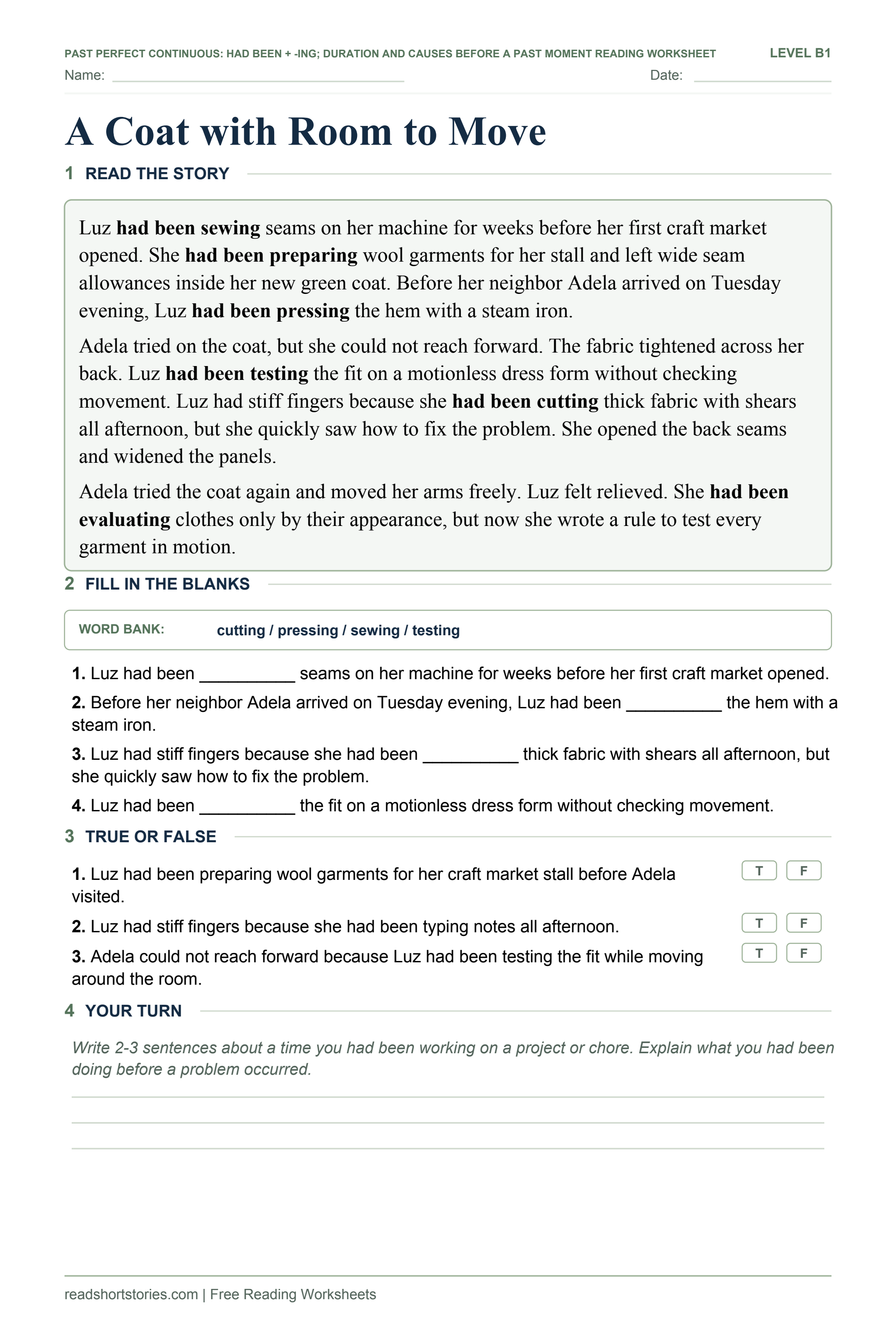
Click to see the short worksheet text and answers
Luz had been sewing seams on her machine for weeks before her first craft market opened. She had been preparing wool garments for her stall and left wide seam allowances inside her new green coat. Before her neighbor Adela arrived on Tuesday evening, Luz had been pressing the hem with a steam iron.
Adela tried on the coat, but she could not reach forward. The fabric tightened across her back. Luz had been testing the fit on a motionless dress form without checking movement. Luz had stiff fingers because she had been cutting thick fabric with shears all afternoon, but she quickly saw how to fix the problem. She opened the back seams and widened the panels.
Adela tried the coat again and moved her arms freely. Luz felt relieved. She had been evaluating clothes only by their appearance, but now she wrote a rule to test every garment in motion.
Fill in the Blanks
Words: sewing, pressing, cutting, testing
- Luz had been __________ seams on her machine for weeks before her first craft market opened. Answer: sewing
- Before her neighbor Adela arrived on Tuesday evening, Luz had been __________ the hem with a steam iron. Answer: pressing
- Luz had stiff fingers because she had been __________ thick fabric with shears all afternoon, but she quickly saw how to fix the problem. Answer: cutting
- Luz had been __________ the fit on a motionless dress form without checking movement. Answer: testing
True or False
- Luz had been preparing wool garments for her craft market stall before Adela visited. True. Evidence: She had been preparing wool garments for her stall and left wide seam allowances inside her new green coat.
- Luz had stiff fingers because she had been typing notes all afternoon. False. Luz had stiff fingers because she had been cutting thick fabric with shears all afternoon. Evidence: Luz had stiff fingers because she had been cutting thick fabric with shears all afternoon, but she quickly saw how to fix the problem.
- Adela could not reach forward because Luz had been testing the fit while moving around the room. False. Luz had been testing the fit on a motionless dress form without checking movement. Evidence: Luz had been testing the fit on a motionless dress form without checking movement.
Write 2–3 sentences about a time you had been working on a project or chore. Explain what you had been doing before a problem occurred.
Sample answer: I had been painting my bedroom walls for three hours before I noticed the color looked too dark. My arms were tired because I had been holding a heavy roller all morning.
Download the Free PDF
Print all 6 stories and their activities. The answer key follows the student pages.
Frequently Asked Questions
What level are these stories for?
These stories are written for B1 English learners. Read with support when needed.
What does the PDF include?
6 stories, reading questions, past perfect continuous exercises, writing tasks, and a separate answer key.
When do we use the past perfect continuous?
Use had been plus an -ing verb for an activity continuing up to, or recently ending before, a past moment. It often explains duration or a past result. Use had not been for negatives and Had + subject + been + -ing for questions. The past perfect simple often emphasizes a completed action or result.